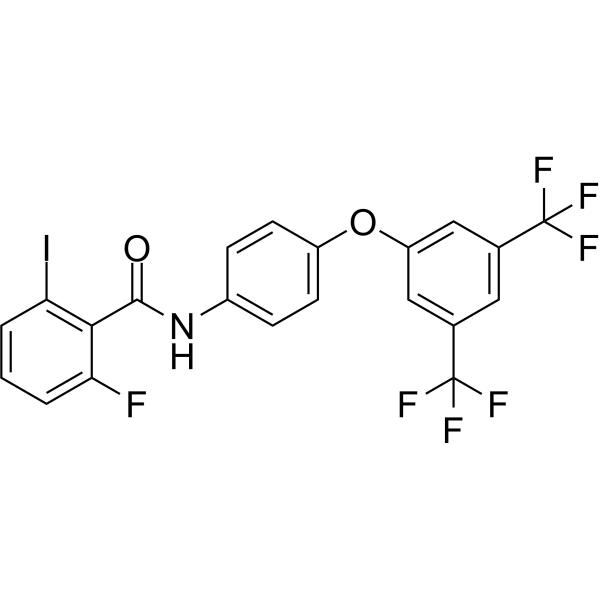
Physicochemical Properties
| Molecular Formula | C21H11F7INO2 |
| Molecular Weight | 569.211 |
| Exact Mass | 568.972 |
| CAS # | 2471982-20-2 |
| PubChem CID | 154734323 |
| Appearance | White to off-white solid powder |
| Density | 1.7±0.1 g/cm3 |
| Boiling Point | 427.3±45.0 °C at 760 mmHg |
| Flash Point | 212.2±28.7 °C |
| Vapour Pressure | 0.0±1.0 mmHg at 25°C |
| Index of Refraction | 1.577 |
| LogP | 5.16 |
| Hydrogen Bond Donor Count | 1 |
| Hydrogen Bond Acceptor Count | 9 |
| Rotatable Bond Count | 4 |
| Heavy Atom Count | 32 |
| Complexity | 615 |
| Defined Atom Stereocenter Count | 0 |
| InChi Key | QYSLCRYVUJORPX-UHFFFAOYSA-N |
| InChi Code | InChI=1S/C21H11F7INO2/c22-16-2-1-3-17(29)18(16)19(31)30-13-4-6-14(7-5-13)32-15-9-11(20(23,24)25)8-12(10-15)21(26,27)28/h1-10H,(H,30,31) |
| Chemical Name | N-[4-[3,5-bis(trifluoromethyl)phenoxy]phenyl]-2-fluoro-6-iodobenzamide |
| HS Tariff Code | 2934.99.9001 |
| Storage |
Powder-20°C 3 years 4°C 2 years In solvent -80°C 6 months -20°C 1 month |
| Shipping Condition | Room temperature (This product is stable at ambient temperature for a few days during ordinary shipping and time spent in Customs) |
Biological Activity
| ln Vitro | Human embryonic kidney (HEK) 293 cells expressing human Toll-like receptor (hTLR) genes and inducible secretory embryonic alkaline phosphatase (SEAP) reporter genes were compared with CU -115 combined for 16 hours in endosomal and non-endosomal TLR specificity experiments. Therefore, at low doses (0.5 μM), CU-115 shows action against TLR7 and TLR8. Among HEK-293 TLR1/2, TLR2/6, TLR3, and TLR4 cells, CU-115 did not affect the NF-kB inhibition produced by Pam2CSK4, Pam3CSK4, Poly(I:C), LPS, R848, or Flic. Between 10 and 25 percent is the amount that CU-115 inhibits TLR9 signaling at 1, 5, and 20 µM. CU-115 (5–20 µM) suppresses the increase in type I IFN transcriptional activity caused by the ssRNA nucleic acid ligand 3p–hpRNA or G3–YSD in a luciferase reporter test. In Hek293 TLR7 and TLR8 cells, CU-115 (0.5, 1.0, 5, and 20 µM; 16 hours) is lethal at 100 µM and benign at low concentrations (0.5 and 20 µM). Additionally, at low concentrations (0.5 and 20 μM), CU-115 was harmless; but, at 100 μM, it partially harmed THP Dual cells. TNF-α upregulation/inhibition in human THP-1 cells was assessed using the enzyme-linked immunosorbent assay (ELISA) (hTHP-1). TNF-α production in hTHP1 triggered by R848 (1 µg/ml) is eliminated by CU-115 (5–20 µM). In hTHP-1 cells, it also suppresses the expression of IL-1β. These findings suggest that TLR8 and TLR7 signaling pathways are inhibited by CU-115. |
| References |
[1]. Discovery of Novel Small Molecule Dual Inhibitors Targeting Toll-Like Receptors 7 and 8. J Med Chem. 2019 Nov 27;62(22):10221-10244. |
Solubility Data
| Solubility (In Vitro) | DMSO : ~100 mg/mL (~175.68 mM) |
| Solubility (In Vivo) |
Solubility in Formulation 1: ≥ 2.5 mg/mL (4.39 mM) (saturation unknown) in 10% DMSO + 90% Corn Oil (add these co-solvents sequentially from left to right, and one by one), clear solution. For example, if 1 mL of working solution is to be prepared, you can add 100 μL of 25.0 mg/mL clear DMSO stock solution to 900 μL of corn oil and mix evenly. (Please use freshly prepared in vivo formulations for optimal results.) |
| Preparing Stock Solutions | 1 mg | 5 mg | 10 mg | |
| 1 mM | 1.7568 mL | 8.7841 mL | 17.5682 mL | |
| 5 mM | 0.3514 mL | 1.7568 mL | 3.5136 mL | |
| 10 mM | 0.1757 mL | 0.8784 mL | 1.7568 mL |