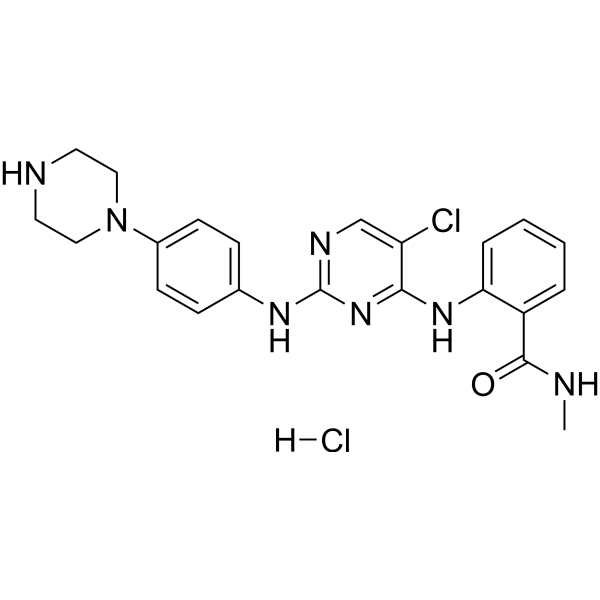
Physicochemical Properties
| Molecular Formula | C22H25CL2N7O |
| Molecular Weight | 474.39 |
| Related CAS # | CTX-0294885;1439934-41-4 |
| Appearance | Light yellow to yellow solid powder |
| HS Tariff Code | 2934.99.9001 |
| Storage |
Powder-20°C 3 years 4°C 2 years In solvent -80°C 6 months -20°C 1 month Note: Please store this product in a sealed and protected environment, avoid exposure to moisture. |
| Shipping Condition | Room temperature (This product is stable at ambient temperature for a few days during ordinary shipping and time spent in Customs) |
Biological Activity
| ln Vitro | Large-scale kinome profiling research using CTX-0294885 hydrochloride as a kinase capture method have discovered 185 kinases as total protein and 179 as phosphopeptides from TiO2 enrichment in MDA-MB-231 cells (by quantitative MS)[1]. All members of the AKT family that have not been identified by earlier research employing alternative kinase capture reagents are captured by CTX -0294885 hydrochloride[1]. |
| References |
[1]. Characterization of the novel broad-spectrum kinase inhibitor CTx-0294885 as an affinity reagent for mass spectrometry-based kinome profiling. J Proteome Res. 2013 Jul 5;12(7):3104-16. |
Solubility Data
| Solubility (In Vitro) |
H2O :~55 mg/mL (~115.94 mM) DMSO :~9.17 mg/mL (~19.33 mM) |
| Solubility (In Vivo) |
Solubility in Formulation 1: ≥ 0.92 mg/mL (1.94 mM) (saturation unknown) in 10% DMSO + 40% PEG300 + 5% Tween80 + 45% Saline (add these co-solvents sequentially from left to right, and one by one), clear solution. For example, if 1 mL of working solution is to be prepared, you can add 100 μL of 9.2 mg/mL clear DMSO stock solution to 400 μL PEG300 and mix evenly; then add 50 μL Tween-80 to the above solution and mix evenly; then add 450 μL normal saline to adjust the volume to 1 mL. Preparation of saline: Dissolve 0.9 g of sodium chloride in 100 mL ddH₂ O to obtain a clear solution. Solubility in Formulation 2: ≥ 0.92 mg/mL (1.94 mM) (saturation unknown) in 10% DMSO + 90% (20% SBE-β-CD in Saline) (add these co-solvents sequentially from left to right, and one by one), clear solution. For example, if 1 mL of working solution is to be prepared, you can add 100 μL of 9.2 mg/mL clear DMSO stock solution to 900 μL of 20% SBE-β-CD physiological saline solution and mix evenly. Preparation of 20% SBE-β-CD in Saline (4°C,1 week): Dissolve 2 g SBE-β-CD in 10 mL saline to obtain a clear solution. Solubility in Formulation 3: ≥ 0.92 mg/mL (1.94 mM) (saturation unknown) in 10% DMSO + 90% Corn Oil (add these co-solvents sequentially from left to right, and one by one), clear solution. For example, if 1 mL of working solution is to be prepared, you can add 100 μL of 9.2 mg/mL clear DMSO stock solution to 900 μL of corn oil and mix evenly. Solubility in Formulation 4: 50 mg/mL (105.40 mM) in PBS (add these co-solvents sequentially from left to right, and one by one), clear solution; with ultrasonication. (Please use freshly prepared in vivo formulations for optimal results.) |
| Preparing Stock Solutions | 1 mg | 5 mg | 10 mg | |
| 1 mM | 2.1080 mL | 10.5399 mL | 21.0797 mL | |
| 5 mM | 0.4216 mL | 2.1080 mL | 4.2159 mL | |
| 10 mM | 0.2108 mL | 1.0540 mL | 2.1080 mL |