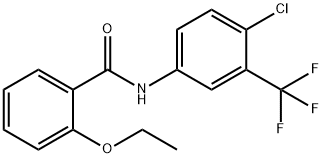
CTB (also known as Cholera Toxin B subunit) is a potent activator of p300 histone acetyltransferase and induces apoptosis in MCF-7 cells.
Physicochemical Properties
| Molecular Formula | C16H13NO2F3CL |
| Molecular Weight | 343.728 |
| Exact Mass | 343.06 |
| Elemental Analysis | C, 55.91; H, 3.81; Cl, 10.31; F, 16.58; N, 4.07; O, 9.31 |
| CAS # | 451491-47-7 |
| PubChem CID | 729859 |
| Appearance | White to off-white solid powder |
| LogP | 4.6 |
| Hydrogen Bond Donor Count | 1 |
| Hydrogen Bond Acceptor Count | 5 |
| Rotatable Bond Count | 4 |
| Heavy Atom Count | 23 |
| Complexity | 405 |
| Defined Atom Stereocenter Count | 0 |
| InChi Key | YDXZSNHARVUYNM-UHFFFAOYSA-N |
| InChi Code | InChI=1S/C16H13ClF3NO2/c1-2-23-14-6-4-3-5-11(14)15(22)21-10-7-8-13(17)12(9-10)16(18,19)20/h3-9H,2H2,1H3,(H,21,22) |
| Chemical Name | N-[4-chloro-3-(trifluoromethyl)phenyl]-2-ethoxybenzamide |
| Synonyms | CTB ACT activator; CTB; Histone Acetyltransferase Activator |
| HS Tariff Code | 2934.99.9001 |
| Storage |
Powder-20°C 3 years 4°C 2 years In solvent -80°C 6 months -20°C 1 month Note: This product requires protection from light (avoid light exposure) during transportation and storage. |
| Shipping Condition | Room temperature (This product is stable at ambient temperature for a few days during ordinary shipping and time spent in Customs) |
Biological Activity
| ln Vitro | CTB increases p300 HAT activity in a dose-dependent manner (10, 50, 100, 150, 200, and 250 μM; 10 min) [1]. MCF-7 cells' viability is inhibited by CTB (0 - 200 μM; 24 hours). There is a time-dependent induction of MCF-7 cells by CTB (85.43 μM; 24, 48, and 72 hours) [2]. With an IC50 of 85.43 μM, CTB (50 μM; 24 h) boosts p300/CBP activity[2]. |
| Cell Assay |
Cell viability assay [2] Cell Types: MCF-7 Cell Tested Concentrations: 0-200 μM Incubation Duration: 24 hrs (hours) Experimental Results: Inhibits viability with IC50 of 85.43 μM and reduces autophagic corrosion in primary neurons [3]. . Apoptosis analysis [2] Cell Types: MCF-7 Cell Tested Concentrations: 85.43 μM Incubation Duration: 24, 48 and 72 h Experimental Results: Time-dependent apoptosis was induced. |
| References |
[1]. Activation of p300 histone acetyltransferase by small molecules altering enzyme structure: probed by surface-enhanced Raman spectroscopy. J Phys Chem B. 2007;111(17):4527-4534. [2]. The effect of CTB on P53 protein acetylation and consequence apoptosis on MCF-7 and MRC-5 cell lines. Adv Biomed Res. 2013;2:24. Published 2013 Mar 6. [3]. Promoting tau secretion and propagation by hyperactive p300/CBP via autophagy-lysosomal pathway in tauopathy. Mol Neurodegener. 2020;15(1):2. Published 2020 Jan 6. |
| Additional Infomation |
N-[4-chloro-3-(trifluoromethyl)phenyl]-2-ethoxybenzamide is a member of benzamides. An ENTEROTOXIN from VIBRIO CHOLERAE. It consists of two major protomers, the heavy (H) or A subunit and the B protomer which consists of 5 light (L) or B subunits. The catalytic A subunit is proteolytically cleaved into fragments A1 and A2. The A1 fragment is a MONO(ADP-RIBOSE) TRANSFERASE. The B protomer binds cholera toxin to intestinal epithelial cells and facilitates the uptake of the A1 fragment. The A1 catalyzed transfer of ADP-RIBOSE to the alpha subunits of heterotrimeric G PROTEINS activates the production of CYCLIC AMP. Increased levels of cyclic AMP are thought to modulate release of fluid and electrolytes from intestinal crypt cells. |
Solubility Data
| Solubility (In Vitro) | DMSO : ~100 mg/mL (~290.93 mM) |
| Solubility (In Vivo) |
Solubility in Formulation 1: ≥ 2.5 mg/mL (7.27 mM) (saturation unknown) in 10% DMSO + 40% PEG300 + 5% Tween80 + 45% Saline (add these co-solvents sequentially from left to right, and one by one), clear solution. For example, if 1 mL of working solution is to be prepared, you can add 100 μL of 25.0 mg/mL clear DMSO stock solution to 400 μL PEG300 and mix evenly; then add 50 μL Tween-80 to the above solution and mix evenly; then add 450 μL normal saline to adjust the volume to 1 mL. Preparation of saline: Dissolve 0.9 g of sodium chloride in 100 mL ddH₂ O to obtain a clear solution. Solubility in Formulation 2: ≥ 2.5 mg/mL (7.27 mM) (saturation unknown) in 10% DMSO + 90% Corn Oil (add these co-solvents sequentially from left to right, and one by one), clear solution. For example, if 1 mL of working solution is to be prepared, you can add 100 μL of 25.0 mg/mL clear DMSO stock solution to 900 μL of corn oil and mix evenly. (Please use freshly prepared in vivo formulations for optimal results.) |
| Preparing Stock Solutions | 1 mg | 5 mg | 10 mg | |
| 1 mM | 2.9093 mL | 14.5463 mL | 29.0926 mL | |
| 5 mM | 0.5819 mL | 2.9093 mL | 5.8185 mL | |
| 10 mM | 0.2909 mL | 1.4546 mL | 2.9093 mL |