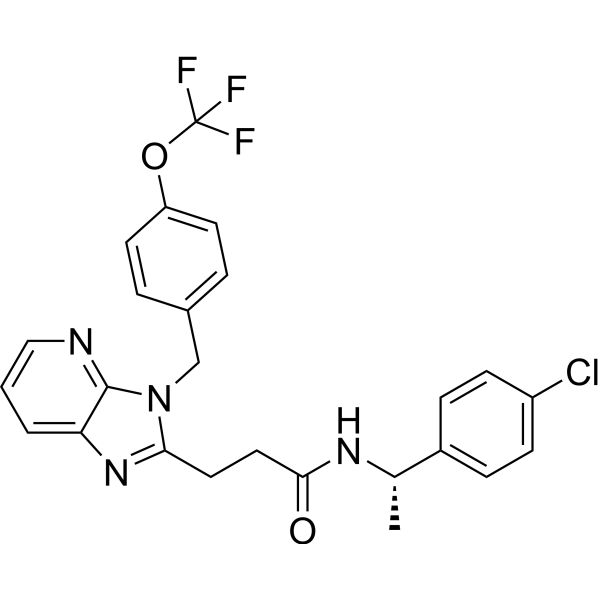
Physicochemical Properties
| Molecular Formula | C25H22CLF3N4O2 |
| Molecular Weight | 502.915995121002 |
| Exact Mass | 502.138 |
| Elemental Analysis | C, 59.71; H, 4.41; Cl, 7.05; F, 11.33; N, 11.14; O, 6.36 |
| CAS # | 1979939-16-6 |
| PubChem CID | 122199235 |
| Appearance | White to off-white solid powder |
| LogP | 5.5 |
| Hydrogen Bond Donor Count | 1 |
| Hydrogen Bond Acceptor Count | 7 |
| Rotatable Bond Count | 8 |
| Heavy Atom Count | 35 |
| Complexity | 684 |
| Defined Atom Stereocenter Count | 1 |
| SMILES | C[C@@H](C1=CC=C(C=C1)Cl)NC(=O)CCC2=NC3=C(N2CC4=CC=C(C=C4)OC(F)(F)F)N=CC=C3 |
| InChi Key | HXYXHSDYBDFOFO-INIZCTEOSA-N |
| InChi Code | InChI=1S/C25H22ClF3N4O2/c1-16(18-6-8-19(26)9-7-18)31-23(34)13-12-22-32-21-3-2-14-30-24(21)33(22)15-17-4-10-20(11-5-17)35-25(27,28)29/h2-11,14,16H,12-13,15H2,1H3,(H,31,34)/t16-/m0/s1 |
| Chemical Name | N-[(1S)-1-(4-chlorophenyl)ethyl]-3-[3-[[4-(trifluoromethoxy)phenyl]methyl]imidazo[4,5-b]pyridin-2-yl]propanamide |
| Synonyms | CRT-0273750; CRT 0273750; CRT0273750; 1979939-16-6; CHEMBL3917975; (S)-N-(1-(4-Chlorophenyl)ethyl)-3-(3-(4-(trifluoromethoxy)benzyl)-3H-imidazo[4,5-b]pyridin-2-yl)propanamide; N-[(1S)-1-(4-chlorophenyl)ethyl]-3-[3-[[4-(trifluoromethoxy)phenyl]methyl]imidazo[4,5-b]pyridin-2-yl]propanamide; N-[1(S)-(4-Chlorophenyl)-ethyl]-3-[3-(4-trifluoromethoxybenzyl)-3H-imidazo[4,5-b]pyridin-2-yl]-propionamide; LYY3P2KA27; SCHEMBL17966918; CRT0273750 |
| HS Tariff Code | 2934.99.9001 |
| Storage |
Powder-20°C 3 years 4°C 2 years In solvent -80°C 6 months -20°C 1 month |
| Shipping Condition | Room temperature (This product is stable at ambient temperature for a few days during ordinary shipping and time spent in Customs) |
Biological Activity
| Targets | ATX/autotaxin |
| ln Vitro | The IC50 of CRT0273750 evaluated in biochemical studies and choline release assay experiments were 0.01 μM and 0.014 μM, respectively [1]. CRT0273750 curve inhibits the migration of 4T1 cells with an EC50 of 0.025 μM[1]. |
| ln Vivo | The moderate blood clearance of CRT0273750 (1 mg/kg; intravenous) is 41 mL/min/kg[1]. Cmax, AUC, and t1/2 values for CRT0273750 (10 mg/kg; face) were 3.8, 3.9, and 3.8, respectively. |
| Animal Protocol |
Animal/Disease Models: Balb-c nu/nu (nude) mice [1] Doses: 10, 30 and 100 mg/kg Route of Administration: Oral (pharmacokinetic/PK/PK analysis) Experimental Results: Cmax were 3.8, 10.9 and 18.1 µM respectively. AUCs were 3.2, 15.2 and 59.3 µM.h respectively. t1/2s are 1.4, 0.9 and 1.3 hrs (hrs (hours)) respectively. |
| References |
[1]. Discovery of potent inhibitors of the lysophospholipase autotaxin. Bioorg Med Chem Lett. 2016;26(22):5403-5410. |
| Additional Infomation | Autotaxin Inhibitor IOA-289 is an orally bioavailable small molecule inhibitor of autotaxin (ATX; ectonucleotide pyrophosphatase/phosphodiesterase family member 2; ENPP2), with potential antifibrotic and antineoplastic activities. Upon oral administration, ATX inhibitor IOA-289 targets and binds to both the substrate pocket and the lysophosphatidic acid (LPA) carrier channel of ATX, thereby inhibiting the activity of ATX. This both directly inhibits the proliferation of tumor cells and reduces fibrosis in the tumor microenvironment (TME), allowing lymphocytes to infiltrate into the tumor and enhancing immune responses against tumor cells. ATX, a secreted glycoprotein with lysophospholipase D activity, hydrolyzes lysophosphatidylcholine (LPC) to LPA. LPA-mediated signaling plays an important role in cellular migration, proliferation and survival in fibrotic response. ATX and LPA are overexpressed in many tumors. |
Solubility Data
| Solubility (In Vitro) | DMSO : ~250 mg/mL (~497.10 mM) |
| Solubility (In Vivo) |
Solubility in Formulation 1: ≥ 2.08 mg/mL (4.14 mM) (saturation unknown) in 10% DMSO + 40% PEG300 + 5% Tween80 + 45% Saline (add these co-solvents sequentially from left to right, and one by one), clear solution. For example, if 1 mL of working solution is to be prepared, you can add 100 μL of 20.8 mg/mL clear DMSO stock solution to 400 μL PEG300 and mix evenly; then add 50 μL Tween-80 to the above solution and mix evenly; then add 450 μL normal saline to adjust the volume to 1 mL. Preparation of saline: Dissolve 0.9 g of sodium chloride in 100 mL ddH₂ O to obtain a clear solution. Solubility in Formulation 2: ≥ 2.08 mg/mL (4.14 mM) (saturation unknown) in 10% DMSO + 90% Corn Oil (add these co-solvents sequentially from left to right, and one by one), clear solution. For example, if 1 mL of working solution is to be prepared, you can add 100 μL of 20.8 mg/mL clear DMSO stock solution to 900 μL of corn oil and mix evenly. (Please use freshly prepared in vivo formulations for optimal results.) |
| Preparing Stock Solutions | 1 mg | 5 mg | 10 mg | |
| 1 mM | 1.9884 mL | 9.9419 mL | 19.8839 mL | |
| 5 mM | 0.3977 mL | 1.9884 mL | 3.9768 mL | |
| 10 mM | 0.1988 mL | 0.9942 mL | 1.9884 mL |