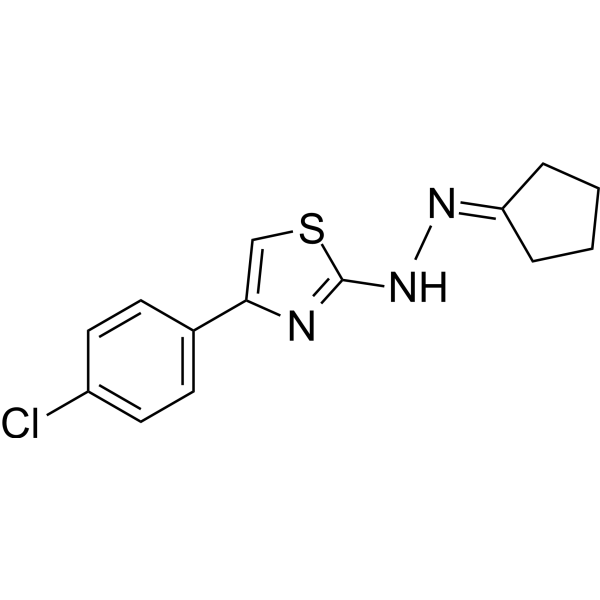
Physicochemical Properties
| Molecular Formula | C14H14CLN3S |
| Molecular Weight | 291.797 |
| Exact Mass | 291.06 |
| Elemental Analysis | C, 57.63; H, 4.84; Cl, 12.15; N, 14.40; S, 10.99 |
| CAS # | 357649-93-5 |
| Related CAS # | CPTH2 hydrochloride;2108899-91-6 |
| PubChem CID | 25193530 |
| Appearance | White to off-white solid powder |
| LogP | 4.878 |
| Hydrogen Bond Donor Count | 1 |
| Hydrogen Bond Acceptor Count | 4 |
| Rotatable Bond Count | 3 |
| Heavy Atom Count | 19 |
| Complexity | 321 |
| Defined Atom Stereocenter Count | 0 |
| SMILES | C1CCC(=NNC2=NC(=CS2)C3=CC=C(C=C3)Cl)C1 |
| InChi Key | YYTHPXHGWSAKIZ-UHFFFAOYSA-N |
| InChi Code | InChI=1S/C14H14ClN3S/c15-11-7-5-10(6-8-11)13-9-19-14(16-13)18-17-12-3-1-2-4-12/h5-9H,1-4H2,(H,16,18) |
| Chemical Name | N-[4-(4-Chloro-phenyl)-thiazol-2-yl]-N'-cyclopentylidene-hydrazine |
| Synonyms | CPTH-2; CPTH 2; CPTH2 |
| HS Tariff Code | 2934.99.9001 |
| Storage |
Powder-20°C 3 years 4°C 2 years In solvent -80°C 6 months -20°C 1 month Note: This product requires protection from light (avoid light exposure) during transportation and storage. |
| Shipping Condition | Room temperature (This product is stable at ambient temperature for a few days during ordinary shipping and time spent in Customs) |
Biological Activity
| Targets | histone acetyltransferase (HAT); Gcn5 |
| ln Vitro | CPTH2 (100 μM; 12, 24, 48 hours) causes a reduction in cell proliferation as early as 12 hours, with further significant reductions after 48 hours of stimulation [1]. CPTH2 (100 μM; 12 or 48 hours) caused a substantial decrease in the viability of both cell lines [1]. CPTH2 (100 μM; 48 hours) generates a substantial rise in the apoptotic/dead cell population after 48 hours [1]. CPTH2 (100 μM; 12, 24, 48 hours) reveals lower acetylation of global AcH3 histones and H3AcK18 [1]. CPTH2 (100 μM; 24, 48 hours) inhibits invasion and migration of ccRCC-786-O cells in vitro [1]. CPTH2 (0.2, 0.5, 1 mM) suppresses the development of GCN5 deletion strain and single catalytic mutant E173H [2]. CPTH2 (0.6, 0.8 mM; for 24 hours) suppresses histone H3 acetylation in yeast cell cultures [2]. CPTH2 suppresses Gcn5p-dependent functional networks [2]. |
| Enzyme Assay |
In vitro HAT assay [1] Histone acetyltransferase activity was measured with fluorescent in vitro HAT Assay Kit in nuclear extracts (7 μg) prepared with EpiQuik™ Nuclear Extraction Kit I treated 24 or 48 h with CPTH2 100 μM or solvent DMSO. Twenty-five micrograms of recombinant proteins p300, GCN5, and PCAF were incubated with Anacardic Acid 15 μM, CPTH2 400 μM, and 600 μM or in DMSO. HAT activity was measured in tubes in presence of Ac-CoA (0.5 mM) and histone H3 (50 μM). Resulting fluorescence was measured with GloMax® after conjugation between developer and free sulfhydryl groups on CoA-SH. |
| Cell Assay |
Cell proliferation assay [1] Cell Types: Papillary thyroid (K1) and clear cell renal cell carcinoma (ccRCC-786-O) Cell line Tested Concentrations: 100 μM Incubation Duration: 12, 24, 48 hrs (hours) Experimental Results: Result in diminished cell proliferation early After 12 hrs (hours), there was a further significant reduction 48 hrs (hours) after stimulation. Cell viability assay[1] Cell Types: K1 and ccRCC-786-O cell lines Tested Concentrations: 100 μM Incubation Duration: 24 hrs (hours) (K1 cells) and 48 hrs (hours) (ccRCC-786-O cells) Experimental Results: Results in both cell lines activity. Apoptosis analysis[1] Cell Types: ccRCC-786-O Cell Tested Concentrations: 100 μM Incubation Duration: 48 hrs (hours) Experimental Results: Dramatic increase in apoptotic/dead cell population after 48 hrs (hours). Western Blot Analysis[1] Cell Types: ccRCC-786-O Cell Tested Concentrations: 100 μM Incubation Duration: 12, 24, 48 hrs (hours) Experimental Results: Shows diminished acetylation of global AcH3 histones and H3AcK18. |
| References |
[1]. KAT3B-p300 and H3AcK18/H3AcK14 levels are prognostic markers for kidney ccRCC tumoraggressiveness and target of KAT inhibitor CPTH2. Clin Epigenetics. 2018 Apr 4;10:44. [2]. A novel histone acetyltransferase inhibitor modulating Gcn5 network: cyclopentylidene-[4-(4'-chlorophenyl)thiazol-2-yl)hydrazone. J Med Chem. 2009 Jan 22;52(2):530-6. |
| Additional Infomation | Cyclopentylidene-[4-(4-chlorophenyl)thiazol-2-yl]hydrazone is a member of the class of 1,3-thiazole bearing 2-cyclopentylidenehydrazino and 4-chlorophenyl substituents at positions 2 and 4 respectively. It has a role as an EC 2.3.1.48 (histone acetyltransferase) inhibitor. It is a member of 1,3-thiazoles, a hydrazone and a member of monochlorobenzenes. |
Solubility Data
| Solubility (In Vitro) |
DMSO : ~16.67 mg/mL (~57.13 mM) Ethanol : ~1 mg/mL (~3.43 mM) H2O : < 0.1 mg/mL |
| Solubility (In Vivo) |
Solubility in Formulation 1: ≥ 1.67 mg/mL (5.72 mM) (saturation unknown) in 10% DMSO + 40% PEG300 +5% Tween-80 + 45% Saline (add these co-solvents sequentially from left to right, and one by one), suspension solution. For example, if 1 mL of working solution is to be prepared, you can add 100 μL of 16.7 mg/mL clear DMSO stock solution to 400 μL PEG300 and mix evenly; then add 50 μL Tween-80 + to the above solution and mix evenly; then add 450 μL normal saline to adjust the volume to 1 mL. Preparation of saline: Dissolve 0.9 g of sodium chloride in 100 mL ddH₂ O to obtain a clear solution. (Please use freshly prepared in vivo formulations for optimal results.) |
| Preparing Stock Solutions | 1 mg | 5 mg | 10 mg | |
| 1 mM | 3.4270 mL | 17.1350 mL | 34.2700 mL | |
| 5 mM | 0.6854 mL | 3.4270 mL | 6.8540 mL | |
| 10 mM | 0.3427 mL | 1.7135 mL | 3.4270 mL |