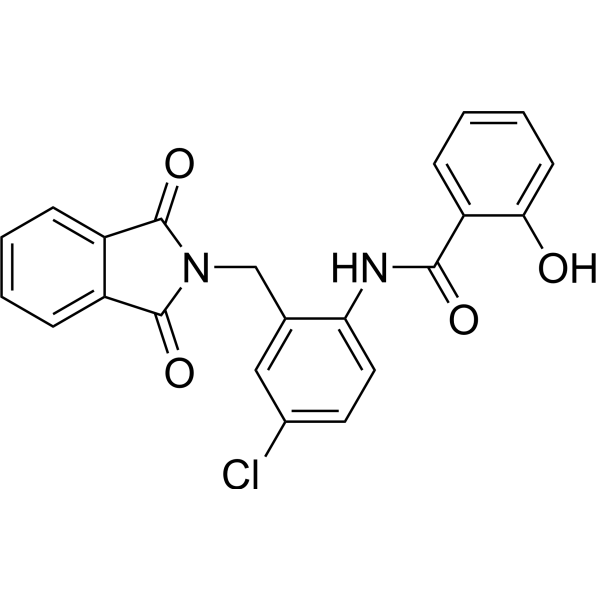
Physicochemical Properties
| Molecular Formula | C22H15N2O4CL |
| Molecular Weight | 406.8185 |
| Exact Mass | 406.072 |
| CAS # | 693288-97-0 |
| PubChem CID | 9931205 |
| Appearance | Light yellow to yellow solid powder |
| Density | 1.506g/cm3 |
| Boiling Point | 539.7ºC at 760 mmHg |
| Flash Point | 280.201ºC |
| Index of Refraction | 1.733 |
| LogP | 4.105 |
| Hydrogen Bond Donor Count | 2 |
| Hydrogen Bond Acceptor Count | 4 |
| Rotatable Bond Count | 4 |
| Heavy Atom Count | 29 |
| Complexity | 633 |
| Defined Atom Stereocenter Count | 0 |
| InChi Key | UFOUABRZSDGGAZ-UHFFFAOYSA-N |
| InChi Code | InChI=1S/C22H15ClN2O4/c23-14-9-10-18(24-20(27)17-7-3-4-8-19(17)26)13(11-14)12-25-21(28)15-5-1-2-6-16(15)22(25)29/h1-11,26H,12H2,(H,24,27) |
| Chemical Name | N-[4-chloro-2-[(1,3-dioxoisoindol-2-yl)methyl]phenyl]-2-hydroxybenzamide |
| HS Tariff Code | 2934.99.9001 |
| Storage |
Powder-20°C 3 years 4°C 2 years In solvent -80°C 6 months -20°C 1 month |
| Shipping Condition | Room temperature (This product is stable at ambient temperature for a few days during ordinary shipping and time spent in Customs) |
Biological Activity
| ln Vitro | CPPHA alone has no agonist action [1]. CPPHA promotes a concentration-dependent increase of the responsiveness of human mGluR5 CHO cells to agonists [1]. CPPHA can boost the threshold response to glutamate in fluorescent Ca2+ assays by 7 to 8 times, with EC50 values in the range of 400 to 800 nM [1]. CPPHA (20 μM; 15 min) improves the reaction to subthreshold doses of DHPG on ERK and cyclic AMP response element binding protein (CREB) activity, as well as NMDA receptor subunit NR1 phosphorylation in cortical and hippocampal slices [3] . |
| Cell Assay |
Western blot analysis [3] Cell Types: Rat hippocampal cells Tested Concentrations: 20 μM Incubation Duration: 15 minutes Experimental Results: Enhanced DHPG (20 μM)-induced increase in ERK and CREB phosphorylation, approaching levels observed with 100 μM DHPG alone . |
| References |
[1]. A novel selective allosteric modulator potentiates the activity of native metabotropic glutamate receptor subtype 5 in rat forebrain. J Pharmacol Exp Ther. 2004 May;309(2):568-77. [2]. N-{4-Chloro-2-[(1,3-dioxo-1,3-dihydro-2H-isoindol-2-yl)methyl]phenyl}-2-hydroxybenzamide (CPPHA) acts through a novel site as a positive allosteric modulator of group 1 metabotropic glutamate receptors. Mol Pharmacol. 2008 Mar;73(3):909-18. [3]. The effect of mGlu5 receptor positive allosteric modulators on signaling molecules in brain slices. Eur J Pharmacol. 2006 May 1;536(3):262-8. [4]. Allosteric potentiators of metabotropic glutamate receptor subtype 5 have differential effects on different signaling pathways in cortical astrocytes. J Pharmacol Exp Ther. 2005 Dec;315(3):1212-9. |
Solubility Data
| Solubility (In Vitro) | DMSO : ~100 mg/mL (~245.81 mM) |
| Solubility (In Vivo) |
Solubility in Formulation 1: ≥ 2.5 mg/mL (6.15 mM) (saturation unknown) in 10% DMSO + 90% Corn Oil (add these co-solvents sequentially from left to right, and one by one), clear solution. For example, if 1 mL of working solution is to be prepared, you can add 100 μL of 25.0 mg/mL clear DMSO stock solution to 900 μL of corn oil and mix evenly. (Please use freshly prepared in vivo formulations for optimal results.) |
| Preparing Stock Solutions | 1 mg | 5 mg | 10 mg | |
| 1 mM | 2.4581 mL | 12.2904 mL | 24.5809 mL | |
| 5 mM | 0.4916 mL | 2.4581 mL | 4.9162 mL | |
| 10 mM | 0.2458 mL | 1.2290 mL | 2.4581 mL |