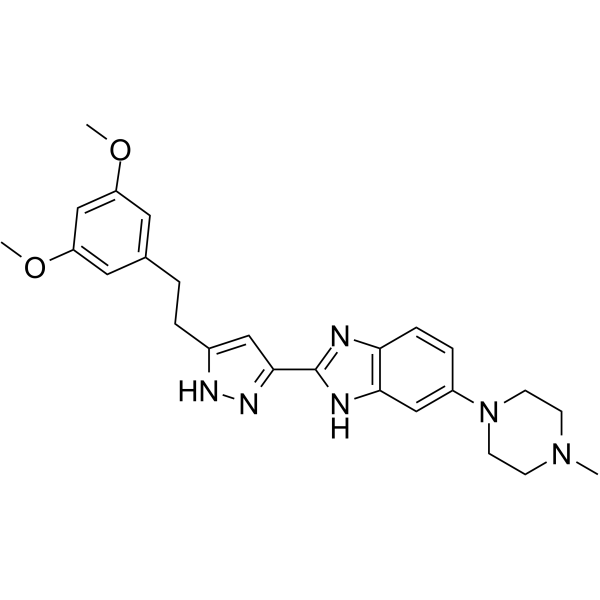
Physicochemical Properties
| Molecular Formula | C25H30N6O2 |
| Molecular Weight | 446.544704914093 |
| Exact Mass | 446.243 |
| CAS # | 1627826-19-0 |
| PubChem CID | 136387462 |
| Appearance | White to light yellow solid powder |
| LogP | 3.6 |
| Hydrogen Bond Donor Count | 2 |
| Hydrogen Bond Acceptor Count | 6 |
| Rotatable Bond Count | 7 |
| Heavy Atom Count | 33 |
| Complexity | 606 |
| Defined Atom Stereocenter Count | 0 |
| SMILES | C(C1NN=C(C2=NC3=CC=C(N4CCN(C)CC4)C=C3N2)C=1)CC1C=C(OC)C=C(OC)C=1 |
| InChi Key | QHCGPJPIPKDWAT-UHFFFAOYSA-N |
| InChi Code | InChI=1S/C25H30N6O2/c1-30-8-10-31(11-9-30)19-6-7-22-23(15-19)27-25(26-22)24-14-18(28-29-24)5-4-17-12-20(32-2)16-21(13-17)33-3/h6-7,12-16H,4-5,8-11H2,1-3H3,(H,26,27)(H,28,29) |
| Chemical Name | 2-[5-[2-(3,5-dimethoxyphenyl)ethyl]-1H-pyrazol-3-yl]-6-(4-methylpiperazin-1-yl)-1H-benzimidazole |
| HS Tariff Code | 2934.99.9001 |
| Storage |
Powder-20°C 3 years 4°C 2 years In solvent -80°C 6 months -20°C 1 month |
| Shipping Condition | Room temperature (This product is stable at ambient temperature for a few days during ordinary shipping and time spent in Customs) |
Biological Activity
| Targets | FGFR1 0.75 nM (IC50) FGFR2 0.5 nM (IC50) FGFR3 3.05 nM (IC50) |
| ln Vitro | CPL304110 (0-0.6 μM) inhibits downstream signaling (p-ERK) and FGFR2 phosphorylation in a dose-dependent manner[1]. In the SNU-16 proliferation assay, CPL304110 (compound 56q) shows an IC50 of 85.64 nM[1]. In comparison to FGFR2, CPL304110 (compound 56q) exhibits a selectivity over KDR (VEGFR2), Flt3, Aura A, and PDGFRb that is more than 45-fold, 345-fold, 395-fold, and 680-fold, respectively. No discernible inhibitory effects were seen with other tyrosine kinases[1]. |
| ln Vivo | Mice treated with CPL304110 (po, 40 mg/kg) show a t1/2 of 2 h and a Cmax of 3369 ng/mL[1]. In mice, CPL304110 (compound 56q, 2 X 20 mg/kg) dramatically suppresses tumor growth without causing toxicity or appreciable body loss. Tumor growth inhibition (TGI) at day 21 (D21, day of termination) is 64% when dosed twice daily at 20 mg/kg[1]. |
| Cell Assay |
Western Blot Analysis[1] Cell Types: SNU-16 cell lines. Tested Tested Concentrations: 0-0.6 μM. Incubation Duration: 1 h. Experimental Results: Suppressed FGFR2 phosphorylation and downstream signaling (p-ERK) |
| Animal Protocol |
Animal/Disease Models: Severe combined immunodeficient (SCID) mice implanted subcutaneously (sc) with SNU-16 (human)[1]. Doses: 20 mg/kg (X2). Route of Administration: Orally, twice (two times) daily for 21 days. Experimental Results: After 6 hrs (hours) of last dosing, concentration of 56q diminished in the plasma (9 %) but increased stepwise in the tumor cells (121%). |
| References |
[1]. Discovery and optimization of novel pyrazole-benzimidazole CPL304110, as a potent and selective inhibitor of fibroblast growth factor receptors FGFR (1-3). Eur J Med Chem. 2020 Nov 7;112990. |
Solubility Data
| Solubility (In Vitro) | DMSO: 100 mg/mL (223.94 mM) |
| Solubility (In Vivo) |
Solubility in Formulation 1: ≥ 2.5 mg/mL (5.60 mM) (saturation unknown) in 10% DMSO + 40% PEG300 + 5% Tween80 + 45% Saline (add these co-solvents sequentially from left to right, and one by one), clear solution. For example, if 1 mL of working solution is to be prepared, you can add 100 μL of 25.0 mg/mL clear DMSO stock solution to 400 μL PEG300 and mix evenly; then add 50 μL Tween-80 to the above solution and mix evenly; then add 450 μL normal saline to adjust the volume to 1 mL. Preparation of saline: Dissolve 0.9 g of sodium chloride in 100 mL ddH₂ O to obtain a clear solution. Solubility in Formulation 2: ≥ 2.5 mg/mL (5.60 mM) (saturation unknown) in 10% DMSO + 90% (20% SBE-β-CD in Saline) (add these co-solvents sequentially from left to right, and one by one), clear solution. For example, if 1 mL of working solution is to be prepared, you can add 100 μL of 25.0 mg/mL clear DMSO stock solution to 900 μL of 20% SBE-β-CD physiological saline solution and mix evenly. Preparation of 20% SBE-β-CD in Saline (4°C,1 week): Dissolve 2 g SBE-β-CD in 10 mL saline to obtain a clear solution. Solubility in Formulation 3: ≥ 2.5 mg/mL (5.60 mM) (saturation unknown) in 10% DMSO + 90% Corn Oil (add these co-solvents sequentially from left to right, and one by one), clear solution. For example, if 1 mL of working solution is to be prepared, you can add 100 μL of 25.0 mg/mL clear DMSO stock solution to 900 μL of corn oil and mix evenly. (Please use freshly prepared in vivo formulations for optimal results.) |
| Preparing Stock Solutions | 1 mg | 5 mg | 10 mg | |
| 1 mM | 2.2394 mL | 11.1972 mL | 22.3944 mL | |
| 5 mM | 0.4479 mL | 2.2394 mL | 4.4789 mL | |
| 10 mM | 0.2239 mL | 1.1197 mL | 2.2394 mL |