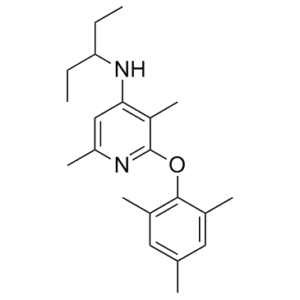
CP 376395 is a novel potent, selective and orally bioactive antagonist of Corticotropin releasing factor 1 (CRF1) receptor. It is a clinical candidate that, when taken orally, significantly improved both the feeding response in humans and dogs. In an effort to resolve the food effect problem, CP 376395, an orally active CRF 1 receptor antagonist, was discovered. It demonstrated enhanced physicochemical properties while maintaining the intended pharmacological properties. It was decided to move CP 376395 to the clinic.
Physicochemical Properties
| Molecular Formula | C20H28N2O | |
| Molecular Weight | 312.46 | |
| Exact Mass | 312.22 | |
| Elemental Analysis | C, 76.88; H, 9.03; N, 8.97; O, 5.12 | |
| CAS # | 175140-00-8 | |
| Related CAS # | CP 376395 hydrochloride; 1013933-37-3 | |
| PubChem CID | 9862166 | |
| Appearance | White to off-white solid powder | |
| LogP | 6.891 | |
| Hydrogen Bond Donor Count | 1 | |
| Hydrogen Bond Acceptor Count | 3 | |
| Rotatable Bond Count | 6 | |
| Heavy Atom Count | 24 | |
| Complexity | 359 | |
| Defined Atom Stereocenter Count | 0 | |
| SMILES | CCC(CC)NC1=C(C)C(OC2=C(C)C=C(C)C=C2C)=NC(C)=C1 |
|
| InChi Key | VIZBSVDBNLAVAW-UHFFFAOYSA-N | |
| InChi Code | InChI=1S/C21H30N2O/c1-8-18(9-2)23-19-12-16(6)22-21(17(19)7)24-20-14(4)10-13(3)11-15(20)5/h10-12,18H,8-9H2,1-7H3,(H,22,23) | |
| Chemical Name |
|
|
| Synonyms |
|
|
| HS Tariff Code | 2934.99.9001 | |
| Storage |
Powder-20°C 3 years 4°C 2 years In solvent -80°C 6 months -20°C 1 month |
|
| Shipping Condition | Room temperature (This product is stable at ambient temperature for a few days during ordinary shipping and time spent in Customs) |
Biological Activity
| Targets | CRFR2; CRFR1 |
| ln Vitro | CP 376395 fully antagonizes oCRF-stimulated adenylyl cyclase activity in the antivascular cerebral cortex and human CRF1 receptors with an apparent Ki value of 12 nM, indicating highly selective antagonist functional activity. It has an affinity greater than 1 µM for 40 neurotransmitter mass receptors and ion channels [1]. |
| ln Vivo | CP 376395 (10-20 mg/kg, i.p., in batch B6 mice) reduces H2O and food acceptance, increases sucrose acceptance, and decreases EtOH acceptance, but does not reduce EtOH preference [2]. Model: Male B6 mice (n=8-9 per group) [2] Dosage: 0.0, 10.0 or 20.0 mg/kg Administration method: intraperitoneal injection Results: H2O and food intake were dose-dependently attenuated, in which H2O intake was particularly affected during the first half of the dosing session. |
| Animal Protocol |
Male B6 mice (n=8-9 per group) 0.0, 10.0, or 20.0 mg/kg Intraperitoneally |
| References |
[1]. 2-aryloxy-4-alkylaminopyridines: discovery of novel corticotropin-releasing factor 1 antagonists. J Med Chem. 2008 Mar 13;51(5):1385-92. [2]. CRF1 receptor signaling regulates food and fluid intake in the drinking-in-the-dark model of binge alcohol consumption. Alcohol Clin Exp Res. 2013 Jul;37(7):1161-70. |
Solubility Data
| Solubility (In Vitro) |
|
|||
| Solubility (In Vivo) |
Solubility in Formulation 1: ≥ 2.5 mg/mL (7.66 mM) (saturation unknown) in 10% DMSO + 40% PEG300 + 5% Tween80 + 45% Saline (add these co-solvents sequentially from left to right, and one by one), clear solution. For example, if 1 mL of working solution is to be prepared, you can add 100 μL of 25.0 mg/mL clear DMSO stock solution to 400 μL PEG300 and mix evenly; then add 50 μL Tween-80 to the above solution and mix evenly; then add 450 μL normal saline to adjust the volume to 1 mL. Preparation of saline: Dissolve 0.9 g of sodium chloride in 100 mL ddH₂ O to obtain a clear solution. Solubility in Formulation 2: 2.5 mg/mL (7.66 mM) in 10% DMSO + 90% (20% SBE-β-CD in Saline) (add these co-solvents sequentially from left to right, and one by one), suspension solution; with ultrasonication. For example, if 1 mL of working solution is to be prepared, you can add 100 μL of 25.0 mg/mL clear DMSO stock solution to 900 μL of 20% SBE-β-CD physiological saline solution and mix evenly. Preparation of 20% SBE-β-CD in Saline (4°C,1 week): Dissolve 2 g SBE-β-CD in 10 mL saline to obtain a clear solution. Solubility in Formulation 3: ≥ 2.5 mg/mL (7.66 mM) (saturation unknown) in 10% DMSO + 90% Corn Oil (add these co-solvents sequentially from left to right, and one by one), clear solution. For example, if 1 mL of working solution is to be prepared, you can add 100 μL of 25.0 mg/mL clear DMSO stock solution to 900 μL of corn oil and mix evenly. (Please use freshly prepared in vivo formulations for optimal results.) |
| Preparing Stock Solutions | 1 mg | 5 mg | 10 mg | |
| 1 mM | 3.2004 mL | 16.0020 mL | 32.0041 mL | |
| 5 mM | 0.6401 mL | 3.2004 mL | 6.4008 mL | |
| 10 mM | 0.3200 mL | 1.6002 mL | 3.2004 mL |