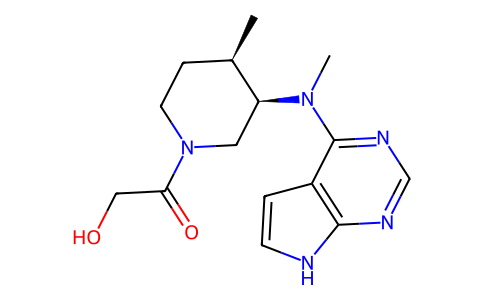
Physicochemical Properties
| Molecular Formula | C15H21N5O2 |
| Molecular Weight | 303.36 |
| Exact Mass | 303.169 |
| Elemental Analysis | C, 59.39; H, 6.98; N, 23.09; O, 10.55 |
| CAS # | 1243290-37-0 |
| PubChem CID | 49856321 |
| Appearance | Typically exists as solid at room temperature |
| Density | 1.3±0.1 g/cm3 |
| Index of Refraction | 1.661 |
| LogP | 0.65 |
| Hydrogen Bond Donor Count | 2 |
| Hydrogen Bond Acceptor Count | 5 |
| Rotatable Bond Count | 3 |
| Heavy Atom Count | 22 |
| Complexity | 407 |
| Defined Atom Stereocenter Count | 2 |
| SMILES | C(=O)(N1CC[C@@H](C)[C@@H](N(C)C2N=CN=C3NC=CC3=2)C1)CO |
| InChi Key | CCOHWQFOFWCBMH-PWSUYJOCSA-N |
| InChi Code | InChI=1S/C15H21N5O2/c1-10-4-6-20(13(22)8-21)7-12(10)19(2)15-11-3-5-16-14(11)17-9-18-15/h3,5,9-10,12,21H,4,6-8H2,1-2H3,(H,16,17,18)/t10-,12+/m1/s1 |
| Chemical Name | 2-hydroxy-1-[(3R,4R)-4-methyl-3-[methyl(7H-pyrrolo[2,3-d]pyrimidin-4-yl)amino]piperidin-1-yl]ethanone |
| Synonyms | CP 690550A; CP-690,550A; CP-690550A; Tofacitinib metabolite M2; 1243290-37-0; UNII-Q7ZOK859UK; Q7ZOK859UK; CP-690,550A; CP 690550A; CHEMBL1630791; Tofacitinib metabolite M2; CP-690550A |
| HS Tariff Code | 2934.99.9001 |
| Storage |
Powder-20°C 3 years 4°C 2 years In solvent -80°C 6 months -20°C 1 month |
| Shipping Condition | Room temperature (This product is stable at ambient temperature for a few days during ordinary shipping and time spent in Customs) |
Biological Activity
| Targets | JAK2/3 |
| ln Vitro | Janus kinases (JAKs) are critical regulators of cytokine pathways and attractive targets of therapeutic value in both inflammatory and myeloproliferative diseases. Although the crystal structures of active JAK1 and JAK2 kinase domains have been reported recently with the clinical compound CP-690550, the structures of both TYK2 and JAK3 with CP-690550 have remained outstanding. Here, we report the crystal structures of TYK2, a first in class structure, and JAK3 in complex with PAN-JAK inhibitors CP-690550 ((3R,4R)-3-[4-methyl-3-[N-methyl-N-(7H-pyrrolo[2,3-d]pyrimidin-4-yl)amino]piperidin-1-yl]-3-oxopropionitrile) and CMP-6 (tetracyclic pyridone 2-t-butyl-9-fluoro-3,6-dihydro-7H-benz[h]-imidaz[4,5-f]isoquinoline-7-one), both of which bind in the ATP-binding cavities of both JAK isozymes in orientations similar to that observed in crystal structures of JAK1 and JAK2. Additionally, a complete thermodynamic characterization of JAK/CP-690550 complex formation was completed by isothermal titration calorimetry, indicating the critical role of the nitrile group from the CP-690550 compound. Finally, computational analysis using WaterMap further highlights the critical positioning of the CP-690550 nitrile group in the displacement of an unfavorable water molecule beneath the glycine-rich loop. Taken together, the data emphasize the outstanding properties of the kinome-selective JAK inhibitor CP-690550, as well as the challenges in obtaining JAK isozyme-selective inhibitors due to the overall structural and sequence similarities between the TYK2, JAK1, JAK2 and JAK3 isozymes. Nevertheless, subtle amino acid variations of residues lining the ligand-binding cavity of the JAK enzymes, as well as the global positioning of the glycine-rich loop, might provide the initial clues to obtaining JAK-isozyme selective inhibitors[1]. |
| References |
[1]. Structural and thermodynamic characterization of the TYK2 and JAK3 kinase domains in complex with CP-690550 and CMP-6. J Mol Biol. 2010 Jul 16;400(3):413-33. |
Solubility Data
| Solubility (In Vitro) | May dissolve in DMSO (in most cases), if not, try other solvents such as H2O, Ethanol, or DMF with a minute amount of products to avoid loss of samples |
| Solubility (In Vivo) |
Note: Listed below are some common formulations that may be used to formulate products with low water solubility (e.g. < 1 mg/mL), you may test these formulations using a minute amount of products to avoid loss of samples. Injection Formulations (e.g. IP/IV/IM/SC) Injection Formulation 1: DMSO : Tween 80: Saline = 10 : 5 : 85 (i.e. 100 μL DMSO stock solution → 50 μL Tween 80 → 850 μL Saline) *Preparation of saline: Dissolve 0.9 g of sodium chloride in 100 mL ddH ₂ O to obtain a clear solution. Injection Formulation 2: DMSO : PEG300 :Tween 80 : Saline = 10 : 40 : 5 : 45 (i.e. 100 μL DMSO → 400 μLPEG300 → 50 μL Tween 80 → 450 μL Saline) Injection Formulation 3: DMSO : Corn oil = 10 : 90 (i.e. 100 μL DMSO → 900 μL Corn oil) Example: Take the Injection Formulation 3 (DMSO : Corn oil = 10 : 90) as an example, if 1 mL of 2.5 mg/mL working solution is to be prepared, you can take 100 μL 25 mg/mL DMSO stock solution and add to 900 μL corn oil, mix well to obtain a clear or suspension solution (2.5 mg/mL, ready for use in animals). Injection Formulation 4: DMSO : 20% SBE-β-CD in saline = 10 : 90 [i.e. 100 μL DMSO → 900 μL (20% SBE-β-CD in saline)] *Preparation of 20% SBE-β-CD in Saline (4°C,1 week): Dissolve 2 g SBE-β-CD in 10 mL saline to obtain a clear solution. Injection Formulation 5: 2-Hydroxypropyl-β-cyclodextrin : Saline = 50 : 50 (i.e. 500 μL 2-Hydroxypropyl-β-cyclodextrin → 500 μL Saline) Injection Formulation 6: DMSO : PEG300 : castor oil : Saline = 5 : 10 : 20 : 65 (i.e. 50 μL DMSO → 100 μLPEG300 → 200 μL castor oil → 650 μL Saline) Injection Formulation 7: Ethanol : Cremophor : Saline = 10: 10 : 80 (i.e. 100 μL Ethanol → 100 μL Cremophor → 800 μL Saline) Injection Formulation 8: Dissolve in Cremophor/Ethanol (50 : 50), then diluted by Saline Injection Formulation 9: EtOH : Corn oil = 10 : 90 (i.e. 100 μL EtOH → 900 μL Corn oil) Injection Formulation 10: EtOH : PEG300:Tween 80 : Saline = 10 : 40 : 5 : 45 (i.e. 100 μL EtOH → 400 μLPEG300 → 50 μL Tween 80 → 450 μL Saline) Oral Formulations Oral Formulation 1: Suspend in 0.5% CMC Na (carboxymethylcellulose sodium) Oral Formulation 2: Suspend in 0.5% Carboxymethyl cellulose Example: Take the Oral Formulation 1 (Suspend in 0.5% CMC Na) as an example, if 100 mL of 2.5 mg/mL working solution is to be prepared, you can first prepare 0.5% CMC Na solution by measuring 0.5 g CMC Na and dissolve it in 100 mL ddH2O to obtain a clear solution; then add 250 mg of the product to 100 mL 0.5% CMC Na solution, to make the suspension solution (2.5 mg/mL, ready for use in animals). Oral Formulation 3: Dissolved in PEG400 Oral Formulation 4: Suspend in 0.2% Carboxymethyl cellulose Oral Formulation 5: Dissolve in 0.25% Tween 80 and 0.5% Carboxymethyl cellulose Oral Formulation 6: Mixing with food powders Note: Please be aware that the above formulations are for reference only. InvivoChem strongly recommends customers to read literature methods/protocols carefully before determining which formulation you should use for in vivo studies, as different compounds have different solubility properties and have to be formulated differently. (Please use freshly prepared in vivo formulations for optimal results.) |
| Preparing Stock Solutions | 1 mg | 5 mg | 10 mg | |
| 1 mM | 3.2964 mL | 16.4821 mL | 32.9641 mL | |
| 5 mM | 0.6593 mL | 3.2964 mL | 6.5928 mL | |
| 10 mM | 0.3296 mL | 1.6482 mL | 3.2964 mL |