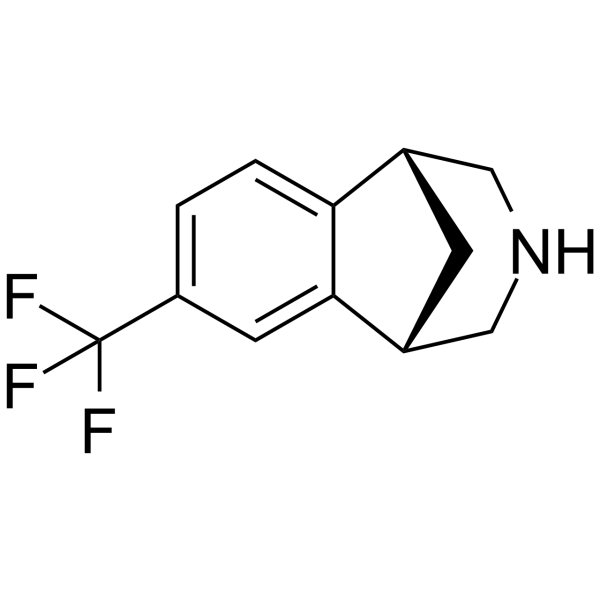
Physicochemical Properties
| Molecular Formula | C12H12F3N |
| Molecular Weight | 227.225593566895 |
| Exact Mass | 227.092 |
| CAS # | 357425-02-6 |
| Related CAS # | (Rac)-CP-601927 hydrochloride;230615-01-7;CP-601932;357425-68-4 |
| PubChem CID | 11498153 |
| Appearance | Light yellow to brown liquid |
| LogP | 2.4 |
| Hydrogen Bond Donor Count | 1 |
| Hydrogen Bond Acceptor Count | 4 |
| Rotatable Bond Count | 0 |
| Heavy Atom Count | 16 |
| Complexity | 276 |
| Defined Atom Stereocenter Count | 2 |
| SMILES | C1[C@H]2CNC[C@@H]1C3=C2C=CC(=C3)C(F)(F)F |
| InChi Key | RNOBTWYQAWEZHH-JGVFFNPUSA-N |
| InChi Code | InChI=1S/C12H12F3N/c13-12(14,15)9-1-2-10-7-3-8(6-16-5-7)11(10)4-9/h1-2,4,7-8,16H,3,5-6H2/t7-,8+/m0/s1 |
| Chemical Name | (1S,8R)-4-(trifluoromethyl)-10-azatricyclo[6.3.1.02,7]dodeca-2(7),3,5-triene |
| HS Tariff Code | 2934.99.9001 |
| Storage |
Powder-20°C 3 years 4°C 2 years In solvent -80°C 6 months -20°C 1 month |
| Shipping Condition | Room temperature (This product is stable at ambient temperature for a few days during ordinary shipping and time spent in Customs) |
Biological Activity
| ln Vivo | CP-601927 (0.125 mg/kg-1.5 mg/kg; i.p.; C57BL/6J male mice) shows antidepressant-like effects in animal models [2]. |
| References |
[1]. Toxicity study in juvenile rats with the α4β2 nicotinic acetylcholine receptor partial agonist CP-601,927. Birth Defects Res B Dev Reprod Toxicol. 2011;92(4):323-332. [2]. α4β2 nicotinic acetylcholine receptor partial agonists with low intrinsic efficacy have antidepressant-like properties. Behav Pharmacol. 2011;22(4):291-299. |
| Additional Infomation | CP-601,927 has been used in trials studying the basic science and treatment of Major Depressive Disorder. |
Solubility Data
| Solubility (In Vitro) | DMSO : ~200 mg/mL (~880.17 mM) |
| Solubility (In Vivo) |
Solubility in Formulation 1: ≥ 5 mg/mL (22.00 mM) (saturation unknown) in 10% DMSO + 40% PEG300 + 5% Tween80 + 45% Saline (add these co-solvents sequentially from left to right, and one by one), clear solution. For example, if 1 mL of working solution is to be prepared, you can add 100 μL of 50.0 mg/mL clear DMSO stock solution to 400 μL PEG300 and mix evenly; then add 50 μL Tween-80 to the above solution and mix evenly; then add 450 μL normal saline to adjust the volume to 1 mL. Preparation of saline: Dissolve 0.9 g of sodium chloride in 100 mL ddH₂ O to obtain a clear solution. Solubility in Formulation 2: ≥ 5 mg/mL (22.00 mM) (saturation unknown) in 10% DMSO + 90% Corn Oil (add these co-solvents sequentially from left to right, and one by one), clear solution. For example, if 1 mL of working solution is to be prepared, you can add 100 μL of 50.0 mg/mL clear DMSO stock solution to 900 μL of corn oil and mix evenly. (Please use freshly prepared in vivo formulations for optimal results.) |
| Preparing Stock Solutions | 1 mg | 5 mg | 10 mg | |
| 1 mM | 4.4008 mL | 22.0041 mL | 44.0083 mL | |
| 5 mM | 0.8802 mL | 4.4008 mL | 8.8017 mL | |
| 10 mM | 0.4401 mL | 2.2004 mL | 4.4008 mL |