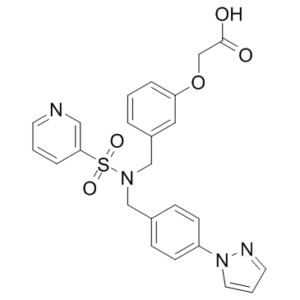
Taprenepag (formerly known as CP-544326) is a potent and selective agonist of EP2 (prostaglandin EP receptor 2) with IC50 of 10 nM and EC50 of 2.8 nM. The compound, when dosed as the isopropyl ester prodrug PF-04217329, significantly increased both its ocular bioavailability and corneal permeability. In a clinical study involving patients with primary open angle glaucoma, PF-04217329 (Taprenepag isopropyl), a prodrug of CP-544326 (active acid metabolite), a potent and selective EP(2) receptor agonist, was successfully evaluated for its ocular hypotensive activity. In preclinical species, topical ocular dosing of PF-04217329 resulted in an elevation of cAMP in aqueous humor/iris-ciliary body, indicating in vivo activation of EP(2) target receptors. The treatment was well tolerated. CP-544326 was exposed to the eyes at doses higher than the EC(50) for the EP(2) receptor when PF-04217329 was applied topically. After administering PF-04217329 once daily, normotensive Dutch-belted rabbits, normotensive dogs, and laser-induced ocular hypertensive cynomolgus monkeys showed reductions in IOP of between 30 and 50% in single-day studies, and between 20 and 40% in multiple-day studies when compared to eyes that were dosed with a vehicle. One topical dose resulted in an IOP reduction that lasted for six to twenty-four hours straight. Finally, preclinical data collected thus far seem to favor PF-04217329's clinical development as a novel glaucoma treatment drug.
Physicochemical Properties
| Molecular Formula | C24H22N4O5S |
| Molecular Weight | 478.52028 |
| Exact Mass | 478.131 |
| Elemental Analysis | C, 60.24; H, 4.63; N, 11.71; O, 16.72; S, 6.70 |
| CAS # | 752187-80-7 |
| Related CAS # | Taprenepag isopropyl; 1005549-94-9 |
| PubChem CID | 18376177 |
| Appearance | White to off-white solid powder |
| LogP | 4.202 |
| Hydrogen Bond Donor Count | 1 |
| Hydrogen Bond Acceptor Count | 8 |
| Rotatable Bond Count | 10 |
| Heavy Atom Count | 34 |
| Complexity | 753 |
| Defined Atom Stereocenter Count | 0 |
| SMILES | O=S(C1=CN=CC=C1)(N(CC2=CC(OCC(O)=O)=CC=C2)CC3=CC=C(N4C=CC=N4)C=C3)=O |
| InChi Key | MFFBXYNKZHTCEY-UHFFFAOYSA-N |
| InChi Code | InChI=1S/C24H22N4O5S/c29-24(30)18-33-22-5-1-4-20(14-22)17-27(34(31,32)23-6-2-11-25-15-23)16-19-7-9-21(10-8-19)28-13-3-12-26-28/h1-15H,16-18H2,(H,29,30) |
| Chemical Name | 2-[3-[[(4-pyrazol-1-ylphenyl)methyl-pyridin-3-ylsulfonylamino]methyl]phenoxy]acetic acid |
| Synonyms | Taprenepag; CP-544326; CP544326; CP544326; PF-0421732 metabolite |
| HS Tariff Code | 2934.99.9001 |
| Storage |
Powder-20°C 3 years 4°C 2 years In solvent -80°C 6 months -20°C 1 month |
| Shipping Condition | Room temperature (This product is stable at ambient temperature for a few days during ordinary shipping and time spent in Customs) |
Biological Activity
| Targets | human EP2 ( IC50 = 10 nM ); rat EP2 ( IC50 = 15 nM ) | ||
| ln Vitro |
|
||
| ln Vivo |
|
||
| Enzyme Assay | CP-544326 is a novel, selective and potent EP2 agonist. CP-544326 is at least 270 times more selective for the human EP2 subtype than the other human EP subtypes, 1, 3, and 4, with an IC50 for human EP2 equal to 10 nM (average of two independent experiments; 9 and 11 nM). cAMP levels increased in a dose- and time-dependent manner, yielding an average EC50 of 1.9 nM (1.5 and 2.4 nM; from two independent experiments), according to the cell-based efficacy data using rat EP2-HEP293 cells. The EC50 of 2.8 nM (2.5 and 3.1 nM; from two independent experiments) for CP-544326-mediated cAMP production in human EP2-HEK293 cells was comparable to that of PGE2 (EC50 = 2.6 nM). | ||
| Animal Protocol |
|
||
| References |
[1]. Effect of PF-04217329 a prodrug of a selective prostaglandin EP(2) agonist on intraocular pressure inpreclinical models of glaucoma. Exp Eye Res. 2011 Sep;93(3):256-64. |
||
| Additional Infomation |
Taprenepag has been used in trials studying the treatment of Ocular Hypertension and Glaucoma, Open-Angle. See also: Taprenepag Isopropyl (annotation moved to). |
Solubility Data
| Solubility (In Vitro) |
|
|||
| Solubility (In Vivo) |
Solubility in Formulation 1: ≥ 2.5 mg/mL (5.22 mM) (saturation unknown) in 10% DMSO + 40% PEG300 + 5% Tween80 + 45% Saline (add these co-solvents sequentially from left to right, and one by one), clear solution. For example, if 1 mL of working solution is to be prepared, you can add 100 μL of 25.0 mg/mL clear DMSO stock solution to 400 μL PEG300 and mix evenly; then add 50 μL Tween-80 to the above solution and mix evenly; then add 450 μL normal saline to adjust the volume to 1 mL. Preparation of saline: Dissolve 0.9 g of sodium chloride in 100 mL ddH₂ O to obtain a clear solution. Solubility in Formulation 2: ≥ 2.5 mg/mL (5.22 mM) (saturation unknown) in 10% DMSO + 90% Corn Oil (add these co-solvents sequentially from left to right, and one by one), clear solution. For example, if 1 mL of working solution is to be prepared, you can add 100 μL of 25.0 mg/mL clear DMSO stock solution to 900 μL of corn oil and mix evenly. (Please use freshly prepared in vivo formulations for optimal results.) |
| Preparing Stock Solutions | 1 mg | 5 mg | 10 mg | |
| 1 mM | 2.0898 mL | 10.4489 mL | 20.8978 mL | |
| 5 mM | 0.4180 mL | 2.0898 mL | 4.1796 mL | |
| 10 mM | 0.2090 mL | 1.0449 mL | 2.0898 mL |