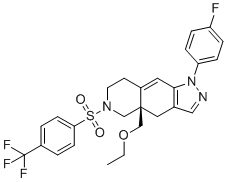
Physicochemical Properties
| Exact Mass | 535.155 |
| CAS # | 1018679-79-2 |
| PubChem CID | 44454750 |
| Appearance | White to off-white solid powder |
| LogP | 6.105 |
| Hydrogen Bond Donor Count | 0 |
| Hydrogen Bond Acceptor Count | 9 |
| Rotatable Bond Count | 6 |
| Heavy Atom Count | 37 |
| Complexity | 940 |
| Defined Atom Stereocenter Count | 1 |
| SMILES | O=S(N1C[C@@]2(COCC)CC3=C(N(C4=CC=C(F)C=C4)N=C3)C=C2CC1)(C5=CC=C(C(F)(F)F)C=C5)=O |
| InChi Key | SLKURXRZHJOZOD-RUZDIDTESA-N |
| InChi Code | InChI=1S/C26H25F4N3O3S/c1-2-36-17-25-14-18-15-31-33(22-7-5-21(27)6-8-22)24(18)13-20(25)11-12-32(16-25)37(34,35)23-9-3-19(4-10-23)26(28,29)30/h3-10,13,15H,2,11-12,14,16-17H2,1H3/t25-/m1/s1 |
| Chemical Name | (4aR)-4a-(ethoxymethyl)-1-(4-fluorophenyl)-6-[4-(trifluoromethyl)phenyl]sulfonyl-4,5,7,8-tetrahydropyrazolo[3,4-g]isoquinoline |
| Synonyms | CORT-108297 CORT108297 CORT 108297 |
| HS Tariff Code | 2934.99.9001 |
| Storage |
Powder-20°C 3 years 4°C 2 years In solvent -80°C 6 months -20°C 1 month |
| Shipping Condition | Room temperature (This product is stable at ambient temperature for a few days during ordinary shipping and time spent in Customs) |
Biological Activity
| ln Vitro | When compared to treatment with R1881/Enzalutamide (RE) alone, combination therapy with dexamethasone increased steady-state SGK1 expression in LAPC4 cells by a factor of 1.7. The dexamethasone-induced SGK1 expression was 50% suppressed by the addition of CORT118335 (1μM), whereas the dexamethasone-mediated rise in SGK1 was totally prevented by Cort108297 (p<0.05). When compared to RE therapy, dexamethasone enhanced KLK3 expression 2.5 times. Both CORT118335 and Cort108297 inhibited KLK3 expression produced by dexamethasone (48% and 60% inhibition, respectively, p<0.05). In CWR-22Rv1 cells, dexamethasone ± SGRM for three days resulted in a significant 100-fold increase in SGK1 gene expression as compared to RE-treated cells. Cort108297 and CORT118335 fully eliminated this induction (p<0.01). In CWR-22Rv1 cells, dexamethasone also increased KLK3 (7.5-fold) in comparison to RE; this induction was reduced by 70% and 75%, respectively, by Cort108297 and CORT118335 (p<0.01) [2]. |
| ln Vivo | Male C57BL/6J mice aged ten weeks were given a meal consisting of 60% fat calories and water enhanced with 11% sucrose for a duration of four weeks. Cort108297 (80 mg/kg QD), Cort108297 (40 mg/kg BID), mifepristone (30 mg/kg BID), rosiglitazone (10 mg/kg QD), or carrier were administered to the group (n = 8). Compared to mice given a high-fat, high-sugar diet alone, mice given a high-fat, high-sugar diet plus mifepristone or Cort108297 lost a substantial amount of weight. Mice receiving either Cort108297 40 mg/kg BID or Cort108297 80 mg/kg QD had significantly lower levels of stable plasma glucose at the conclusion of the 4-week treatment period compared to those receiving vehicle [3]. Male rats were subjected to a forced swim test (FST) or restraint stress after receiving treatment with mifepristone (10 mg/kg), Cort108297 (30 mg/kg and 60 mg/kg), imipramine (10 mg/kg), or vehicle for five days. Cort108297 successfully suppressed the peak corticosterone response to restraint stress and FST at both dosages. In the forced swim test (FST), immobility was only considerably decreased by the higher dosage of Cort108297 (60 mg/kg) [4]. |
| References |
[1]. LLY-2707, a novel nonsteroidal glucocorticoid antagonist that reduces atypical antipsychotic-associated weight gain in rats. J Pharmacol Exp Ther. 2014 Jan;348(1):192-201. [2]. Selective Glucocorticoid Receptor Modulators (SGRMs) Delay Castrate-Resistant Prostate Cancer Growth. Mol Cancer Ther. 2017 Aug;16(8):1680-1692. [3]. Selective Glucocorticoid Receptor (GR-II) Antagonist Reduces Body Weight Gain in Mice. J Nutr Metab. 2011;2011:235389. [4]. The selective glucocorticoid receptor antagonist CORT 108297 decreases neuroendocrine stress responses and immobility in the forced swim test. Horm Behav. 2014 Apr;65(4):363-71. |
Solubility Data
| Solubility (In Vitro) | May dissolve in DMSO (in most cases), if not, try other solvents such as H2O, Ethanol, or DMF with a minute amount of products to avoid loss of samples |
| Solubility (In Vivo) |
Note: Listed below are some common formulations that may be used to formulate products with low water solubility (e.g. < 1 mg/mL), you may test these formulations using a minute amount of products to avoid loss of samples. Injection Formulations (e.g. IP/IV/IM/SC) Injection Formulation 1: DMSO : Tween 80: Saline = 10 : 5 : 85 (i.e. 100 μL DMSO stock solution → 50 μL Tween 80 → 850 μL Saline) *Preparation of saline: Dissolve 0.9 g of sodium chloride in 100 mL ddH ₂ O to obtain a clear solution. Injection Formulation 2: DMSO : PEG300 :Tween 80 : Saline = 10 : 40 : 5 : 45 (i.e. 100 μL DMSO → 400 μLPEG300 → 50 μL Tween 80 → 450 μL Saline) Injection Formulation 3: DMSO : Corn oil = 10 : 90 (i.e. 100 μL DMSO → 900 μL Corn oil) Example: Take the Injection Formulation 3 (DMSO : Corn oil = 10 : 90) as an example, if 1 mL of 2.5 mg/mL working solution is to be prepared, you can take 100 μL 25 mg/mL DMSO stock solution and add to 900 μL corn oil, mix well to obtain a clear or suspension solution (2.5 mg/mL, ready for use in animals). Injection Formulation 4: DMSO : 20% SBE-β-CD in saline = 10 : 90 [i.e. 100 μL DMSO → 900 μL (20% SBE-β-CD in saline)] *Preparation of 20% SBE-β-CD in Saline (4°C,1 week): Dissolve 2 g SBE-β-CD in 10 mL saline to obtain a clear solution. Injection Formulation 5: 2-Hydroxypropyl-β-cyclodextrin : Saline = 50 : 50 (i.e. 500 μL 2-Hydroxypropyl-β-cyclodextrin → 500 μL Saline) Injection Formulation 6: DMSO : PEG300 : castor oil : Saline = 5 : 10 : 20 : 65 (i.e. 50 μL DMSO → 100 μLPEG300 → 200 μL castor oil → 650 μL Saline) Injection Formulation 7: Ethanol : Cremophor : Saline = 10: 10 : 80 (i.e. 100 μL Ethanol → 100 μL Cremophor → 800 μL Saline) Injection Formulation 8: Dissolve in Cremophor/Ethanol (50 : 50), then diluted by Saline Injection Formulation 9: EtOH : Corn oil = 10 : 90 (i.e. 100 μL EtOH → 900 μL Corn oil) Injection Formulation 10: EtOH : PEG300:Tween 80 : Saline = 10 : 40 : 5 : 45 (i.e. 100 μL EtOH → 400 μLPEG300 → 50 μL Tween 80 → 450 μL Saline) Oral Formulations Oral Formulation 1: Suspend in 0.5% CMC Na (carboxymethylcellulose sodium) Oral Formulation 2: Suspend in 0.5% Carboxymethyl cellulose Example: Take the Oral Formulation 1 (Suspend in 0.5% CMC Na) as an example, if 100 mL of 2.5 mg/mL working solution is to be prepared, you can first prepare 0.5% CMC Na solution by measuring 0.5 g CMC Na and dissolve it in 100 mL ddH2O to obtain a clear solution; then add 250 mg of the product to 100 mL 0.5% CMC Na solution, to make the suspension solution (2.5 mg/mL, ready for use in animals). Oral Formulation 3: Dissolved in PEG400 Oral Formulation 4: Suspend in 0.2% Carboxymethyl cellulose Oral Formulation 5: Dissolve in 0.25% Tween 80 and 0.5% Carboxymethyl cellulose Oral Formulation 6: Mixing with food powders Note: Please be aware that the above formulations are for reference only. InvivoChem strongly recommends customers to read literature methods/protocols carefully before determining which formulation you should use for in vivo studies, as different compounds have different solubility properties and have to be formulated differently. (Please use freshly prepared in vivo formulations for optimal results.) |