Physicochemical Properties
| Exact Mass | 330.902 |
| CAS # | 1001015-18-4 |
| Related CAS # | 1001040-67-0 (cation);1001015-18-4; |
| PubChem CID | 168430661 |
| Appearance | Light yellow to yellow solid powder |
| LogP | 0.016 |
| Hydrogen Bond Donor Count | 1 |
| Hydrogen Bond Acceptor Count | 8 |
| Rotatable Bond Count | 2 |
| Heavy Atom Count | 18 |
| Complexity | 151 |
| Defined Atom Stereocenter Count | 0 |
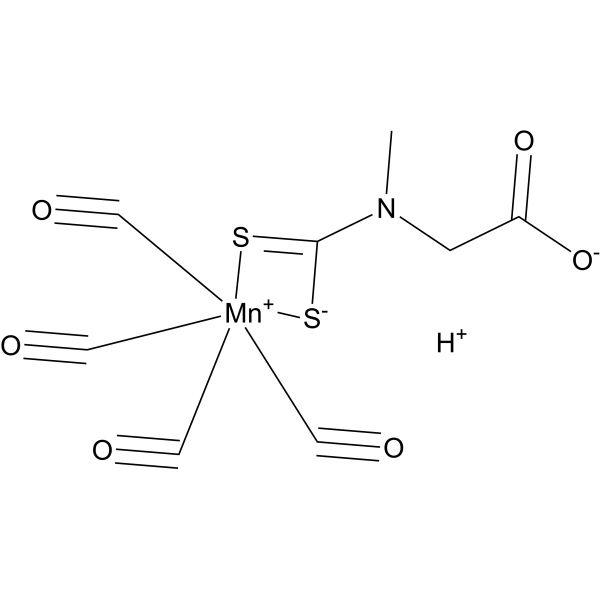
| SMILES | [H+].[O+]#C[Mn+]1([SH-]C(N(CC([O-])=O)C)=S1)(C#[O+])(C#[O+])C#[O+] |
| InChi Key | BYBYPEYFKXEVIY-UHFFFAOYSA-M |
| InChi Code | InChI=1S/C4H7NO2S2.4CO.Mn/c1-5(4(8)9)2-3(6)7;4*1-2;/h2H2,1H3,(H,6,7)(H,8,9);;;;;/p-1 |
| Chemical Name | carbon monoxide;N-(carboxymethyl)-N-methylcarbamodithioate;manganese |
| HS Tariff Code | 2934.99.9001 |
| Storage |
Powder-20°C 3 years 4°C 2 years In solvent -80°C 6 months -20°C 1 month |
| Shipping Condition | Room temperature (This product is stable at ambient temperature for a few days during ordinary shipping and time spent in Customs) |
Biological Activity
| ln Vitro | Endothelial EA.hy926 cells are stimulated to produce NO by CORM-401 (100 μM; 1 h)[1]. Endoplasmic reticulum and plasma membrane pool-operated calcium channels are better coupled when CORM-401 (30 μM) is added, inducing peak calcium signaling [1]. CORM-401 (50 μM; 1h) dramatically lowers ROS generation and cell death caused by TNF-α/CHX and H2O2 [2]. The oxygen consumption rate of endothelial EA.hy926 cells is sustainedly increased by CORM-401 (0.5, 1 mM) [3]. While decreasing ECAR, CORM-401 (10, 30, and 100 μM) causes an increase in OCR that is concentration-dependent [3]. |
| References |
[1]. CORM-401 induces calcium signalling, NO increase and activation of pentose phosphate pathway in endothelial cells. FEBS J. 2018 Apr;285(7):1346-1358. [2]. Differential Effects of CORM-2 and CORM-401 in Murine Intestinal Epithelial MODE-K Cells under Oxidative Stress. Front Pharmacol. 2017 Feb 8;8:31. [3]. Carbon monoxide released by CORM-401 uncouples mitochondrial respiration and inhibits glycolysis in endothelial cells: A role for mitoBKCa channels. Biochim Biophys Acta. 2015 Oct;1847(10):1297-309. |
Solubility Data
| Solubility (In Vitro) | DMSO : ~25 mg/mL (~75.48 mM) |
| Solubility (In Vivo) |
Solubility in Formulation 1: 2.5 mg/mL (7.55 mM) in 10% DMSO + 40% PEG300 + 5% Tween80 + 45% Saline (add these co-solvents sequentially from left to right, and one by one), suspension solution; with sonication. For example, if 1 mL of working solution is to be prepared, you can add 100 μL of 25.0 mg/mL clear DMSO stock solution to 400 μL PEG300 and mix evenly; then add 50 μL Tween-80 to the above solution and mix evenly; then add 450 μL normal saline to adjust the volume to 1 mL. Preparation of saline: Dissolve 0.9 g of sodium chloride in 100 mL ddH₂ O to obtain a clear solution. Solubility in Formulation 2: 2.5 mg/mL (7.55 mM) in 10% DMSO + 90% (20% SBE-β-CD in Saline) (add these co-solvents sequentially from left to right, and one by one), suspension solution; with ultrasonication. For example, if 1 mL of working solution is to be prepared, you can add 100 μL of 25.0 mg/mL clear DMSO stock solution to 900 μL of 20% SBE-β-CD physiological saline solution and mix evenly. Preparation of 20% SBE-β-CD in Saline (4°C,1 week): Dissolve 2 g SBE-β-CD in 10 mL saline to obtain a clear solution. (Please use freshly prepared in vivo formulations for optimal results.) |