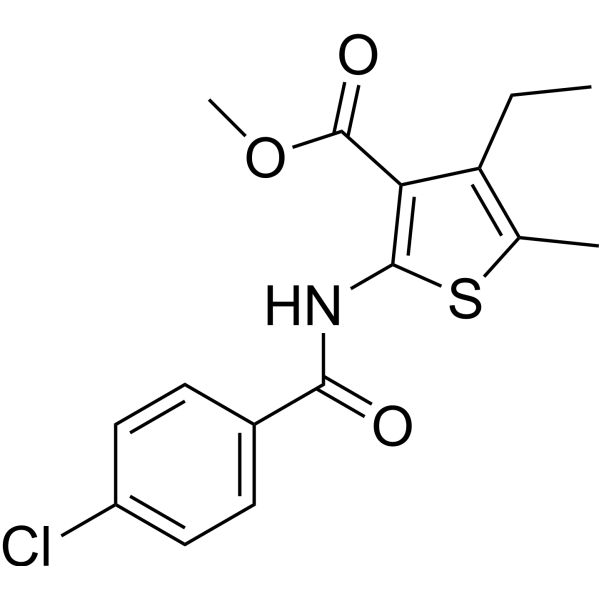
Physicochemical Properties
| Molecular Formula | C16H16CLNO3S |
| Molecular Weight | 337.821142196655 |
| Exact Mass | 337.053 |
| CAS # | 544450-68-2 |
| PubChem CID | 897320 |
| Appearance | Off-white to light yellow solid powder |
| LogP | 5 |
| Hydrogen Bond Donor Count | 1 |
| Hydrogen Bond Acceptor Count | 4 |
| Rotatable Bond Count | 5 |
| Heavy Atom Count | 22 |
| Complexity | 412 |
| Defined Atom Stereocenter Count | 0 |
| SMILES | ClC1C=CC(=CC=1)C(NC1=C(C(=O)OC)C(=C(C)S1)CC)=O |
| InChi Key | AAFLALGGEYRGTR-UHFFFAOYSA-N |
| InChi Code | InChI=1S/C16H16ClNO3S/c1-4-12-9(2)22-15(13(12)16(20)21-3)18-14(19)10-5-7-11(17)8-6-10/h5-8H,4H2,1-3H3,(H,18,19) |
| Chemical Name | methyl 2-[(4-chlorobenzoyl)amino]-4-ethyl-5-methylthiophene-3-carboxylate |
| HS Tariff Code | 2934.99.9001 |
| Storage |
Powder-20°C 3 years 4°C 2 years In solvent -80°C 6 months -20°C 1 month Note: Please store this product in a sealed and protected environment (e.g. under nitrogen), avoid exposure to moisture and light. |
| Shipping Condition | Room temperature (This product is stable at ambient temperature for a few days during ordinary shipping and time spent in Customs) |
Biological Activity
| ln Vitro | It appears that COR659 works through a combination of mechanisms, including as activation at the cannabinoid CB1 receptor and positive allosteric regulation of the GABAB receptor[3]. |
| ln Vivo | In food-deprived Wistar rats, the COR659 (0, 2.5, 5 and 10 mg/kg) therapy has no effect at all on lever-responding (FR10) for ordinary food pellets[1]. Lever-responding for a chocolate solution in Wistar rats and a sucrose solution in sP rats can be suppressed by COR659[2]. |
| Animal Protocol |
Animal/Disease Models: Male sP and Wistar rats[1]. Doses: 0, 2.5, 5 and 10 mg/kg. Route of Administration: intraperitoneally (ip) (administered 30 min before the start of the self-administration, reinstatement, and locomotor activity sessions.). Experimental Results: The magnitude of the reducing effect of the compound on number of lever-responses for alcohol averaged approximately 30, 55, and 70%, in comparison to the vehicle-treated rat group, in the rat groups treated with 2.5, 5, and 10 mg/kg COR659, respectively. The magnitude of the reducing effect of COR659 on number of lever-responses for alcohol averaged approximately 20, 40, and 80%, in comparison to the vehicle treated rat group, in the rat groups treated with 2.5, 5, and 10 mg/kg COR659, respectively. |
| References |
[1]. Suppressing effect of COR659 on alcohol, sucrose, and chocolate self-administration in rats: involvement of the GABA B and cannabinoid CB 1 receptors. Psychopharmacology (Berl). 2017 Sep;234(17):2525-2543. [2]. The GABA B receptor positive allosteric modulator COR659: In vitro metabolism, in vivo pharmacokinetics in rats, synthesis and pharmacological characterization of metabolically protected derivatives. Eur J Pharm Sci. 2020 Dec 1;155:105544. [3]. Anti-addictive properties of COR659 - Additional pharmacological evidence and comparison with a series of novel analogues. Alcohol. 2019 Mar;75:55-66. |
Solubility Data
| Solubility (In Vitro) | DMSO: 25 mg/mL (74.00 mM) |
| Solubility (In Vivo) |
Solubility in Formulation 1: ≥ 2.5 mg/mL (7.40 mM) (saturation unknown) in 10% DMSO + 40% PEG300 + 5% Tween80 + 45% Saline (add these co-solvents sequentially from left to right, and one by one), clear solution. For example, if 1 mL of working solution is to be prepared, you can add 100 μL of 25.0 mg/mL clear DMSO stock solution to 400 μL PEG300 and mix evenly; then add 50 μL Tween-80 to the above solution and mix evenly; then add 450 μL normal saline to adjust the volume to 1 mL. Preparation of saline: Dissolve 0.9 g of sodium chloride in 100 mL ddH₂ O to obtain a clear solution. Solubility in Formulation 2: 2.5 mg/mL (7.40 mM) in 10% DMSO + 90% (20% SBE-β-CD in Saline) (add these co-solvents sequentially from left to right, and one by one), suspension solution; with ultrasonication. For example, if 1 mL of working solution is to be prepared, you can add 100 μL of 25.0 mg/mL clear DMSO stock solution to 900 μL of 20% SBE-β-CD physiological saline solution and mix evenly. Preparation of 20% SBE-β-CD in Saline (4°C,1 week): Dissolve 2 g SBE-β-CD in 10 mL saline to obtain a clear solution. Solubility in Formulation 3: ≥ 2.5 mg/mL (7.40 mM) (saturation unknown) in 10% DMSO + 90% Corn Oil (add these co-solvents sequentially from left to right, and one by one), clear solution. For example, if 1 mL of working solution is to be prepared, you can add 100 μL of 25.0 mg/mL clear DMSO stock solution to 900 μL of corn oil and mix evenly. (Please use freshly prepared in vivo formulations for optimal results.) |
| Preparing Stock Solutions | 1 mg | 5 mg | 10 mg | |
| 1 mM | 2.9602 mL | 14.8008 mL | 29.6016 mL | |
| 5 mM | 0.5920 mL | 2.9602 mL | 5.9203 mL | |
| 10 mM | 0.2960 mL | 1.4801 mL | 2.9602 mL |