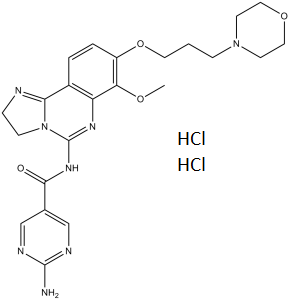
Copanlisib HCl (formerly BAY-806946; BAY 80-6946; Aliqopa), the hydrochloride salt of Copanlisib, is a pan-class I PI3K (phosphoinositide 3-kinase) inhibitor approved in 2017 for the treatment of relapsed follicular lymphoma. In cell-free assays, it inhibits PI3Kα/β/γ/δ with IC50 values of 0.5, 3.7, 6.4, and 0.7 nM, respectively. The FDA approved copanlisib in 2017 for the treatment of adults with relapsed follicular lymphoma. Phosphoinositide 3-kinase (PI3K) inhibitor BAY 80-6946 has potential anticancer properties and inhibits proliferation in HuCCT-1 (KRASG12D) and EGI-1 (KRASG12D) cell lines with IC50 values of 147 nM and 137 nM, respectively. The maximum tolerated dose (MTD) of BAY 80-6946 is generally well tolerated at 0.8 mg/kg. The results of pharmacokinetics (PK) support weekly dosing. In the first 24 hours following a MTD dose, hyperglycemia of grade 2 or 3 may occur. Clinical SD, pharmacokinetics, and FDG-PET data all support effective exposure and PI3K pathway inhibition.
Physicochemical Properties
| Molecular Formula | C23H30CL2N8O4 | |
| Molecular Weight | 553.45 | |
| Exact Mass | 552.176 | |
| Elemental Analysis | C, 49.92; H, 5.46; Cl, 12.81; N, 20.25; O, 11.56 | |
| CAS # | 1402152-13-9 | |
| Related CAS # | Copanlisib;1032568-63-0 | |
| PubChem CID | 135565785 | |
| Appearance | Off-white to light yellow solid powder | |
| Hydrogen Bond Donor Count | 4 | |
| Hydrogen Bond Acceptor Count | 9 | |
| Rotatable Bond Count | 7 | |
| Heavy Atom Count | 37 | |
| Complexity | 974 | |
| Defined Atom Stereocenter Count | 0 | |
| SMILES | Cl.Cl.O1CCN(CC1)CCCOC1C=CC2C(C=1OC)=N/C(=N\C(C1=CN=C(N)N=C1)=O)/N1CCNC1=2 |
|
| InChi Key | STGQPVQAAFJJFX-UHFFFAOYSA-N | |
| InChi Code | InChI=1S/C23H28N8O4.2ClH/c1-33-19-17(35-10-2-6-30-8-11-34-12-9-30)4-3-16-18(19)28-23(31-7-5-25-20(16)31)29-21(32)15-13-26-22(24)27-14-15;;/h3-4,13-14H,2,5-12H2,1H3,(H2,24,26,27)(H,28,29,32);2*1H | |
| Chemical Name |
|
|
| Synonyms | BAY 80-6946; BAY80-6946; BAY-80-6946; BAY806946; BAY-806946; BAY 806946; Copanlisib HCl; Copanlisib dihydrochloride; Copanlisib; trade name Aliqopa | |
| HS Tariff Code | 2934.99.9001 | |
| Storage |
Powder-20°C 3 years 4°C 2 years In solvent -80°C 6 months -20°C 1 month Note: Please store this product in a sealed and protected environment, avoid exposure to moisture. |
|
| Shipping Condition | Room temperature (This product is stable at ambient temperature for a few days during ordinary shipping and time spent in Customs) |
Biological Activity
| Targets | PI3Kα (IC50 = 0.5 nM); PI3Kδ (IC50 = 0.7 nM); PI3Kβ (IC50 = 3.7 nM); PI3Kγ (IC50 = 6.4 nM); mTOP (IC50 = 45 nM) |
| ln Vitro | In both KPL4 cells and LPA-stimulated PC3 cells, BAY 80-6946 reduces pAKT levels. BAY 80-6946 exhibits antiproliferative activity and induces apoptosis in a subset of human cancer cell lines that have PIK3CA mutations and/or overexpression of HER2. Combining HER2-targeted therapies with BAY 80-6946 inhibits growth more effectively than either therapy when used separately and can improve cells' sensitivity to trastuzumab and lapatinib. |
| ln Vivo | Copanlisib (BAY 80-6946; 0.5-6 mg/kg; intravenous injection; every second day, every third day; for 60 days; athymic nude rats) treatment exhibits significant antitumor activity in the rat KPL4 tumor xenograft model[1]. |
| Enzyme Assay | The effect of BAY 80-6946 on PI3Kα, PI3Kβ, and PI3Kγ activity is measured by the inhibition of 33P incorporation into phosphatidylinositol (PI) in 384-well MaxiSorp® plates coated with 2 µg/well of PI and phosphatidylserine (PS) (1:1 molar ratio). In each PI3K isoform assay, 9 µL of reaction buffer (50 mM MOPSO, pH 7.0, 100 mM NaCl, 4 mM MgCl2, 0.1% BSA) is used, containing either 25 ng of purified human p110γ protein or 7.5 ng of His-tagged N-terminally truncated p110α or p110β protein. Adding 5 µL liters of a 40-µM ATP solution with 20 µCi/mL [33>/sup>P]-ATP initiates the reaction. By adding 5 µL of a 25-mM EDTA solution, the reaction is stopped after 2 hours of incubation at room temperature. After washing the plates, Ultima GoldTM scintillation cocktail (25 µL) is added. With the help of a BetaPlate Liquid Scintillation Counter, the radioactivity incorporated into the immobilized PI substrate is identified. |
| Cell Assay | The CellTiter-Glo® luminescent cell viability kit is used to calculate the rate of cell proliferation over a 72-hour period. In separate microtiter plates, cells are briefly plated. After an overnight incubation at 37 °C, the luminescence values in the t=0 hour plates are calculated. The cells are incubated in the t=72 hour plates for 72 hours at 37 °C after the addition of test substances that have been diluted in growth medium. After a 10-minute reaction with CellTiter-Glo® solution, Luminescence values are calculated using a Wallac 1420 Victor2TM 1420 multilabel HTS counter. Subtracting the luminescence values from the corresponding values in the t=72 hour plates, one can calculate the percentage inhibition of cell growth. Calculating the percentage of cell growth inhibition is done by comparing values between drug-treated cells and controls. |
| Animal Protocol |
Athymic nude rats injected with KPL4 tumor cells[1] 0.5 mg/kg, 1 mg/kg, 3 mg/kg or 6 mg/kg Intravenous injection; every second day, every third day; for 60 days |
| References |
[1]. BAY 80-6946 is a highly selective intravenous PI3K inhibitor with potent p110α and p110δ activities in tumor cell lines and xenograft models. Mol Cancer Ther. 2013 Nov;12(11):2319-30. |
| Additional Infomation |
Copanlisib dihydrochloride is the dihydrochloride salt of copanlisib. It has a role as an antineoplastic agent, an apoptosis inducer and an EC 2.7.1.137 (phosphatidylinositol 3-kinase) inhibitor. It contains a copanlisib. See also: Copanlisib Dihydrochloride (annotation moved to). |
Solubility Data
| Solubility (In Vitro) |
|
|||
| Solubility (In Vivo) |
Solubility in Formulation 1: 100 mg/mL (180.69 mM) in PBS (add these co-solvents sequentially from left to right, and one by one), clear solution; with sonication. Solubility in Formulation 2: 10% Trifluoroacetic acid water solution: 1mg/mL (Please use freshly prepared in vivo formulations for optimal results.) |
| Preparing Stock Solutions | 1 mg | 5 mg | 10 mg | |
| 1 mM | 1.8068 mL | 9.0342 mL | 18.0685 mL | |
| 5 mM | 0.3614 mL | 1.8068 mL | 3.6137 mL | |
| 10 mM | 0.1807 mL | 0.9034 mL | 1.8068 mL |