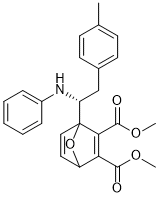
COH000 is an allosteric, covalent and irreversible (covalent) inhibitor of ubiquitin-like 1-activating enzyme (SUMO-activating enzyme) (E1), with an IC50 of 0.2 μM for SUMOylation in vitro.
Physicochemical Properties
| Molecular Formula | C25H25NO5 |
| Molecular Weight | 419.469707250595 |
| Exact Mass | 419.17 |
| Elemental Analysis | C, 71.58; H, 6.01; N, 3.34; O, 19.07 |
| CAS # | 1534358-79-6 |
| PubChem CID | 60156415 |
| Appearance | Light yellow to yellow solid powder |
| LogP | 4 |
| Hydrogen Bond Donor Count | 1 |
| Hydrogen Bond Acceptor Count | 6 |
| Rotatable Bond Count | 9 |
| Heavy Atom Count | 31 |
| Complexity | 745 |
| Defined Atom Stereocenter Count | 3 |
| SMILES | CC1=CC=C(C=C1)C[C@H]([C@]23C=C[C@H](O2)C(=C3C(=O)OC)C(=O)OC)NC4=CC=CC=C4 |
| InChi Key | UFPINDDCTUCUSA-ABGUIGEDSA-N |
| InChi Code | InChI=1S/C25H25NO5/c1-16-9-11-17(12-10-16)15-20(26-18-7-5-4-6-8-18)25-14-13-19(31-25)21(23(27)29-2)22(25)24(28)30-3/h4-14,19-20,26H,15H2,1-3H3/t19?,20-,25?/m1/s1 |
| Chemical Name | dimethyl 1-((R)-1-(phenylamino)-2-(p-tolyl)ethyl)-7-oxabicyclo [2.2.1]hepta-2,5-diene-2,3-dicarboxylate |
| Synonyms | COH000; COH-000; COH 000; |
| HS Tariff Code | 2934.99.9001 |
| Storage |
Powder-20°C 3 years 4°C 2 years In solvent -80°C 6 months -20°C 1 month |
| Shipping Condition | Room temperature (This product is stable at ambient temperature for a few days during ordinary shipping and time spent in Customs) |
Biological Activity
| Targets |
SUMO-activating enzyme(IC50= 0.2 μM) More than 500 times more selective for SUMOylation than ubiquitylation is COH000. Without immediately competing with ATP or SUMO1 binding, COH000 inhibits SUMO adenylation. Because of its incredibly slow off-rate, COH000 is likely covalently bound to the enzyme[1]. |
| ln Vitro |
More than 500 times more selective for SUMOylation than ubiquitylation is COH000. Without immediately competing with ATP or SUMO1 binding, COH000 inhibits SUMO adenylation. Because of its incredibly slow off-rate, COH000 is likely covalently bound to the enzyme[1]. COH000 inhibits SUMOylation in a biochemical assay with an average IC50 of approximately 0.2 µM. It shows over 500-fold selectivity for SUMOylation over ubiquitination, as it did not inhibit ubiquitylation at concentrations up to 100 µM. [1] COH000 specifically inhibits the formation of the SUMO-E1 thioester conjugate and the ATP-dependent adenylation step of SUMO E1 catalysis. This inhibition is non-competitive with respect to ATP and SUMO1. [1] Inhibition of SUMO E1 by COH000 is irreversible and time-dependent, consistent with a covalent mechanism. Kinetic analysis yielded a KI of 0.64 µM and a kinact of 0.14 min⁻¹. [1] Mass spectrometry analysis confirmed that COH000 forms a covalent adduct specifically with Cys30 of SAE2 (UBA2). The catalytic Cys173 was not modified. [1] Mutation of Cys30 to Ser (C30S) in SAE2 abolished the inhibitory effect of COH000, confirming Cys30 as the critical site of action. [1] COH000 binding induces a conformational change in SUMO E1, as evidenced by a change in its thermal denaturation profile (increased melting temperature). [1] In cells, COH000 treatment leads to increased degradation of SAE2, likely via enhanced ubiquitin-proteasome-mediated degradation, as shown by pulse-chase assays and increased ubiquitylation of SAE2 upon proteasome inhibition. [1] |
| ln Vivo |
In an HCT-116 colorectal cancer xenograft model established in plasma esterase-deficient SCID mice (Es1e/SCID), subcutaneous peritumoral administration of COH000 (10 mg/kg, once daily for 14 days) significantly inhibited tumor growth compared to vehicle control. [1] Tumor tissues from COH000-treated mice showed reduced levels of SAE2 protein and c-Myc protein, increased apoptosis (as detected by TUNEL staining), and elevated levels of miR-34b. [1] In primary colorectal cancer cells derived from patient-derived xenograft (PDX) tissues, COH000 treatment reduced c-Myc protein levels (in samples with high baseline c-Myc) and decreased cancer cell viability while inducing apoptosis. [1] |
| Enzyme Assay |
SUMOylation Assay (AlphaScreen): A biochemical assay was conducted to detect the formation of SUMO1 conjugated to RanGAP1. The assay mixture contained SAE (E1), Ubc9 (E2), GST-SUMO, and His6-RanGAP1 in a buffer (50 mM Tris-HCl pH 7.4, 0.3 mM DTT, 10 mM MgCl2, 0.005% Tween-20) along with ATP. After incubation, nickel chelate acceptor beads and glutathione donor beads were added for detection using AlphaScreen technology. Compound inhibition was measured by the decrease in luminescent signal. [1] ATP:PPi Exchange Assay: This assay specifically measures the adenylation step of SUMO E1 catalysis. SUMO E1 was pre-incubated with the compound. The reaction was initiated by adding a mixture containing ATP and [³²P]-labeled pyrophosphate (PPi). The conversion of labeled PPi into ATP, reflecting the adenylation activity, was measured by absorbing the newly formed [³²P]-ATP onto activated charcoal resin, followed by washing and scintillation counting. [1] LC-MS/MS Analysis for Covalent Modification: SUMO E1 protein, with or without prior inhibition by COH000, was subjected to on-line pepsin digestion. The resulting peptides were analyzed by liquid chromatography-tandem mass spectrometry (LC-MS/MS). Data were searched against the SUMO E1 sequence, allowing for a potential modification mass corresponding to the addition of COH000 (+419.1733 Da) on cysteine residues, to identify the specific covalent modification site. [1] Time-Dependent Inhibition Kinetics: SUMO E1 was pre-incubated with varying concentrations of COH000 for different times. Residual enzyme activity was then measured using a homogeneous time-resolved fluorescence (HTRF) assay for Ubc9•SUMO-1 thioester formation. The observed inactivation rates (kobs) at different inhibitor concentrations were plotted and fitted to a hyperbolic equation to derive the inhibition constant (KI) and the maximal inactivation rate (kinact). [1] |
| Cell Assay |
Cellular SUMOylation Inhibition: Cells (e.g., HCT-116) were treated with COH000 in culture media for 18 hours. Cells were then lysed, and global SUMOylation levels were assessed by Western blot using anti-SUMO-1 and anti-SUMO-2/3 antibodies. [1] Selective E1 Inhibition in Cells: To assess selectivity, formation of E2 thioester intermediates was monitored. Cells treated with COH000 were lysed, and lysates were analyzed by Western blot for levels of SUMO•Ubc9, ubiquitin•Ubc5, and NEDD8•Ubc12 thioester conjugates. [1] Cellular Thermal Shift Assay (CETSA): HCT-116 cells were treated with COH000 or vehicle for 2 hours. Cells were then heated at various temperatures (42–56°C) in a thermal cycler. After heating, cells were lysed, and the amount of thermostable SAE2 protein remaining in the soluble fraction was quantified by Western blot. Increased thermostability indicates target engagement. [1] Apoptosis Assay (Annexin V Staining): HCT-116 cells (parental, SAE2-overexpressing, or SAE2-knockdown) were treated with COH000 or vehicle for 20 hours. Cells were then harvested, stained with Annexin V-APC, and analyzed by flow cytometry to determine the percentage of apoptotic cells. [1] Cell Proliferation Assay (MTS): Cells were treated with COH000 or its inactive analogs at indicated concentrations. After 72 hours, cell proliferation/viability was measured using an MTS-based assay according to standard protocols. Absorbance was read to determine the inhibitory effect. [1] miRNA and mRNA Expression Analysis: Lymphoma (Raji) and colorectal cancer (HCT116) cells were treated with COH000. Total RNA and microRNA were extracted. miR-34b levels were measured by RT-qPCR using specific TaqMan assays. c-Myc mRNA levels were also measured by RT-qPCR. c-Myc protein levels were analyzed by Western blot. [1] |
| Animal Protocol |
Colorectal Cancer Xenograft Model in Mice: HCT-116 cells were subcutaneously injected into plasma esterase-deficient SCID mice (Es1e/SCID). Once tumors became palpable, mice were randomly assigned to treatment groups. COH000 was dissolved in a vehicle (5% DMSO, 30% solutol in PBS). Mice received subcutaneous peritumoral injections of COH000 (10 mg/kg body weight) or an equal volume of vehicle, once daily for 14 days. Tumor volume was measured regularly. At the endpoint, mice were euthanized, and tumors were excised for further analysis (IHC, Western blot, TUNEL, RNA extraction). [1] |
| ADME/Pharmacokinetics |
The manuscript notes that COH000 contains two ester bonds, making it susceptible to hydrolysis by plasma esterases in vivo. To circumvent this for efficacy studies, a plasma esterase-deficient mouse strain (Es1e/SCID) was used for the xenograft experiments. [1] |
| References |
[1]. Allosteric Inhibition of Ubiquitin-like Modifications by a Class of Inhibitor of SUMO-Activating Enzyme. Cell Chem Biol. 2018 Dec 5. pii: S2451-9456(18)30386-6. |
| Additional Infomation |
COH000 represents the first-in-class allosteric, covalent inhibitor of the SUMO-activating enzyme (E1). [1] Its mechanism involves binding to a buried allosteric site (Cys30 on UBA2), inducing a conformational change that inhibits the adenylation step of SUMO activation and also promotes degradation of the E1 enzyme itself. [1] The discovery of this allosteric inhibitory mechanism provides a novel approach to target ubiquitin-like modifications, complementary to existing ATP-competitive inhibitors. [1] COH000 demonstrates anti-cancer activity in preclinical models by inhibiting SUMOylation, leading to upregulation of tumor-suppressive miR-34b, downregulation of oncogenic c-Myc, and induction of apoptosis. This suggests potential for treating c-Myc and KRas-driven cancers. [1] |
Solubility Data
| Solubility (In Vitro) |
DMSO : 35.71~50 mg/mL ( 85.13~119.19 mM ) Ethanol : ~1 mg/mL |
| Solubility (In Vivo) |
Note: Listed below are some common formulations that may be used to formulate products with low water solubility (e.g. < 1 mg/mL), you may test these formulations using a minute amount of products to avoid loss of samples. Injection Formulations (e.g. IP/IV/IM/SC) Injection Formulation 1: DMSO : Tween 80: Saline = 10 : 5 : 85 (i.e. 100 μL DMSO stock solution → 50 μL Tween 80 → 850 μL Saline) *Preparation of saline: Dissolve 0.9 g of sodium chloride in 100 mL ddH ₂ O to obtain a clear solution. Injection Formulation 2: DMSO : PEG300 :Tween 80 : Saline = 10 : 40 : 5 : 45 (i.e. 100 μL DMSO → 400 μLPEG300 → 50 μL Tween 80 → 450 μL Saline) Injection Formulation 3: DMSO : Corn oil = 10 : 90 (i.e. 100 μL DMSO → 900 μL Corn oil) Example: Take the Injection Formulation 3 (DMSO : Corn oil = 10 : 90) as an example, if 1 mL of 2.5 mg/mL working solution is to be prepared, you can take 100 μL 25 mg/mL DMSO stock solution and add to 900 μL corn oil, mix well to obtain a clear or suspension solution (2.5 mg/mL, ready for use in animals). Injection Formulation 4: DMSO : 20% SBE-β-CD in saline = 10 : 90 [i.e. 100 μL DMSO → 900 μL (20% SBE-β-CD in saline)] *Preparation of 20% SBE-β-CD in Saline (4°C,1 week): Dissolve 2 g SBE-β-CD in 10 mL saline to obtain a clear solution. Injection Formulation 5: 2-Hydroxypropyl-β-cyclodextrin : Saline = 50 : 50 (i.e. 500 μL 2-Hydroxypropyl-β-cyclodextrin → 500 μL Saline) Injection Formulation 6: DMSO : PEG300 : castor oil : Saline = 5 : 10 : 20 : 65 (i.e. 50 μL DMSO → 100 μLPEG300 → 200 μL castor oil → 650 μL Saline) Injection Formulation 7: Ethanol : Cremophor : Saline = 10: 10 : 80 (i.e. 100 μL Ethanol → 100 μL Cremophor → 800 μL Saline) Injection Formulation 8: Dissolve in Cremophor/Ethanol (50 : 50), then diluted by Saline Injection Formulation 9: EtOH : Corn oil = 10 : 90 (i.e. 100 μL EtOH → 900 μL Corn oil) Injection Formulation 10: EtOH : PEG300:Tween 80 : Saline = 10 : 40 : 5 : 45 (i.e. 100 μL EtOH → 400 μLPEG300 → 50 μL Tween 80 → 450 μL Saline) Oral Formulations Oral Formulation 1: Suspend in 0.5% CMC Na (carboxymethylcellulose sodium) Oral Formulation 2: Suspend in 0.5% Carboxymethyl cellulose Example: Take the Oral Formulation 1 (Suspend in 0.5% CMC Na) as an example, if 100 mL of 2.5 mg/mL working solution is to be prepared, you can first prepare 0.5% CMC Na solution by measuring 0.5 g CMC Na and dissolve it in 100 mL ddH2O to obtain a clear solution; then add 250 mg of the product to 100 mL 0.5% CMC Na solution, to make the suspension solution (2.5 mg/mL, ready for use in animals). Oral Formulation 3: Dissolved in PEG400 Oral Formulation 4: Suspend in 0.2% Carboxymethyl cellulose Oral Formulation 5: Dissolve in 0.25% Tween 80 and 0.5% Carboxymethyl cellulose Oral Formulation 6: Mixing with food powders Note: Please be aware that the above formulations are for reference only. InvivoChem strongly recommends customers to read literature methods/protocols carefully before determining which formulation you should use for in vivo studies, as different compounds have different solubility properties and have to be formulated differently. (Please use freshly prepared in vivo formulations for optimal results.) |
| Preparing Stock Solutions | 1 mg | 5 mg | 10 mg | |
| 1 mM | 2.3840 mL | 11.9198 mL | 23.8396 mL | |
| 5 mM | 0.4768 mL | 2.3840 mL | 4.7679 mL | |
| 10 mM | 0.2384 mL | 1.1920 mL | 2.3840 mL |