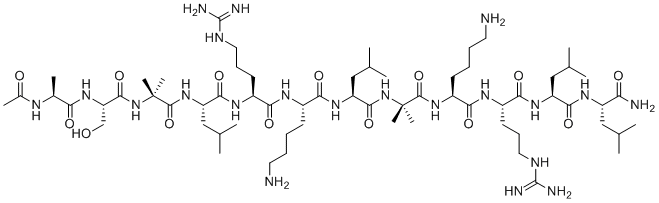
Physicochemical Properties
| Molecular Formula | C64H121N21O14 |
| Molecular Weight | 1408.8 |
| Exact Mass | 1407.94 |
| CAS # | 878009-24-6 |
| Related CAS # | Biotin-COG1410 TFA |
| PubChem CID | 72941932 |
| Appearance | White to off-white solid powder |
| Density | 1.3±0.1 g/cm3 |
| Index of Refraction | 1.603 |
| LogP | -1.87 |
| Hydrogen Bond Donor Count | 20 |
| Hydrogen Bond Acceptor Count | 18 |
| Rotatable Bond Count | 49 |
| Heavy Atom Count | 99 |
| Complexity | 2720 |
| Defined Atom Stereocenter Count | 10 |
| SMILES | [C@@H](CCCNC(N)=N)(NC(=O)[C@H](CC(C)C)NC(=O)C(C)(C)NC(=O)[C@H](CO)NC(=O)[C@H](C)NC(=O)C)C(=O)N[C@@H](CCCCN)C(=O)N[C@@H](CC(C)C)C(=O)NC(C)(C)C(=O)N[C@@H](CCCCN)C(=O)N[C@@H](CCCNC(N)=N)C(=O)N[C@@H](CC(C)C)C(=O)N[C@H](C(=O)N)CC(C)C |
| InChi Key | RPCLHYWMLWFFTE-VKTQGLPSSA-N |
| InChi Code | InChI=1S/C64H121N21O14/c1-34(2)29-44(49(67)88)78-55(94)45(30-35(3)4)79-53(92)42(24-20-28-73-62(70)71)76-54(93)43(22-16-18-26-66)82-59(98)63(11,12)84-57(96)47(32-37(7)8)80-52(91)40(21-15-17-25-65)75-51(90)41(23-19-27-72-61(68)69)77-56(95)46(31-36(5)6)83-60(99)64(13,14)85-58(97)48(33-86)81-50(89)38(9)74-39(10)87/h34-38,40-48,86H,15-33,65-66H2,1-14H3,(H2,67,88)(H,74,87)(H,75,90)(H,76,93)(H,77,95)(H,78,94)(H,79,92)(H,80,91)(H,81,89)(H,82,98)(H,83,99)(H,84,96)(H,85,97)(H4,68,69,72)(H4,70,71,73)/t38-,40-,41-,42-,43-,44-,45-,46-,47-,48-/m0/s1 |
| Chemical Name | (S)-6-amino-N-((S)-1-(((S)-1-(((S)-1-amino-4-methyl-1-oxopentan-2-yl)amino)-4-methyl-1-oxopentan-2-yl)amino)-5-guanidino-1-oxopentan-2-yl)-2-((5S,8S,11S,14S,20S,23S)-8-(4-aminobutyl)-11-(3-guanidinopropyl)-20-(hydroxymethyl)-5,14-diisobutyl-2,2,17,17,23-pentamethyl-4,7,10,13,16,19,22,25-octaoxo-3,6,9,12,15,18,21,24-octaazahexacosanamido)hexanamide |
| Synonyms | COG-1410 COG 1410 COG1410 |
| HS Tariff Code | 2934.99.9001 |
| Storage |
Powder-20°C 3 years 4°C 2 years In solvent -80°C 6 months -20°C 1 month Note: Please store this product in a sealed and protected environment (e.g. under nitrogen), avoid exposure to moisture and light. |
| Shipping Condition | Room temperature (This product is stable at ambient temperature for a few days during ordinary shipping and time spent in Customs) |
Biological Activity
| ln Vitro | Cog1410 (1-25 μm; 48 h) inhibits BV2 astrocytes' synthesis and release of NO and TNFα [1]. |
| ln Vivo | In mice, COG1410 (0.3-0.6 mg/kg; single intravenous injection) dramatically enhanced both long-term tests of spatial learning and memory and short-term tests of vestibular motor function [1]. Improved vestibular motor function, less post-stroke motor discomfort, and a reduction in the amount of the ipsilateral hemisphere infarct are all brought about by COG1410 (0.8 mg/kg; single intravenous injection) [2]. |
| Animal Protocol |
Animal/Disease Models: Male C57Bl/6J mice (12-16 weeks) TBI[1] Doses: 0.3, 0.6 mg/kg Route of Administration: Single intravenous (iv) (iv)injection through tail vein Experimental Results: Motor function improved 1-5 days after injury . Dramatically improve cognitive impairment. Reduce the number of damaged hippocampal neurons. Inhibits microglial activation. |
| References |
[1]. Laskowitz DT, et, al. COG1410, a novel apolipoprotein E-based peptide, improves functional recovery in a murine model of traumatic brain injury. J Neurotrauma. 2007 Jul;24(7):1093-107. [2]. Tukhovskaya EA, et, al. COG1410, a novel apolipoprotein-E mimetic, improves functional and morphological recovery in a rat model of focal brain ischemia. J Neurosci Res. 2009 Feb 15;87(3):677-82. [3]. Kuai L, et, al. Apolipoprotein E-Mimetic Peptide COG1410 Enhances Retinal Ganglion Cell Survival by Attenuating Inflammation and Apoptosis Following TONI. Front Neurosci. 2019 Sep 13;13:980. |
Solubility Data
| Solubility (In Vitro) |
DMSO : ~50 mg/mL (~35.49 mM) H2O : ~25 mg/mL (~17.75 mM) |
| Solubility (In Vivo) |
Solubility in Formulation 1: ≥ 2.5 mg/mL (1.77 mM) (saturation unknown) in 10% DMSO + 40% PEG300 + 5% Tween80 + 45% Saline (add these co-solvents sequentially from left to right, and one by one), clear solution. For example, if 1 mL of working solution is to be prepared, you can add 100 μL of 25.0 mg/mL clear DMSO stock solution to 400 μL PEG300 and mix evenly; then add 50 μL Tween-80 to the above solution and mix evenly; then add 450 μL normal saline to adjust the volume to 1 mL. Preparation of saline: Dissolve 0.9 g of sodium chloride in 100 mL ddH₂ O to obtain a clear solution. Solubility in Formulation 2: ≥ 2.5 mg/mL (1.77 mM) (saturation unknown) in 10% DMSO + 90% (20% SBE-β-CD in Saline) (add these co-solvents sequentially from left to right, and one by one), clear solution. For example, if 1 mL of working solution is to be prepared, you can add 100 μL of 25.0 mg/mL clear DMSO stock solution to 900 μL of 20% SBE-β-CD physiological saline solution and mix evenly. Preparation of 20% SBE-β-CD in Saline (4°C,1 week): Dissolve 2 g SBE-β-CD in 10 mL saline to obtain a clear solution. Solubility in Formulation 3: ≥ 2.5 mg/mL (1.77 mM) (saturation unknown) in 10% DMSO + 90% Corn Oil (add these co-solvents sequentially from left to right, and one by one), clear solution. For example, if 1 mL of working solution is to be prepared, you can add 100 μL of 25.0 mg/mL clear DMSO stock solution to 900 μL of corn oil and mix evenly. Solubility in Formulation 4: 14.29 mg/mL (10.14 mM) in PBS (add these co-solvents sequentially from left to right, and one by one), clear solution; with heating and sonication. (Please use freshly prepared in vivo formulations for optimal results.) |
| Preparing Stock Solutions | 1 mg | 5 mg | 10 mg | |
| 1 mM | 0.7098 mL | 3.5491 mL | 7.0982 mL | |
| 5 mM | 0.1420 mL | 0.7098 mL | 1.4196 mL | |
| 10 mM | 0.0710 mL | 0.3549 mL | 0.7098 mL |