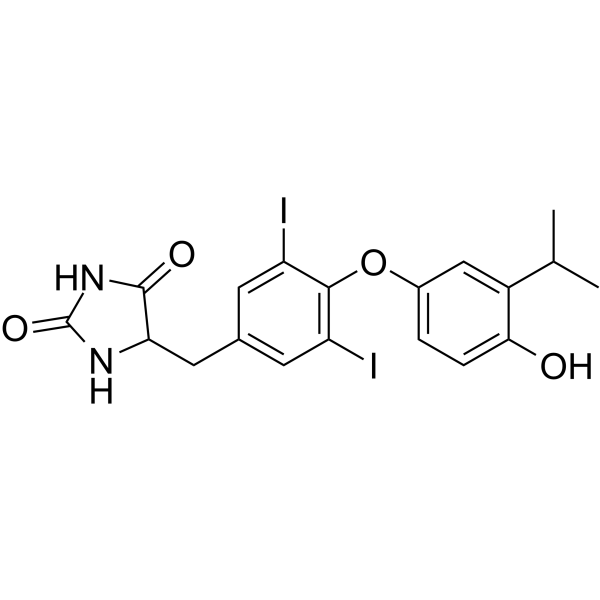
Physicochemical Properties
| Molecular Formula | C19H18I2N2O4 |
| Molecular Weight | 592.166169643402 |
| Exact Mass | 591.935 |
| CAS # | 1370363-74-8 |
| PubChem CID | 44452442 |
| Appearance | Off-white to light yellow solid powder |
| LogP | 4.5 |
| Hydrogen Bond Donor Count | 3 |
| Hydrogen Bond Acceptor Count | 4 |
| Rotatable Bond Count | 5 |
| Heavy Atom Count | 27 |
| Complexity | 550 |
| Defined Atom Stereocenter Count | 0 |
| SMILES | IC1C(=C(C=C(C=1)CC1C(NC(N1)=O)=O)I)OC1=CC=C(C(=C1)C(C)C)O |
| InChi Key | JWJXVEFUJLKBBT-UHFFFAOYSA-N |
| InChi Code | InChI=1S/C19H18I2N2O4/c1-9(2)12-8-11(3-4-16(12)24)27-17-13(20)5-10(6-14(17)21)7-15-18(25)23-19(26)22-15/h3-6,8-9,15,24H,7H2,1-2H3,(H2,22,23,25,26) |
| Chemical Name | 5-[[4-(4-hydroxy-3-propan-2-ylphenoxy)-3,5-diiodophenyl]methyl]imidazolidine-2,4-dione |
| HS Tariff Code | 2934.99.9001 |
| Storage |
Powder-20°C 3 years 4°C 2 years In solvent -80°C 6 months -20°C 1 month |
| Shipping Condition | Room temperature (This product is stable at ambient temperature for a few days during ordinary shipping and time spent in Customs) |
Biological Activity
| Targets |
Thyroid hormone receptor (TR) agonist (activity observed on genes regulated by both TRα and TRβ in vivo). The literature states that CO23 was previously described as a TRα1-selective agonist in other systems (e.g., tadpoles), but in this rat study, it displayed no clear receptor subtype selectivity in vivo.[1] |
| ln Vitro |
In primary cultures of cerebellar granule neurons, addition of CO23 at incremental doses (10, 100, and 500 nM) significantly increased the mRNA expression of hairless (Hr) and neurotrophin 3 (Ntf3). Significant responses were obtained with the two higher doses (100 and 500 nM). The results suggested that CO23 was at least 50 times less active than T3 (used at 10 nM) on these isolated neurons.[1] |
| ln Vivo |
At a dose of 0.8 nmol/g, CO23 (ip; 0.04-5.0 nmol/g) can lower cholesterol by around 50%; larger doses had similar effects. At the lowest dose of 0.04 nmol/g, CO23 has no effect; at doses of 0.8, 2.5, and 5 nmol/g, on the other hand, it elevates Dio1 mRNA by 5, 10, and 15 times, respectively [1]. When administered to hypothyroid rat pups, CO23 was active in liver, heart, and brain on genes regulated by either TRα or TRβ.[1] In the liver of hypothyroid rats, daily administration of CO23 at doses of 0.8, 2.5, and 5.0 nmol/g body weight for 6 days reduced elevated plasma cholesterol levels (0.8 nmol/g dose had a similar effect as 22.5 pmol/g T3) and increased liver Dio1 mRNA expression in a dose-dependent manner (5-, 10-, and 15-fold increases at 0.8, 2.5, and 5.0 nmol/g, respectively). A dose of 2.5 nmol/g of CO23 was equivalent to 22.5 pmol/g of T3 for Dio1 induction. CO23 also decreased the elevated liver Gsta3 mRNA levels in hypothyroid rats, with the 0.8 nmol/g dose having a similar effect as 22.5 pmol/g T3.[1] In the heart of hypothyroid rats, CO23 increased Atp2a2 mRNA (1.8-fold induction with 2.5 nmol/g, equivalent to T3) and Myh6 mRNA (14-fold induction with 2.5 nmol/g, equivalent to T3). It also decreased the elevated Myh7 mRNA levels, with 0.8 nmol/g inducing a 65% decrease and the highest dose (5.0 nmol/g) required to elicit an effect similar to T3.[1] In the brain of hypothyroid rats, CO23 induced the expression of several thyroid hormone-responsive genes. The lowest effective dose was 0.8 nmol/g for Syt12 induction (3-fold). For Nrgn, Rasd2, Ntf3, and Nr1d1, the lowest dose that resulted in significant induction was 2.5 nmol/g. The least sensitive gene was Hr, which required the highest dose of CO23 (5.0 nmol/g) to achieve about half the effect of T3 (5.5- vs. 9.7-fold induction). Cerebellar reelin (Rln) mRNA was insensitive to CO23 treatment.[1] A preliminary experiment showed that a dose of 22.5 pmol/g of CO23 (equal molar to the effective T3 dose) had no effect on plasma cholesterol, liver Dio1 and Gsta3, heart Myh6, Myh7, and Atp2a2, or cerebellum Hr and Ntf3, indicating a much lower relative potency compared to T3.[1] |
| Cell Assay |
For the primary neuronal culture assay, primary cultures were established from neonatal rat cortex or cerebellum. Cultures were incubated in the absence or presence of T3 (10 nM), CO23, or other analogs at the indicated concentrations. After treatment, mRNA expression of target genes (e.g., Hr, Ntf3) was measured, likely via methods such as RT-PCR (specific details of the post-treatment mRNA measurement are not provided in the extracted text).[1] |
| Animal Protocol |
Animal/Disease Models: Hypothyroid Wistar rats [1] Doses: 0.04, 0.8, 2.5 and 5.0 nmol/g Route of Administration: intraperitoneal (ip) injection Experimental Results: The 0.8 nmol/g dose can reduce cholesterol by about 50%, and higher doses are equally effective. Hypothyroidism was induced in rat pups by administering 0.02% 2-mercapto-1-methylimidazole and 1% KClO4 in the drinking water to the dams from gestational day 9 until the end of the experiment on postnatal day (P) 16.[1] CO23 was administered to the hypothyroid pups dissolved in PBS containing 0.1% BSA. It was given as a single daily intraperitoneal (ip) injection at specified doses (e.g., 0.04, 0.8, 2.5, 5.0 nmol/g body weight). Treatments were started on P10, and the last dose was administered on P15. Animals were euthanized 24 hours after the last injection for tissue collection and analysis.[1] |
| ADME/Pharmacokinetics |
The relative potency of CO23 was much lower than T3. In cultured cerebellar granule cells, its potency was estimated to be more than 50-fold lower than T3. In vivo, high doses of CO23 (100- to 200-fold the molar dose of T3) had to be used to observe effects.[1] The study suggests that CO23 is able to be transported through the blood-brain barrier and cross the neuronal cell membrane, but the specific transporter involved is not identified. It is considered unlikely that it uses the monocarboxylate transporter 8 (MCT8).[1] |
| References |
[1]. In vivo activity of the thyroid hormone receptor beta- and α-selective agonists GC-24 and CO23on rat liver, heart, and brain. Endocrinology. 2011 Mar;152(3):1136-42. |
| Additional Infomation |
CO23 is a thyroid hormone (T3) analog.[1] It was previously characterized as a TRα-selective agonist in tadpoles and in cultured cell assays using specific reporter systems.[1] However, in this in vivo study using rats, CO23 activated thyroid hormone-responsive genes in tissues expressing preferentially either TRα1 (e.g., heart, brain) or TRβ (e.g., liver), displaying no clear receptor subtype selectivity.[1] The liver responses (cholesterol reduction, Dio1 induction) are interpreted to be due to TRβ1 stimulation, based on the known biology of these endpoints.[1] The lack of clear TR selectivity in mammalian tissues would make this compound less interesting as a therapeutic agent targeting a specific receptor subtype. However, its ability to cross the blood-brain barrier may be of interest for potential brain applications.[1] |
Solubility Data
| Solubility (In Vitro) | DMSO : ~250 mg/mL (~422.18 mM) |
| Solubility (In Vivo) |
Note: Listed below are some common formulations that may be used to formulate products with low water solubility (e.g. < 1 mg/mL), you may test these formulations using a minute amount of products to avoid loss of samples. Injection Formulations (e.g. IP/IV/IM/SC) Injection Formulation 1: DMSO : Tween 80: Saline = 10 : 5 : 85 (i.e. 100 μL DMSO stock solution → 50 μL Tween 80 → 850 μL Saline) *Preparation of saline: Dissolve 0.9 g of sodium chloride in 100 mL ddH ₂ O to obtain a clear solution. Injection Formulation 2: DMSO : PEG300 :Tween 80 : Saline = 10 : 40 : 5 : 45 (i.e. 100 μL DMSO → 400 μLPEG300 → 50 μL Tween 80 → 450 μL Saline) Injection Formulation 3: DMSO : Corn oil = 10 : 90 (i.e. 100 μL DMSO → 900 μL Corn oil) Example: Take the Injection Formulation 3 (DMSO : Corn oil = 10 : 90) as an example, if 1 mL of 2.5 mg/mL working solution is to be prepared, you can take 100 μL 25 mg/mL DMSO stock solution and add to 900 μL corn oil, mix well to obtain a clear or suspension solution (2.5 mg/mL, ready for use in animals). Injection Formulation 4: DMSO : 20% SBE-β-CD in saline = 10 : 90 [i.e. 100 μL DMSO → 900 μL (20% SBE-β-CD in saline)] *Preparation of 20% SBE-β-CD in Saline (4°C,1 week): Dissolve 2 g SBE-β-CD in 10 mL saline to obtain a clear solution. Injection Formulation 5: 2-Hydroxypropyl-β-cyclodextrin : Saline = 50 : 50 (i.e. 500 μL 2-Hydroxypropyl-β-cyclodextrin → 500 μL Saline) Injection Formulation 6: DMSO : PEG300 : castor oil : Saline = 5 : 10 : 20 : 65 (i.e. 50 μL DMSO → 100 μLPEG300 → 200 μL castor oil → 650 μL Saline) Injection Formulation 7: Ethanol : Cremophor : Saline = 10: 10 : 80 (i.e. 100 μL Ethanol → 100 μL Cremophor → 800 μL Saline) Injection Formulation 8: Dissolve in Cremophor/Ethanol (50 : 50), then diluted by Saline Injection Formulation 9: EtOH : Corn oil = 10 : 90 (i.e. 100 μL EtOH → 900 μL Corn oil) Injection Formulation 10: EtOH : PEG300:Tween 80 : Saline = 10 : 40 : 5 : 45 (i.e. 100 μL EtOH → 400 μLPEG300 → 50 μL Tween 80 → 450 μL Saline) Oral Formulations Oral Formulation 1: Suspend in 0.5% CMC Na (carboxymethylcellulose sodium) Oral Formulation 2: Suspend in 0.5% Carboxymethyl cellulose Example: Take the Oral Formulation 1 (Suspend in 0.5% CMC Na) as an example, if 100 mL of 2.5 mg/mL working solution is to be prepared, you can first prepare 0.5% CMC Na solution by measuring 0.5 g CMC Na and dissolve it in 100 mL ddH2O to obtain a clear solution; then add 250 mg of the product to 100 mL 0.5% CMC Na solution, to make the suspension solution (2.5 mg/mL, ready for use in animals). Oral Formulation 3: Dissolved in PEG400 Oral Formulation 4: Suspend in 0.2% Carboxymethyl cellulose Oral Formulation 5: Dissolve in 0.25% Tween 80 and 0.5% Carboxymethyl cellulose Oral Formulation 6: Mixing with food powders Note: Please be aware that the above formulations are for reference only. InvivoChem strongly recommends customers to read literature methods/protocols carefully before determining which formulation you should use for in vivo studies, as different compounds have different solubility properties and have to be formulated differently. (Please use freshly prepared in vivo formulations for optimal results.) |
| Preparing Stock Solutions | 1 mg | 5 mg | 10 mg | |
| 1 mM | 1.6887 mL | 8.4435 mL | 16.8870 mL | |
| 5 mM | 0.3377 mL | 1.6887 mL | 3.3774 mL | |
| 10 mM | 0.1689 mL | 0.8444 mL | 1.6887 mL |