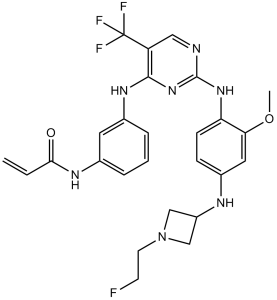
CNX-2006 (CNX2006), a CO-1686 analog, is a covalent / irreversible and mutant-selective EGFR inhibitor with potential antitumor activity. Its EGFR inhibition has an IC50 of less than 20 nM. CO-1686, which is presently undergoing clinical trials for the treatment of lung cancer, and CNX-2006 share structural similarities.
Physicochemical Properties
| Molecular Formula | C26H27F4N7O2 | |
| Molecular Weight | 545.53 | |
| Exact Mass | 545.216 | |
| Elemental Analysis | C, 57.24; H, 4.99; F, 13.93; N, 17.97; O, 5.87 | |
| CAS # | 1375465-09-0 | |
| Related CAS # |
|
|
| PubChem CID | 56968072 | |
| Appearance | white solid powder | |
| Density | 1.4±0.1 g/cm3 | |
| Index of Refraction | 1.643 | |
| LogP | 2.28 | |
| Hydrogen Bond Donor Count | 4 | |
| Hydrogen Bond Acceptor Count | 12 | |
| Rotatable Bond Count | 11 | |
| Heavy Atom Count | 39 | |
| Complexity | 801 | |
| Defined Atom Stereocenter Count | 0 | |
| SMILES | FC([H])([H])C([H])([H])N1C([H])([H])C([H])(C1([H])[H])N([H])C1C([H])=C([H])C(=C(C=1[H])OC([H])([H])[H])N([H])C1=NC([H])=C(C(F)(F)F)C(N([H])C2C([H])=C([H])C([H])=C(C=2[H])N([H])C(C([H])=C([H])[H])=O)=N1 |
|
| InChi Key | BFSRTTWIPACGMI-UHFFFAOYSA-N | |
| InChi Code | InChI=1S/C26H27F4N7O2/c1-3-23(38)33-16-5-4-6-17(11-16)34-24-20(26(28,29)30)13-31-25(36-24)35-21-8-7-18(12-22(21)39-2)32-19-14-37(15-19)10-9-27/h3-8,11-13,19,32H,1,9-10,14-15H2,2H3,(H,33,38)(H2,31,34,35,36) | |
| Chemical Name | N-[3-[[2-[4-[[1-(2-fluoroethyl)azetidin-3-yl]amino]-2-methoxyanilino]-5-(trifluoromethyl)pyrimidin-4-yl]amino]phenyl]prop-2-enamide | |
| Synonyms |
|
|
| HS Tariff Code | 2934.99.9001 | |
| Storage |
Powder-20°C 3 years 4°C 2 years In solvent -80°C 6 months -20°C 1 month |
|
| Shipping Condition | Room temperature (This product is stable at ambient temperature for a few days during ordinary shipping and time spent in Customs) |
Biological Activity
| Targets |
EGFR T790M (IC50 = 20 nM); EGFR L858R/T790M CNX-2006 selectively inhibits EGFR T790M mutant tyrosine kinase (IC₅₀ = 15 nM). It shows lower activity against wild-type EGFR (IC₅₀ = 280 nM) [2] |
| ln Vitro |
CNX-2006 suppresses the growth of EGFR-T790M cells up to 1000 times more than that of EGFR cells of the wild type. After one hour of drug exposure, EGFR inhibition is seen in cells with the T790M mutation at IC50 values less than 20 nM. Moreover, the volume of tumor spheres made from H1975 cells is greatly decreased by CNX-2006[1]. With regard to T790M, CNX-2006 demonstrates both potency and specificity. In addition, the medication exhibits efficacy against rare EGFR mutations such as G719S, L861Q, T854A, an exon 19 insertion mutant (I744-K745insKIPVAI), and G719S, but not against an exon 20 insertion (H773-V774HVdup). CNX-2006 strongly prevents the formation of resistant cells in an in vitro resistance model. It has been observed that chronic exposure to increasing doses of CNX-2006 does not promote or select for T790M-mediated resistance using PC-9 or HCC827 cells (both of which carry exon 19 deletions) or PC-9/ER and HCC827/ER cells that already have T790M and are erlotinib-resistant[2]. CNX-2006 dose-dependently inhibited the proliferation of T790M-mediated gefitinib-resistant non-small cell lung cancer (NSCLC) cell lines, including H1975 (EGFR L858R/T790M, IC₅₀ = 22 nM) and PC-9/GR (EGFR del19/T790M, IC₅₀ = 18 nM). It blocked phosphorylated EGFR (p-EGFR) and downstream Akt/ERK1/2 signaling in these cells at concentrations ≥ 30 nM [2] CNX-2006 did not induce additional T790M mutation or enhance T790M-mediated resistance in long-term culture (28 days) of PC-9/GR cells. It maintained inhibitory activity with an IC₅₀ of 25 nM after prolonged exposure [2] In NSCLC cells with epithelial-mesenchymal transition (EMT) phenotype (A549-EMT), CNX-2006 showed reduced antiproliferative activity (IC₅₀ = 150 nM) compared to parental A549 cells (IC₅₀ = 35 nM), suggesting EMT may confer partial resistance to the drug [1] |
| ln Vivo | CNX-2006 is efficacious in H1975 (EGFR L858R/T790M) xenograft model. |
| Enzyme Assay |
Drugs are administered to human EGFR mutant lung adenocarcinoma cell lines using conventional growth inhibition assays. Recombinant EGFR T790M mutant and wild-type EGFR kinase domains were incubated with ATP and specific peptide substrates in the presence of serial dilutions of CNX-2006. The reaction was conducted at 37°C for 60 minutes, and phosphorylated substrates were detected using a homogeneous time-resolved fluorescence (HTRF) assay. Inhibition rates were calculated by comparing fluorescence intensity with vehicle controls, and IC₅₀ values were derived from dose-response curves [2] |
| Cell Assay |
After 6 hours of inhibitor treatment, lysates from cells expressing endogenous or transiently transfected mutant EGFRs (293 cells) are extracted and subjected to immunoblotting analysis. H1975, PC-9/GR, A549, and A549-EMT cells were seeded in 96-well plates at 5×10³ cells/well and treated with CNX-2006 (1-500 nM) for 72 hours. Cell viability was measured using a tetrazolium-based assay to calculate IC₅₀ values [1,2] For Western blot analysis, H1975 and PC-9/GR cells were treated with CNX-2006 (20-100 nM) for 24 hours, lysed, and probed with antibodies against p-EGFR, Akt, ERK1/2, and GAPDH [2] PC-9/GR cells were continuously treated with CNX-2006 (20 nM) for 28 days. Cell proliferation was monitored weekly, and EGFR mutation status was analyzed by Sanger sequencing at the end of the culture period [2] |
| Animal Protocol |
Nude mice 25 mg/kg i.p. |
| References |
[1]. Role of epithelial-mesenchymal transition (EMT) in sensitivity to CNX-2006, a novel mutant-selective EGFR inhibitor which overcomes in vitro T790M-mediated resistance in NSCLC. Cancer Res (2013) 73 (8_Supplement): 3244. [2]. CNX-2006, a novel irreversible epidermal growth factor receptor (EGFR) inhibitor, selectively inhibits EGFR T790M and fails to induce T790M-mediated resistance in vitro. Cancer Res (2013) 73 (8_Supplement): 2101A. |
| Additional Infomation |
CNX-2006 is a novel irreversible EGFR tyrosine kinase inhibitor designed to selectively target EGFR T790M mutant, a key mediator of acquired resistance to first-generation EGFR inhibitors [2] The reduced sensitivity of EMT-positive NSCLC cells to CNX-2006 indicates that combining EGFR inhibition with EMT reversal strategies may improve therapeutic efficacy in advanced NSCLC [1] |
Solubility Data
| Solubility (In Vitro) |
|
|||
| Solubility (In Vivo) |
Note: Listed below are some common formulations that may be used to formulate products with low water solubility (e.g. < 1 mg/mL), you may test these formulations using a minute amount of products to avoid loss of samples. Injection Formulations (e.g. IP/IV/IM/SC) Injection Formulation 1: DMSO : Tween 80: Saline = 10 : 5 : 85 (i.e. 100 μL DMSO stock solution → 50 μL Tween 80 → 850 μL Saline) *Preparation of saline: Dissolve 0.9 g of sodium chloride in 100 mL ddH ₂ O to obtain a clear solution. Injection Formulation 2: DMSO : PEG300 :Tween 80 : Saline = 10 : 40 : 5 : 45 (i.e. 100 μL DMSO → 400 μLPEG300 → 50 μL Tween 80 → 450 μL Saline) Injection Formulation 3: DMSO : Corn oil = 10 : 90 (i.e. 100 μL DMSO → 900 μL Corn oil) Example: Take the Injection Formulation 3 (DMSO : Corn oil = 10 : 90) as an example, if 1 mL of 2.5 mg/mL working solution is to be prepared, you can take 100 μL 25 mg/mL DMSO stock solution and add to 900 μL corn oil, mix well to obtain a clear or suspension solution (2.5 mg/mL, ready for use in animals). Injection Formulation 4: DMSO : 20% SBE-β-CD in saline = 10 : 90 [i.e. 100 μL DMSO → 900 μL (20% SBE-β-CD in saline)] *Preparation of 20% SBE-β-CD in Saline (4°C,1 week): Dissolve 2 g SBE-β-CD in 10 mL saline to obtain a clear solution. Injection Formulation 5: 2-Hydroxypropyl-β-cyclodextrin : Saline = 50 : 50 (i.e. 500 μL 2-Hydroxypropyl-β-cyclodextrin → 500 μL Saline) Injection Formulation 6: DMSO : PEG300 : castor oil : Saline = 5 : 10 : 20 : 65 (i.e. 50 μL DMSO → 100 μLPEG300 → 200 μL castor oil → 650 μL Saline) Injection Formulation 7: Ethanol : Cremophor : Saline = 10: 10 : 80 (i.e. 100 μL Ethanol → 100 μL Cremophor → 800 μL Saline) Injection Formulation 8: Dissolve in Cremophor/Ethanol (50 : 50), then diluted by Saline Injection Formulation 9: EtOH : Corn oil = 10 : 90 (i.e. 100 μL EtOH → 900 μL Corn oil) Injection Formulation 10: EtOH : PEG300:Tween 80 : Saline = 10 : 40 : 5 : 45 (i.e. 100 μL EtOH → 400 μLPEG300 → 50 μL Tween 80 → 450 μL Saline) Oral Formulations Oral Formulation 1: Suspend in 0.5% CMC Na (carboxymethylcellulose sodium) Oral Formulation 2: Suspend in 0.5% Carboxymethyl cellulose Example: Take the Oral Formulation 1 (Suspend in 0.5% CMC Na) as an example, if 100 mL of 2.5 mg/mL working solution is to be prepared, you can first prepare 0.5% CMC Na solution by measuring 0.5 g CMC Na and dissolve it in 100 mL ddH2O to obtain a clear solution; then add 250 mg of the product to 100 mL 0.5% CMC Na solution, to make the suspension solution (2.5 mg/mL, ready for use in animals). Oral Formulation 3: Dissolved in PEG400 Oral Formulation 4: Suspend in 0.2% Carboxymethyl cellulose Oral Formulation 5: Dissolve in 0.25% Tween 80 and 0.5% Carboxymethyl cellulose Oral Formulation 6: Mixing with food powders Note: Please be aware that the above formulations are for reference only. InvivoChem strongly recommends customers to read literature methods/protocols carefully before determining which formulation you should use for in vivo studies, as different compounds have different solubility properties and have to be formulated differently. (Please use freshly prepared in vivo formulations for optimal results.) |
| Preparing Stock Solutions | 1 mg | 5 mg | 10 mg | |
| 1 mM | 1.8331 mL | 9.1654 mL | 18.3308 mL | |
| 5 mM | 0.3666 mL | 1.8331 mL | 3.6662 mL | |
| 10 mM | 0.1833 mL | 0.9165 mL | 1.8331 mL |