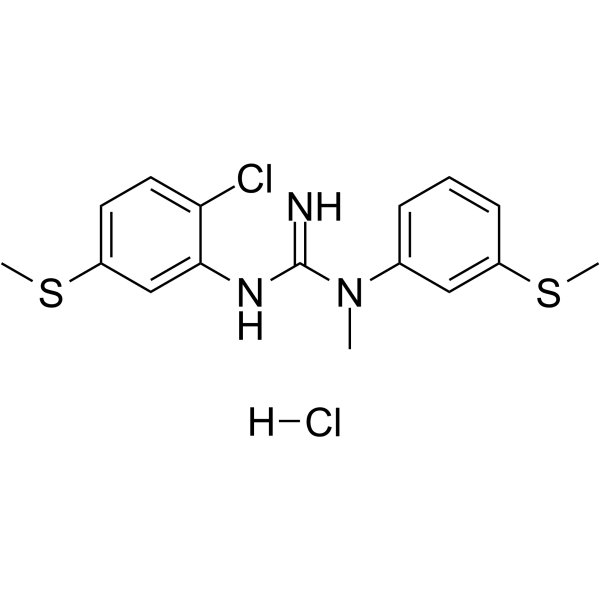
Physicochemical Properties
| Molecular Formula | C16H19CL2N3S2 |
| Molecular Weight | 388.3782 |
| Exact Mass | 387.039 |
| CAS # | 160756-38-7 |
| Related CAS # | CNS 5161;160754-76-7 |
| PubChem CID | 9886565 |
| Appearance | Typically exists as solid at room temperature |
| Hydrogen Bond Donor Count | 2 |
| Hydrogen Bond Acceptor Count | 3 |
| Rotatable Bond Count | 5 |
| Heavy Atom Count | 23 |
| Complexity | 380 |
| Defined Atom Stereocenter Count | 0 |
| SMILES | ClC1C([H])=C([H])C(=C([H])C=1/N=C(\N([H])[H])/N(C([H])([H])[H])C1C([H])=C([H])C([H])=C(C=1[H])SC([H])([H])[H])SC([H])([H])[H].Cl[H] |
| InChi Key | ZTVHYOCKPFPHFF-UHFFFAOYSA-N |
| InChi Code | InChI=1S/C16H18ClN3S2.ClH/c1-20(11-5-4-6-12(9-11)21-2)16(18)19-15-10-13(22-3)7-8-14(15)17;/h4-10H,1-3H3,(H2,18,19);1H |
| Chemical Name | 2-(2-chloro-5-methylsulfanylphenyl)-1-methyl-1-(3-methylsulfanylphenyl)guanidine;hydrochloride |
| HS Tariff Code | 2934.99.9001 |
| Storage |
Powder-20°C 3 years 4°C 2 years In solvent -80°C 6 months -20°C 1 month |
| Shipping Condition | Room temperature (This product is stable at ambient temperature for a few days during ordinary shipping and time spent in Customs) |
Biological Activity
| Targets | CNS-5161 (CNS 5161) is a unique selective non-competitive antagonist of a subset of glutamate receptors NMDA in the mammalian brain. CNS-5161 shows significant inhibitory effect on NMDA ion channels in vitro and is able to displace [3H]MK-801 binding in rat brain synaptosomal membrane preparations with a Ki of 1.8 nM [1]. |
| ln Vitro |
CNS-5161 (CNS 5161) is a unique selective non-competitive antagonist of a subset of glutamate receptors NMDA in the mammalian brain. CNS-5161 shows significant inhibitory effect on NMDA ion channels in vitro and is able to displace [3H]MK-801 binding in rat brain synaptosomal membrane preparations with a Ki of 1.8 nM [1]. CNS-5161 hydrochloride exhibits potent inhibitory activity at the NMDA ion channel in vitro.[1] In radioligand binding assays using rat brain synaptosomal membranes, it displaced [³H]MK-801 with a Ki of 1.8 nM.[1] |
| ln Vivo |
In an in vivo NMDA excitotoxicity model in neonatal rats, CNS-5161 (CNS 5161) prevented the necrotic effects of exogenous N-methyl-D-aspartate via the intraperitoneal (ip) route with an ED80 of 4 mg/ kg. CNS-5161 also revealed that intraperitoneal injection of 4 mg/kg in DBA/2 mice prevented 91% of audiogenic seizures and was neuroprotective after hypoxic/ischemic brain damage in newborn rats [1] . In a neonatal rat NMDA excitotoxicity model, intraperitoneal (i.p.) administration of CNS-5161 hydrochloride protected against the necrotic effects of exogenous NMDA with an ED₈₀ of 4 mg/kg.[1] In DBA/2 mice, i.p. administration of 4 mg/kg CNS-5161 hydrochloride showed 91% inhibition of audiogenic seizures.[1] In a focal cerebral ischaemia model in adult male Sprague-Dawley rats (middle cerebral artery occlusion, MCAO), intravenous (i.v.) administration of CNS-5161 hydrochloride (total doses of 0.88, 1.75, or 3.5 mg/kg) significantly and dose-dependently reduced total brain infarct volume by 35%, 42%, and 46%, and cortical infarct volume by 43%, 50%, and 52%, respectively, compared to vehicle-treated rats.[1] In a hypoxic/ischaemic brain injury model in neonatal rats, CNS-5161 hydrochloride showed a neuroprotective effect.[1] In a first-in-human, randomized, double-blind, placebo-controlled phase I study, healthy male volunteers received single intravenous infusions of CNS-5161 hydrochloride (doses ranging from 30 µg to 2000 µg). The drug was well tolerated. A dose-dependent rise in systolic, mean arterial, and diastolic blood pressure was observed, reaching up to 23/19 mmHg, with maximal effects between 60 and 120 minutes post-infusion.[1] |
| Animal Protocol |
In the neonatal rat NMDA excitotoxicity model, CNS-5161 hydrochloride was administered intraperitoneally (i.p.).[1] In the adult rat focal cerebral ischaemia model, male Sprague-Dawley rats underwent middle cerebral artery occlusion (MCAO). Ten minutes after occlusion, they received an intravenous (i.v.) bolus of CNS-5161 hydrochloride (0.275, 0.55, or 1.1 mg/kg) followed by a 3-hour i.v. infusion (0.2, 0.4, or 0.8 mg/kg/h, resulting in total doses of 0.88, 1.75, or 3.5 mg/kg). Control animals received vehicle (0.3 M mannitol).[1] For pharmacokinetic analysis in rats, plasma samples were collected from vehicle and drug-treated animals (0.88 and 1.75 mg/kg total dose groups) and analyzed using a validated HPLC method with electrochemical detection.[1] |
| ADME/Pharmacokinetics |
In the rat focal ischaemia study, mean plasma concentrations of CNS-5161 hydrochloride at the end of the 3-hour infusion were 9.7 ± 0.9 ng/mL for the 0.88 mg/kg dose group and 19.6 ± 1.2 ng/mL for the 1.75 mg/kg dose group.[1] In the human phase I study, following a 15-minute intravenous infusion, the pharmacokinetics of CNS-5161 hydrochloride were best described by a two-compartment model.[1] The mean elimination half-life (t₁/₂) was 2.95 hours (standard deviation, s.d., 0.75).[1] The mean clearance (CL) was 106 L/h (s.d. 17.8).[1] The mean volume of distribution at steady state (Vss) was 296 L (s.d. 69).[1] Maximum plasma concentration (Cmax) and area under the concentration-time curve (AUC) increased linearly with dose.[1] Putative neuroprotective plasma concentrations were achieved transiently in the higher dose groups in humans.[1] |
| Toxicity/Toxicokinetics |
In the adult rat focal ischaemia study, some dose-dependent mortality (up to 25% in the highest dose group) was observed, attributed to sudden respiratory failure during continued i.v. infusion under anaesthesia without mechanical ventilation. No animals died after recovery from anaesthesia.[1] Rats treated with CNS-5161 hydrochloride displayed dose-dependent behavioral changes such as excitation and impaired locomotor coordination upon recovery from anaesthesia.[1] In the human phase I study, CNS-5161 hydrochloride was well tolerated at doses up to 2000 µg. Side-effects were dose-related, self-limiting, and mild.[1] Reported adverse events included minor subjective sensory symptoms (e.g., paresthesia, dysesthesia, numbness in extremities and perioral area), lightheadedness, derealization, drowsiness, flushing, dizziness, and headache. No severe adverse events, priapism, or significant ECG abnormalities were observed.[1] A dose-dependent increase in systolic, mean arterial, and diastolic blood pressure was noted, which returned to baseline within 24 hours.[1] No significant abnormalities in biochemistry, haematology, or urinalysis were identified.[1] |
| References | [1]. Walters MR, et al. Early clinical experience with the novel NMDA receptor antagonist CNS 5161. Br J Clin Pharmacol. 2002 Mar;53(3):305-11. |
| Additional Infomation |
CNS-5161 hydrochloride is a non-competitive NMDA receptor ion-channel antagonist, chemically defined as N-(2-chloro-5-(methylmercapto) phenyl)-N’-(3-(methylmercapto) phenyl)-N’-methylguanidine monohydrochloride.[1] Its proposed mechanism is to block the NMDA receptor-associated ion channel, thereby inhibiting excessive calcium influx and neuronal excitotoxicity associated with conditions like stroke.[1] Preclinical data suggest it has good central nervous system penetration.[1] Potential clinical applications include neuroprotection (e.g., in stroke, hypoxic-ischaemic brain injury) and analgesia.[1] The cardiovascular effects (increased blood pressure) observed in humans were predicted from animal models and may be a dose-limiting factor, especially in elderly stroke patients.[1] |
Solubility Data
| Solubility (In Vitro) | May dissolve in DMSO (in most cases), if not, try other solvents such as H2O, Ethanol, or DMF with a minute amount of products to avoid loss of samples |
| Solubility (In Vivo) |
Note: Listed below are some common formulations that may be used to formulate products with low water solubility (e.g. < 1 mg/mL), you may test these formulations using a minute amount of products to avoid loss of samples. Injection Formulations (e.g. IP/IV/IM/SC) Injection Formulation 1: DMSO : Tween 80: Saline = 10 : 5 : 85 (i.e. 100 μL DMSO stock solution → 50 μL Tween 80 → 850 μL Saline) *Preparation of saline: Dissolve 0.9 g of sodium chloride in 100 mL ddH ₂ O to obtain a clear solution. Injection Formulation 2: DMSO : PEG300 :Tween 80 : Saline = 10 : 40 : 5 : 45 (i.e. 100 μL DMSO → 400 μLPEG300 → 50 μL Tween 80 → 450 μL Saline) Injection Formulation 3: DMSO : Corn oil = 10 : 90 (i.e. 100 μL DMSO → 900 μL Corn oil) Example: Take the Injection Formulation 3 (DMSO : Corn oil = 10 : 90) as an example, if 1 mL of 2.5 mg/mL working solution is to be prepared, you can take 100 μL 25 mg/mL DMSO stock solution and add to 900 μL corn oil, mix well to obtain a clear or suspension solution (2.5 mg/mL, ready for use in animals). Injection Formulation 4: DMSO : 20% SBE-β-CD in saline = 10 : 90 [i.e. 100 μL DMSO → 900 μL (20% SBE-β-CD in saline)] *Preparation of 20% SBE-β-CD in Saline (4°C,1 week): Dissolve 2 g SBE-β-CD in 10 mL saline to obtain a clear solution. Injection Formulation 5: 2-Hydroxypropyl-β-cyclodextrin : Saline = 50 : 50 (i.e. 500 μL 2-Hydroxypropyl-β-cyclodextrin → 500 μL Saline) Injection Formulation 6: DMSO : PEG300 : castor oil : Saline = 5 : 10 : 20 : 65 (i.e. 50 μL DMSO → 100 μLPEG300 → 200 μL castor oil → 650 μL Saline) Injection Formulation 7: Ethanol : Cremophor : Saline = 10: 10 : 80 (i.e. 100 μL Ethanol → 100 μL Cremophor → 800 μL Saline) Injection Formulation 8: Dissolve in Cremophor/Ethanol (50 : 50), then diluted by Saline Injection Formulation 9: EtOH : Corn oil = 10 : 90 (i.e. 100 μL EtOH → 900 μL Corn oil) Injection Formulation 10: EtOH : PEG300:Tween 80 : Saline = 10 : 40 : 5 : 45 (i.e. 100 μL EtOH → 400 μLPEG300 → 50 μL Tween 80 → 450 μL Saline) Oral Formulations Oral Formulation 1: Suspend in 0.5% CMC Na (carboxymethylcellulose sodium) Oral Formulation 2: Suspend in 0.5% Carboxymethyl cellulose Example: Take the Oral Formulation 1 (Suspend in 0.5% CMC Na) as an example, if 100 mL of 2.5 mg/mL working solution is to be prepared, you can first prepare 0.5% CMC Na solution by measuring 0.5 g CMC Na and dissolve it in 100 mL ddH2O to obtain a clear solution; then add 250 mg of the product to 100 mL 0.5% CMC Na solution, to make the suspension solution (2.5 mg/mL, ready for use in animals). Oral Formulation 3: Dissolved in PEG400 Oral Formulation 4: Suspend in 0.2% Carboxymethyl cellulose Oral Formulation 5: Dissolve in 0.25% Tween 80 and 0.5% Carboxymethyl cellulose Oral Formulation 6: Mixing with food powders Note: Please be aware that the above formulations are for reference only. InvivoChem strongly recommends customers to read literature methods/protocols carefully before determining which formulation you should use for in vivo studies, as different compounds have different solubility properties and have to be formulated differently. (Please use freshly prepared in vivo formulations for optimal results.) |
| Preparing Stock Solutions | 1 mg | 5 mg | 10 mg | |
| 1 mM | 2.5748 mL | 12.8740 mL | 25.7480 mL | |
| 5 mM | 0.5150 mL | 2.5748 mL | 5.1496 mL | |
| 10 mM | 0.2575 mL | 1.2874 mL | 2.5748 mL |