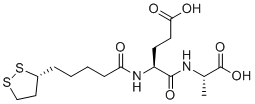
CMX-2043 (CMX2043) is an analogue of α-Lipoic Acid that can activate cell survival pathways and block oxidative damage. CMX-2043 can activate insulin receptor kinase, soluble tyrosine kinase, and Akt phosphorylation. CMX-2043 shows protection against ischemia-reperfusion injury (IRI) in rat model.
Physicochemical Properties
| Molecular Formula | C16H26N2O6S2 |
| Molecular Weight | 406.52 |
| Exact Mass | 406.123 |
| CAS # | 910627-26-8 |
| PubChem CID | 49802864 |
| Appearance | White to off-white solid powder |
| LogP | 0.7 |
| Hydrogen Bond Donor Count | 4 |
| Hydrogen Bond Acceptor Count | 8 |
| Rotatable Bond Count | 12 |
| Heavy Atom Count | 26 |
| Complexity | 517 |
| Defined Atom Stereocenter Count | 3 |
| SMILES | S1[C@@H](CCS1)CCCCC(N[C@H](C(N[C@H](C(=O)O)C)=O)CCC(=O)O)=O |
| InChi Key | MQXRTCVZPIHBLD-TUAOUCFPSA-N |
| InChi Code | InChI=1S/C16H26N2O6S2/c1-10(16(23)24)17-15(22)12(6-7-14(20)21)18-13(19)5-3-2-4-11-8-9-25-26-11/h10-12H,2-9H2,1H3,(H,17,22)(H,18,19)(H,20,21)(H,23,24)/t10-,11+,12-/m0/s1 |
| Chemical Name | (4S)-5-[[(1S)-1-carboxyethyl]amino]-4-[5-[(3R)-dithiolan-3-yl]pentanoylamino]-5-oxopentanoic acid |
| Synonyms | CMX2043 CMX2043 CMX-2043 |
| HS Tariff Code | 2934.99.9001 |
| Storage |
Powder-20°C 3 years 4°C 2 years In solvent -80°C 6 months -20°C 1 month Note: Please store this product in a sealed and protected environment, avoid exposure to moisture. |
| Shipping Condition | Room temperature (This product is stable at ambient temperature for a few days during ordinary shipping and time spent in Customs) |
Biological Activity
| ln Vitro | CMX-2043 has a significant ability to absorb peroxyl radicals (15-250 mM; 10 minutes) [1]. Splen tyrosine kinase (Syk) and intimal endothelial cell kinase (Tie2) are both mildly inhibited by CMX-2043 (1.5 μM) [1]. In A549 cells, CMX-2043 (50 μM; 45 minutes) stimulates Akt phosphorylation via the PI3K pathway [1]. In CHO-M1-WT3 cells, CMX-2043 (2.5 mM; 30 minutes) decreases the rise in cytosolic calcium in a concentration-dependent manner [1]. fluorescent imaging [1] |
| ln Vivo | Myocardial ischemia-reperfusion injury (IRI) as determined by the myocardial infarction to area at risk (MI-AR) ratio and the incidence of arrhythmias measure is decreased by CMX-2043 (50-200 mg/kg, 5 mL; oral; single dose)[2]. |
| Cell Assay |
Immunofluorescence[1] Cell Types: H9c2 (rat cardiomyocytes) Cell Tested Concentrations: 50 μM Incubation Duration: 3 hrs (hours) Experimental Results: Brighter fluorescence intensity in cells compared to control, indicating stronger Akt phosphorylation. |
| Animal Protocol |
Animal/Disease Models: Sprague Dawley rat ischemia-reperfusion injury (IRI) model [2] Doses: 50, 100 and 200 mg/kg; 5 mL of normal saline solution flavored with 2% vanilla extract. Route of Administration: po (oral gavage); Single dose; Induces IRI 30-60 minutes after treatment Experimental Results: Induces arrhythmia and mortality in rats, reduces the ratio of myocardial infarction to risk area. |
| References |
[1]. CMX-2043 Mechanisms of Action In Vitro. J Cardiovasc Pharmacol. 2016 Sept;68:241-247. [2]. CMX-2043 Efficacy in a Rat Model of Cardiac Ischemia-Reperfusion Injury. J Cardiovasc Pharmacol Ther. 2016 Nov;21(6):563-569. |
| Additional Infomation | CMX-2043 has been used in trials studying the treatment and prevention of Non STEMI, Unstable Angina, Stable Coronary Artery Disease, and Percutaneous Coronary Intervention. |
Solubility Data
| Solubility (In Vitro) | DMSO : ~20.83 mg/mL (~51.24 mM) |
| Solubility (In Vivo) |
Solubility in Formulation 1: ≥ 2.08 mg/mL (5.12 mM) (saturation unknown) in 10% DMSO + 40% PEG300 + 5% Tween80 + 45% Saline (add these co-solvents sequentially from left to right, and one by one), clear solution. For example, if 1 mL of working solution is to be prepared, you can add 100 μL of 20.8 mg/mL clear DMSO stock solution to 400 μL PEG300 and mix evenly; then add 50 μL Tween-80 to the above solution and mix evenly; then add 450 μL normal saline to adjust the volume to 1 mL. Preparation of saline: Dissolve 0.9 g of sodium chloride in 100 mL ddH₂ O to obtain a clear solution. Solubility in Formulation 2: 2.08 mg/mL (5.12 mM) in 10% DMSO + 90% (20% SBE-β-CD in Saline) (add these co-solvents sequentially from left to right, and one by one), suspension solution; with ultrasonication. For example, if 1 mL of working solution is to be prepared, you can add 100 μL of 20.8 mg/mL clear DMSO stock solution to 900 μL of 20% SBE-β-CD physiological saline solution and mix evenly. Preparation of 20% SBE-β-CD in Saline (4°C,1 week): Dissolve 2 g SBE-β-CD in 10 mL saline to obtain a clear solution. Solubility in Formulation 3: ≥ 2.08 mg/mL (5.12 mM) (saturation unknown) in 10% DMSO + 90% Corn Oil (add these co-solvents sequentially from left to right, and one by one), clear solution. For example, if 1 mL of working solution is to be prepared, you can add 100 μL of 20.8 mg/mL clear DMSO stock solution to 900 μL of corn oil and mix evenly. (Please use freshly prepared in vivo formulations for optimal results.) |
| Preparing Stock Solutions | 1 mg | 5 mg | 10 mg | |
| 1 mM | 2.4599 mL | 12.2995 mL | 24.5990 mL | |
| 5 mM | 0.4920 mL | 2.4599 mL | 4.9198 mL | |
| 10 mM | 0.2460 mL | 1.2300 mL | 2.4599 mL |