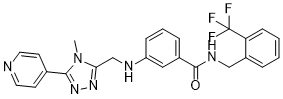
CMPD101 is a novel, potent and selective inhibitor of G-protein coupled receptor kinase 2 and 3 (GRK2/GRK3) with IC50 values of 35 and 32 nM for GRK2 and GRK3, respectively. CMPD101 exhibits selectivity for GRK2/3 over GRK1/5 and reduces DAMGO-induced desensitization and internalization of μ-opioid receptors. CMPD101 has been shown to potentiate phosphatidylinositol 4,5-bisphosphate (PIP2) depletion and slow agonist-induced desensitization of protease-activated receptor 2 (PAR2).
Physicochemical Properties
| Molecular Formula | C24H21F3N6O |
| Molecular Weight | 466.458354711533 |
| Exact Mass | 466.172 |
| Elemental Analysis | C, 61.80; H, 4.54; F, 12.22; N, 18.02; O, 3.43 |
| CAS # | 865608-11-3 |
| PubChem CID | 11677079 |
| Appearance | White to off-white solid powder |
| Density | 1.3±0.1 g/cm3 |
| Index of Refraction | 1.622 |
| LogP | 3.3 |
| Hydrogen Bond Donor Count | 2 |
| Hydrogen Bond Acceptor Count | 8 |
| Rotatable Bond Count | 7 |
| Heavy Atom Count | 34 |
| Complexity | 659 |
| Defined Atom Stereocenter Count | 0 |
| SMILES | O=C(C1C=C(NCC2N(C)C(C3C=CN=CC=3)=NN=2)C=CC=1)NCC1C(C(F)(F)F)=CC=CC=1 |
| InChi Key | WFOVEDJTASPCIR-UHFFFAOYSA-N |
| InChi Code | InChI=1S/C24H21F3N6O/c1-33-21(31-32-22(33)16-9-11-28-12-10-16)15-29-19-7-4-6-17(13-19)23(34)30-14-18-5-2-3-8-20(18)24(25,26)27/h2-13,29H,14-15H2,1H3,(H,30,34) |
| Chemical Name | 3-[[[4-Methyl-5-(4-pyridinyl)-4H-1,2,4-triazol-3-yl]methyl]amino]-N-[[2-(trifluoromethyl)phenyl]methyl]benzamide |
| Synonyms | Takeda101; CMPD101; Takeda-101; Takeda 101; CMPD 101; CMPD-101. |
| HS Tariff Code | 2934.99.9001 |
| Storage |
Powder-20°C 3 years 4°C 2 years In solvent -80°C 6 months -20°C 1 month |
| Shipping Condition | Room temperature (This product is stable at ambient temperature for a few days during ordinary shipping and time spent in Customs) |
Biological Activity
| ln Vitro | The HEK-B2 cell line's plasma membrane retains the β2AR-GFP protein fusion while CMPD101 (100 μM; first 20 min) inhibits the internalization of β2AR and significantly lowers the formation of protein-coated vesicles induced by isopropanol inducer. CMPD101 (3-30 μM; first 30 min) produces strong Ser375 phosphorylation, which is partially inhibited by 3 μM Cmpd101 for 30 min. 30 μM Cmpd101 totally replenishes cell death. 1]. prevents MOPr from being phosphorylated on the residues of Thr370, Thr376, and Thr379 [2]. CMPD101 (3-30 μM; 30 min ago) elicits baseline ERK1/2 phosphorylation in HEK 293 cells expressing HA-MOPrs Already added, however DAMGO-induced ERK1/2 and Elk-1 activation is unaffected by the compound[2]. |
| Cell Assay |
Western Blot Analysis[2] Cell Types: HEK 293 cells stably expressing HA-tagged rat MOPr Tested Concentrations: 3 μM, 30 μM Incubation Duration: 30 minutes ago Experimental Results: No effect on DAMGO-induced p-ERK1/2 and p- Elk-1 expression. |
| References |
[1]. Design, Synthesis, and Evaluation of the Highly Selective and Potent G-Protein-Coupled Receptor Kinase 2 (GRK2) Inhibitor for the Potential Treatment of Heart Failure. J Med Chem. 2017 Aug 24;60(16):6942-6990. [2]. Inhibition of prostatic smooth muscle contraction by the inhibitor of G protein-coupled receptor kinase 2/3, CMPD101.Eur J Pharmacol. 2018 Jul 15;831:9-19. |
Solubility Data
| Solubility (In Vitro) | DMSO : ~250 mg/mL (~535.95 mM) |
| Solubility (In Vivo) |
Solubility in Formulation 1: ≥ 2.08 mg/mL (4.46 mM) (saturation unknown) in 10% DMSO + 40% PEG300 + 5% Tween80 + 45% Saline (add these co-solvents sequentially from left to right, and one by one), clear solution. For example, if 1 mL of working solution is to be prepared, you can add 100 μL of 20.8 mg/mL clear DMSO stock solution to 400 μL PEG300 and mix evenly; then add 50 μL Tween-80 to the above solution and mix evenly; then add 450 μL normal saline to adjust the volume to 1 mL. Preparation of saline: Dissolve 0.9 g of sodium chloride in 100 mL ddH₂ O to obtain a clear solution. Solubility in Formulation 2: ≥ 2.08 mg/mL (4.46 mM) (saturation unknown) in 10% DMSO + 90% (20% SBE-β-CD in Saline) (add these co-solvents sequentially from left to right, and one by one), clear solution. For example, if 1 mL of working solution is to be prepared, you can add 100 μL of 20.8 mg/mL clear DMSO stock solution to 900 μL of 20% SBE-β-CD physiological saline solution and mix evenly. Preparation of 20% SBE-β-CD in Saline (4°C,1 week): Dissolve 2 g SBE-β-CD in 10 mL saline to obtain a clear solution. Solubility in Formulation 3: ≥ 2.08 mg/mL (4.46 mM) (saturation unknown) in 10% DMSO + 90% Corn Oil (add these co-solvents sequentially from left to right, and one by one), clear solution. For example, if 1 mL of working solution is to be prepared, you can add 100 μL of 20.8 mg/mL clear DMSO stock solution to 900 μL of corn oil and mix evenly. (Please use freshly prepared in vivo formulations for optimal results.) |
| Preparing Stock Solutions | 1 mg | 5 mg | 10 mg | |
| 1 mM | 2.1438 mL | 10.7190 mL | 21.4381 mL | |
| 5 mM | 0.4288 mL | 2.1438 mL | 4.2876 mL | |
| 10 mM | 0.2144 mL | 1.0719 mL | 2.1438 mL |