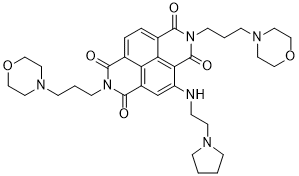
CM03 is a potent inhibitor of cell growth in PDAC cell lines, and has anticancer activity in PDAC models, with a superior profile compared to gemcitabine, a commonly used therapy. Whole-transcriptome RNA-seq methodology has been used to analyze the effects of this quadruplexbinding small molecule on global gene expression. This has revealed the down-regulation of a large number of genes, rich in putative quadruplex elements and involved in essential pathways of PDAC survival, metastasis, and drug resistance. The changes produced by CM03 represent a global response to the complexity of human PDAC and may be applicable to other currently hard-to-treat cancers.
Physicochemical Properties
| Molecular Formula | C34H44N6O6 |
| Molecular Weight | 632.749768257141 |
| Exact Mass | 632.332 |
| Elemental Analysis | C, 64.54; H, 7.01; N, 13.28; O, 15.17 |
| CAS # | 2101208-44-8 |
| Related CAS # | 2101208-44-8;2101208-52-8 (HCl);2101208-53-9 (2HCl);2101208-54-0 (3HCl); |
| PubChem CID | 137203116 |
| Appearance | Brown to dark brown solid powder |
| LogP | -0.5 |
| Hydrogen Bond Donor Count | 1 |
| Hydrogen Bond Acceptor Count | 10 |
| Rotatable Bond Count | 11 |
| Heavy Atom Count | 46 |
| Complexity | 1460 |
| Defined Atom Stereocenter Count | 0 |
| InChi Key | 2,7-bis(3-morpholinopropyl)-4-((2-(pyrrolidin-1-yl)ethyl)amino)benzo[lmn][3,8]phenanthroline-1,3,6,8(2H,7H)-tetraone |
| InChi Code | KCCGFZWBVFNFGW-UHFFFAOYSA-N |
| Chemical Name | CM03 CM-03 CM 03. |
| Synonyms | CM03; 2101208-44-8; Benzo[lmn][3,8]phenanthroline-1,3,6,8(2H,7H)-tetrone, 2,7-bis[3-(4-morpholinyl)propyl]-4-[[2-(1-pyrrolidinyl)ethyl]amino]-; orb1703590; CHEMBL4103012; SCHEMBL18987065; SCHEMBL29370010; DTXSID601105328; |
| HS Tariff Code | 2934.99.9001 |
| Storage |
Powder-20°C 3 years 4°C 2 years In solvent -80°C 6 months -20°C 1 month |
| Shipping Condition | Room temperature (This product is stable at ambient temperature for a few days during ordinary shipping and time spent in Customs) |
Biological Activity
| Targets | G - quadruplex (G4) [1] |
| ln Vitro |
- Anti - proliferative Activity: CM03 shows high anti - proliferative activity against pancreatic cancer cell lines. The GI50 values are 9.0 nM, 15.6 nM, 26.5 nM and 15.5 nM in Mia Paca - 2, Panc - 1, Capan - 1 and BxPC - 3 cells respectively [1] - Synergistic Effect with SAHA: CM03 and the histone deacetylase (HDAC) inhibitor SAHA have synergistic effects at concentrations close to and below their individual GI50 values in both gemcitabine - sensitive and resistant pancreatic cancer cell lines. Immunoblot analysis shows that the combination treatment can increase the levels of γ - H2AX and cleaved PARP proteins, indicating an increase in DNA damage (double - strand break events) and apoptosis induction [1] - Mechanism of Action: CM03 can stabilize G4, down - regulate more G4 - containing genes, and increase the occurrence of double - strand break events due to the torsional strain on DNA and chromatin structure [1] γ-H2AX protein levels are increased in MIA PaCa-2 and PANC-1 upon binding of CM03 (0.4 μM; 24 or 48 hours) to SAHA [1]. High anti-proliferative action against pancreatic cancer cell lines is demonstrated by CM03 (0-100 nM; 96 h) [2]. |
| Cell Assay |
Western Blot Analysis[1] Cell Types: MIA PaCa-2 and PANC-1 Tested Concentrations: 0.4 μM Incubation Duration: 24 hrs (hours) for MIA PaCa-2 and 48 hrs (hours) for PANC-1 Experimental Results: γ-H2AX protein levels Dramatically increased with SAHA (1 μM) combination. Cell proliferation assay[2] Cell Types: MIA PaCa-2, PANC-1, Capan-1 and BxPC-3 Tested Concentrations: 0-100 nM Incubation Duration: 96 hrs (hours) Experimental Results: MIA exhibits high anti-proliferative activity against pancreatic cancer cell lines The GI50s of PaCa-2, PANC-1, Capan-1 and BxPC-3 are 9.0 nM, 15.6 nM, 26.5 nM and 15.5 nM respectively. - Proliferation Inhibition Assay: Culture Mia Paca - 2, Panc - 1, Capan - 1 and BxPC - 3 pancreatic cancer cell lines, add different concentrations of CM03 to the culture medium, and incubate for 96 h. Then use the sulforhodamine B (SRB) cytotoxicity assay to detect the proliferation of cancer cells, so as to evaluate the anti - proliferative activity of CM03 [1] - Immunoblot Analysis: Culture pancreatic cancer cell lines, treat them with CM03 and SAHA alone or in combination. After a certain period of incubation, extract cell proteins, and use immunoblotting to detect the levels of γ - H2AX and cleaved PARP proteins to evaluate the degree of DNA damage and apoptosis induction [1] |
| References |
[1]. A G-Quadruplex-Binding Small Molecule and the HDAC Inhibitor SAHA (Vorinostat) Act Synergistically in Gemcitabine-Sensitive and Resistant Pancreatic Cancer Cells. Molecules. 2020 Nov 19;25(22):5407. [2]. Asymmetrically Substituted Quadruplex-Binding Naphthalene Diimide Showing Potent Activity in Pancreatic Cancer Models. ACS Med Chem Lett. 2020 Jul 16;11(8):1634-1644. |
| Additional Infomation |
- Mechanism of Synergy: SAHA relaxes condensed chromatin, resulting in a higher level of G4 formation. In turn, CM03 can stabilize more G4s, leading to the down - regulation of more G4 - containing genes and a higher incidence of double - strand breaks due to torsional strain on DNA and chromatin structure [1] |
Solubility Data
| Solubility (In Vitro) | DMSO : ~2 mg/mL (~3.16 mM) |
| Solubility (In Vivo) |
Note: Listed below are some common formulations that may be used to formulate products with low water solubility (e.g. < 1 mg/mL), you may test these formulations using a minute amount of products to avoid loss of samples. Injection Formulations (e.g. IP/IV/IM/SC) Injection Formulation 1: DMSO : Tween 80: Saline = 10 : 5 : 85 (i.e. 100 μL DMSO stock solution → 50 μL Tween 80 → 850 μL Saline) *Preparation of saline: Dissolve 0.9 g of sodium chloride in 100 mL ddH ₂ O to obtain a clear solution. Injection Formulation 2: DMSO : PEG300 :Tween 80 : Saline = 10 : 40 : 5 : 45 (i.e. 100 μL DMSO → 400 μLPEG300 → 50 μL Tween 80 → 450 μL Saline) Injection Formulation 3: DMSO : Corn oil = 10 : 90 (i.e. 100 μL DMSO → 900 μL Corn oil) Example: Take the Injection Formulation 3 (DMSO : Corn oil = 10 : 90) as an example, if 1 mL of 2.5 mg/mL working solution is to be prepared, you can take 100 μL 25 mg/mL DMSO stock solution and add to 900 μL corn oil, mix well to obtain a clear or suspension solution (2.5 mg/mL, ready for use in animals). Injection Formulation 4: DMSO : 20% SBE-β-CD in saline = 10 : 90 [i.e. 100 μL DMSO → 900 μL (20% SBE-β-CD in saline)] *Preparation of 20% SBE-β-CD in Saline (4°C,1 week): Dissolve 2 g SBE-β-CD in 10 mL saline to obtain a clear solution. Injection Formulation 5: 2-Hydroxypropyl-β-cyclodextrin : Saline = 50 : 50 (i.e. 500 μL 2-Hydroxypropyl-β-cyclodextrin → 500 μL Saline) Injection Formulation 6: DMSO : PEG300 : castor oil : Saline = 5 : 10 : 20 : 65 (i.e. 50 μL DMSO → 100 μLPEG300 → 200 μL castor oil → 650 μL Saline) Injection Formulation 7: Ethanol : Cremophor : Saline = 10: 10 : 80 (i.e. 100 μL Ethanol → 100 μL Cremophor → 800 μL Saline) Injection Formulation 8: Dissolve in Cremophor/Ethanol (50 : 50), then diluted by Saline Injection Formulation 9: EtOH : Corn oil = 10 : 90 (i.e. 100 μL EtOH → 900 μL Corn oil) Injection Formulation 10: EtOH : PEG300:Tween 80 : Saline = 10 : 40 : 5 : 45 (i.e. 100 μL EtOH → 400 μLPEG300 → 50 μL Tween 80 → 450 μL Saline) Oral Formulations Oral Formulation 1: Suspend in 0.5% CMC Na (carboxymethylcellulose sodium) Oral Formulation 2: Suspend in 0.5% Carboxymethyl cellulose Example: Take the Oral Formulation 1 (Suspend in 0.5% CMC Na) as an example, if 100 mL of 2.5 mg/mL working solution is to be prepared, you can first prepare 0.5% CMC Na solution by measuring 0.5 g CMC Na and dissolve it in 100 mL ddH2O to obtain a clear solution; then add 250 mg of the product to 100 mL 0.5% CMC Na solution, to make the suspension solution (2.5 mg/mL, ready for use in animals). Oral Formulation 3: Dissolved in PEG400 Oral Formulation 4: Suspend in 0.2% Carboxymethyl cellulose Oral Formulation 5: Dissolve in 0.25% Tween 80 and 0.5% Carboxymethyl cellulose Oral Formulation 6: Mixing with food powders Note: Please be aware that the above formulations are for reference only. InvivoChem strongly recommends customers to read literature methods/protocols carefully before determining which formulation you should use for in vivo studies, as different compounds have different solubility properties and have to be formulated differently. (Please use freshly prepared in vivo formulations for optimal results.) |
| Preparing Stock Solutions | 1 mg | 5 mg | 10 mg | |
| 1 mM | 1.5804 mL | 7.9020 mL | 15.8040 mL | |
| 5 mM | 0.3161 mL | 1.5804 mL | 3.1608 mL | |
| 10 mM | 0.1580 mL | 0.7902 mL | 1.5804 mL |