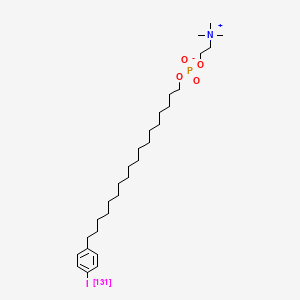
Physicochemical Properties
| Molecular Formula | C29H53INO4P |
| Molecular Weight | 641.6 |
| Exact Mass | 641.27734 |
| CAS # | 873438-88-1 |
| PubChem CID | 16045365 |
| Appearance | Typically exists as solid at room temperature |
| LogP | 9.9 |
| Hydrogen Bond Acceptor Count | 4 |
| Rotatable Bond Count | 24 |
| Heavy Atom Count | 36 |
| Complexity | 542 |
| Defined Atom Stereocenter Count | 0 |
| SMILES | C[N+](C)(C)CCOP(=O)([O-])OCCCCCCCCCCCCCCCCCCC1=CC=C(C=C1)[131I] |
| InChi Key | ZOAIEFWMQLYMTF-YRKXUXMHSA-N |
| InChi Code | InChI=1S/C29H53INO4P/c1-31(2,3)25-27-35-36(32,33)34-26-19-17-15-13-11-9-7-5-4-6-8-10-12-14-16-18-20-28-21-23-29(30)24-22-28/h21-24H,4-20,25-27H2,1-3H3/i30+4 |
| Chemical Name | 18-(4-(131I)iodanylphenyl)octadecyl 2-(trimethylazaniumyl)ethyl phosphate |
| Synonyms | I-131-CLR-1404; CLR-131; NM-404 I-131; 873438-88-1; 131I-NM-404; IOPOFOSINE I-131; Iopofosine I 131 [USAN]; UNII-R048696O9L; CLR 131; CLR-131; 131I-NM-404 |
| HS Tariff Code | 2934.99.9001 |
| Storage |
Powder-20°C 3 years 4°C 2 years In solvent -80°C 6 months -20°C 1 month |
| Shipping Condition | Room temperature (This product is stable at ambient temperature for a few days during ordinary shipping and time spent in Customs) |
Biological Activity
| ln Vitro | Iodine I 131 Iopofosine is a radioconjugate composed of iopofosine, a phospholipid ether analog, labeled with the radioactive isotope iodine I 131, with potential antineoplastic activity. Upon administration, iodine I 131 iopofosine selectively accumulates in and retains within tumor cells for a prolonged period of time due to the decreased activity of a phospholipase D (PLD) in tumor cells compared to normal cells, thereby delivering cytotoxic radiation specifically to tumor cells. PLD is an enzyme found in the cell membrane of normal cells that degrades phospholipids. |
| References |
[1]. Cancer Biother Radiopharm. 2019 Feb 6;34(1):13–23. [2]. https://pubchem.ncbi.nlm.nih.gov/compound/16045365 |
| Additional Infomation | Introduction: CLR1404 is a theranostic molecular agent that can be radiolabeled with 124I (CLR 124) for positron emission tomography (PET) imaging, or 131I (CLR 131) for single-photon emission computed tomography (SPECT) imaging and targeted radionuclide therapy. This pilot study evaluated a pretreatment dosimetry methodology in a triple-negative breast cancer patient who was uniquely enrolled in both a CLR 124 PET imaging clinical trial and a CLR 131 therapeutic dose escalation clinical trial. Materials and Methods: Three-dimensional PET/CT images were acquired at 1, 3, 24, 48, and 120 h postinjection of 178 MBq CLR 124. One month later, pretherapy 2D whole-body planar images were acquired at 0.25, 5, 24, 48, and 144 h postinjection of 370 MBq CLR 131. Following the therapeutic administration of 1990 MBq CLR 131, 3D SPECT/CT images were acquired at 74, 147, 334, and 505 h postinjection. The therapeutic CLR 131 voxel-level absorbed dose was estimated from PET (RAPID PET) and SPECT (RAPID SPECT) images using a Geant4-based Monte Carlo dosimetry platform called RAPID (Radiopharmaceutical Assessment Platform for Internal Dosimetry), and region of interest (ROI) mean doses were also estimated using the OLINDA/EXM software based on PET (OLINDA PET), SPECT (OLINDA SPECT), and planar (OLINDA planar) images. Results: The RAPID PET and OLINDA PET tracer-predicted ROI mean doses correlated well (m ≥ 0.631, R2 ≥ 0.694, p ≤ 0.01) with both the RAPID SPECT and OLINDA SPECT therapeutic mean doses. The 2D planar images did not have any significant correlations. The ROI mean doses differed by −4% to −43% between RAPID and OLINDA/EXM, and by −19% to 29% between PET and SPECT. The 3D dose distributions and dose volume histograms calculated with RAPID were similar for the PET/CT and SPECT/CT. Conclusions: This pilot study demonstrated that CLR 124 pretreatment PET images can be used to predict CLR 131 3D therapeutic dosimetry better than CLR 131 2D planar images. In addition, unlike OLINDA/EXM, Monte Carlo dosimetry methods were capable of accurately predicting dose heterogeneity, which is important for predicting dose–response relationships and clinical outcomes.[1] |
Solubility Data
| Solubility (In Vitro) | May dissolve in DMSO (in most cases), if not, try other solvents such as H2O, Ethanol, or DMF with a minute amount of products to avoid loss of samples |
| Solubility (In Vivo) |
Note: Listed below are some common formulations that may be used to formulate products with low water solubility (e.g. < 1 mg/mL), you may test these formulations using a minute amount of products to avoid loss of samples. Injection Formulations (e.g. IP/IV/IM/SC) Injection Formulation 1: DMSO : Tween 80: Saline = 10 : 5 : 85 (i.e. 100 μL DMSO stock solution → 50 μL Tween 80 → 850 μL Saline) *Preparation of saline: Dissolve 0.9 g of sodium chloride in 100 mL ddH ₂ O to obtain a clear solution. Injection Formulation 2: DMSO : PEG300 :Tween 80 : Saline = 10 : 40 : 5 : 45 (i.e. 100 μL DMSO → 400 μLPEG300 → 50 μL Tween 80 → 450 μL Saline) Injection Formulation 3: DMSO : Corn oil = 10 : 90 (i.e. 100 μL DMSO → 900 μL Corn oil) Example: Take the Injection Formulation 3 (DMSO : Corn oil = 10 : 90) as an example, if 1 mL of 2.5 mg/mL working solution is to be prepared, you can take 100 μL 25 mg/mL DMSO stock solution and add to 900 μL corn oil, mix well to obtain a clear or suspension solution (2.5 mg/mL, ready for use in animals). Injection Formulation 4: DMSO : 20% SBE-β-CD in saline = 10 : 90 [i.e. 100 μL DMSO → 900 μL (20% SBE-β-CD in saline)] *Preparation of 20% SBE-β-CD in Saline (4°C,1 week): Dissolve 2 g SBE-β-CD in 10 mL saline to obtain a clear solution. Injection Formulation 5: 2-Hydroxypropyl-β-cyclodextrin : Saline = 50 : 50 (i.e. 500 μL 2-Hydroxypropyl-β-cyclodextrin → 500 μL Saline) Injection Formulation 6: DMSO : PEG300 : castor oil : Saline = 5 : 10 : 20 : 65 (i.e. 50 μL DMSO → 100 μLPEG300 → 200 μL castor oil → 650 μL Saline) Injection Formulation 7: Ethanol : Cremophor : Saline = 10: 10 : 80 (i.e. 100 μL Ethanol → 100 μL Cremophor → 800 μL Saline) Injection Formulation 8: Dissolve in Cremophor/Ethanol (50 : 50), then diluted by Saline Injection Formulation 9: EtOH : Corn oil = 10 : 90 (i.e. 100 μL EtOH → 900 μL Corn oil) Injection Formulation 10: EtOH : PEG300:Tween 80 : Saline = 10 : 40 : 5 : 45 (i.e. 100 μL EtOH → 400 μLPEG300 → 50 μL Tween 80 → 450 μL Saline) Oral Formulations Oral Formulation 1: Suspend in 0.5% CMC Na (carboxymethylcellulose sodium) Oral Formulation 2: Suspend in 0.5% Carboxymethyl cellulose Example: Take the Oral Formulation 1 (Suspend in 0.5% CMC Na) as an example, if 100 mL of 2.5 mg/mL working solution is to be prepared, you can first prepare 0.5% CMC Na solution by measuring 0.5 g CMC Na and dissolve it in 100 mL ddH2O to obtain a clear solution; then add 250 mg of the product to 100 mL 0.5% CMC Na solution, to make the suspension solution (2.5 mg/mL, ready for use in animals). Oral Formulation 3: Dissolved in PEG400 Oral Formulation 4: Suspend in 0.2% Carboxymethyl cellulose Oral Formulation 5: Dissolve in 0.25% Tween 80 and 0.5% Carboxymethyl cellulose Oral Formulation 6: Mixing with food powders Note: Please be aware that the above formulations are for reference only. InvivoChem strongly recommends customers to read literature methods/protocols carefully before determining which formulation you should use for in vivo studies, as different compounds have different solubility properties and have to be formulated differently. (Please use freshly prepared in vivo formulations for optimal results.) |
| Preparing Stock Solutions | 1 mg | 5 mg | 10 mg | |
| 1 mM | 1.5586 mL | 7.7930 mL | 15.5860 mL | |
| 5 mM | 0.3117 mL | 1.5586 mL | 3.1172 mL | |
| 10 mM | 0.1559 mL | 0.7793 mL | 1.5586 mL |