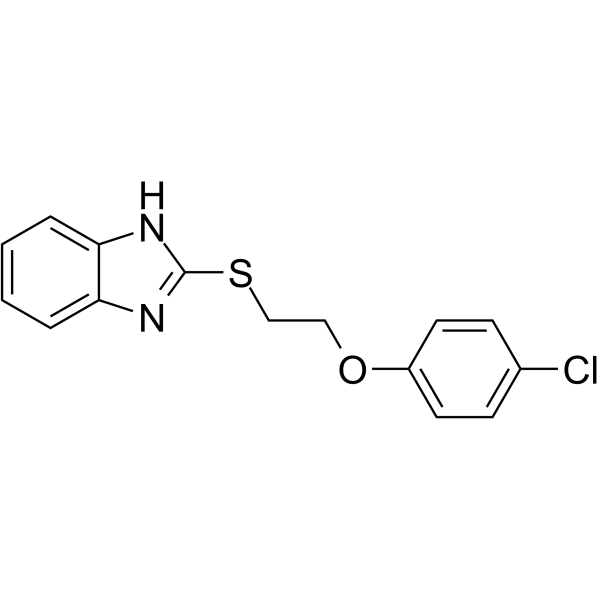
Physicochemical Properties
| Molecular Formula | C15H13CLN2OS |
| Molecular Weight | 304.79 |
| Exact Mass | 304.043 |
| CAS # | 312749-73-8 |
| PubChem CID | 1736098 |
| Appearance | Off-white to brown solid powder |
| Density | 1.4±0.1 g/cm3 |
| Boiling Point | 509.6±56.0 °C at 760 mmHg |
| Flash Point | 262.0±31.8 °C |
| Vapour Pressure | 0.0±1.3 mmHg at 25°C |
| Index of Refraction | 1.693 |
| LogP | 5.08 |
| Hydrogen Bond Donor Count | 1 |
| Hydrogen Bond Acceptor Count | 3 |
| Rotatable Bond Count | 5 |
| Heavy Atom Count | 20 |
| Complexity | 300 |
| Defined Atom Stereocenter Count | 0 |
| InChi Key | KZEWVENYWPSSOZ-UHFFFAOYSA-N |
| InChi Code | InChI=1S/C15H13ClN2OS/c16-11-5-7-12(8-6-11)19-9-10-20-15-17-13-3-1-2-4-14(13)18-15/h1-8H,9-10H2,(H,17,18) |
| Chemical Name | 2-[2-(4-chlorophenoxy)ethylsulfanyl]-1H-benzimidazole |
| HS Tariff Code | 2934.99.9001 |
| Storage |
Powder-20°C 3 years 4°C 2 years In solvent -80°C 6 months -20°C 1 month |
| Shipping Condition | Room temperature (This product is stable at ambient temperature for a few days during ordinary shipping and time spent in Customs) |
Biological Activity
| ln Vitro | Using CHO-K1 cells expressing GPR142 in the aequorin assay and HEK293 cells expressing GPR142 in the SPA assay, CLP-3094 inhibits the increase of intracellular Ca2+ concentration ([Ca2+]i) induced by L-tryptophan. In the aequorin assay, CLP-3094's IC50 values are 0.2 μM for the mouse receptor against 200 μM L-tryptophan and 2.3 μM for the human receptor against 1 mM L-tryptophan. Moreover, CLP-3094 prevents islets from secreting insulin in response to GPR142 and L-tryptophan agonists[2]. |
| ln Vivo | Compared to mice given with a vehicle, CLP-3094 (30, 100 mg/kg; intraperitoneally every day from Day 0 to Day 11) consistently showed significantly reduced arthritis scores[2]. |
| Animal Protocol |
Animal/Disease Models: CAIA mouse model (Female DBA1/J mice were iv administered with2 mg of anti-collagen antibody, followed by ip administration of 50 μg of LPS)[2] Doses: 30, 100 mg/kg Route of Administration: Ip daily from Day 0 to Day 11 Experimental Results: Dose-dependently decreased, by not much, the arth-ritis scores. |
| References |
[1]. Targeting the binding function 3 (BF3) site of the androgen receptor through virtual screening. 2. development of 2-((2-phenoxyethyl) thio)-1H-benzimidazole derivatives. J Med Chem. 2013;56(3):1136-1148. [2]. Discovery and pharmacological effects of a novel GPR142 antagonist. J Recept Signal Transduct Res. 2017;37(3):290-296. |
Solubility Data
| Solubility (In Vitro) | DMSO: 100 mg/mL (328.09 mM) |
| Solubility (In Vivo) |
Solubility in Formulation 1: ≥ 2.5 mg/mL (8.20 mM) (saturation unknown) in 10% DMSO + 40% PEG300 + 5% Tween80 + 45% Saline (add these co-solvents sequentially from left to right, and one by one), clear solution. For example, if 1 mL of working solution is to be prepared, you can add 100 μL of 25.0 mg/mL clear DMSO stock solution to 400 μL PEG300 and mix evenly; then add 50 μL Tween-80 to the above solution and mix evenly; then add 450 μL normal saline to adjust the volume to 1 mL. Preparation of saline: Dissolve 0.9 g of sodium chloride in 100 mL ddH₂ O to obtain a clear solution. Solubility in Formulation 2: ≥ 2.5 mg/mL (8.20 mM) (saturation unknown) in 10% DMSO + 90% Corn Oil (add these co-solvents sequentially from left to right, and one by one), clear solution. For example, if 1 mL of working solution is to be prepared, you can add 100 μL of 25.0 mg/mL clear DMSO stock solution to 900 μL of corn oil and mix evenly. (Please use freshly prepared in vivo formulations for optimal results.) |
| Preparing Stock Solutions | 1 mg | 5 mg | 10 mg | |
| 1 mM | 3.2809 mL | 16.4047 mL | 32.8095 mL | |
| 5 mM | 0.6562 mL | 3.2809 mL | 6.5619 mL | |
| 10 mM | 0.3281 mL | 1.6405 mL | 3.2809 mL |