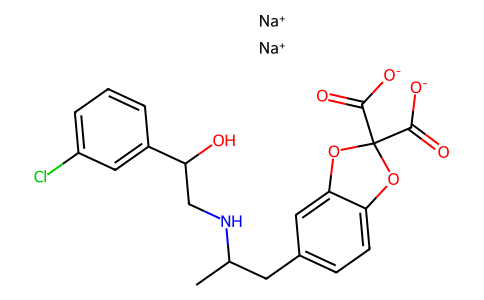
CL-316243 disodium (CL316243) is a novel and potent β3-adrenoceptor agonist with the potential for the treatment obesity, diabetes and urge urinary incontinence. It activates β3-adrenoceptor with a EC50 of 3 nM.
Physicochemical Properties
| Molecular Formula | C20H18CLNNA2O7 |
| Molecular Weight | 465.7935 |
| Exact Mass | 465.057 |
| CAS # | 138908-40-4 |
| PubChem CID | 5312115 |
| Appearance | White to yellow solid powder |
| Boiling Point | 689.5ºC at 760 mmHg |
| Flash Point | 370.8ºC |
| Vapour Pressure | 5.86E-20mmHg at 25°C |
| Hydrogen Bond Donor Count | 2 |
| Hydrogen Bond Acceptor Count | 8 |
| Rotatable Bond Count | 6 |
| Heavy Atom Count | 31 |
| Complexity | 578 |
| Defined Atom Stereocenter Count | 2 |
| SMILES | C[C@H](CC1=CC2=C(C=C1)OC(O2)(C(=O)[O-])C(=O)[O-])NC[C@@H](C3=CC(=CC=C3)Cl)O.[Na+].[Na+] |
| InChi Key | FUZBPOHHSBDTJQ-CFOQQKEYSA-L |
| InChi Code | InChI=1S/C20H20ClNO7.2Na/c1-11(22-10-15(23)13-3-2-4-14(21)9-13)7-12-5-6-16-17(8-12)29-20(28-16,18(24)25)19(26)27;;/h2-6,8-9,11,15,22-23H,7,10H2,1H3,(H,24,25)(H,26,27);;/q;2*+1/p-2/t11-,15+;;/m1../s1 |
| Chemical Name | disodium;5-[(2R)-2-[[(2R)-2-(3-chlorophenyl)-2-hydroxyethyl]amino]propyl]-1,3-benzodioxole-2,2-dicarboxylate |
| Synonyms | CL316243 CL 316243 CL-316243 |
| HS Tariff Code | 2934.99.9001 |
| Storage |
Powder-20°C 3 years 4°C 2 years In solvent -80°C 6 months -20°C 1 month Note: Please store this product in a sealed and protected environment, avoid exposure to moisture. |
| Shipping Condition | Room temperature (This product is stable at ambient temperature for a few days during ordinary shipping and time spent in Customs) |
Biological Activity
| Targets |
|
|
| ln Vitro | Clenidine 316243 has IC50 values of 0.6 μM and 1 μM, respectively, against the rat heart and soleus muscle[1]. Based on concentration-dependent inhibition, CL 316243 prevents 50% of the maximal response from spontaneous contractions in isolated rat detrusor muscle strips at an average dose of 2.65 nM [3]. | |
| ln Vivo | Unaffected by food, CL316243 disodium (subcutaneous injection; 0.1 mg/kg/d; once daily; 1 week) raises BAT's levels of UCP1 mRNA and protein expression [2]. | |
| Animal Protocol |
Animal/Disease Models: Male C57BL/6J mice fed with high-fat diets (HFD; 45%-kcal fat) or a control diet (ND; 10%-kcal fat) for 14 weeks[2] Doses: 0.1 mg/kg/day Route of Administration: one time/day; 1 weeks Experimental Results: demonstrated a premium effect of obesity in mice. |
|
| References |
[1]. Disodium (R,R)-5-[2-[[2-(3-chlorophenyl)-2-hydroxyethyl]-amino] propyl]-1,3-benzodioxole-2,2-dicarboxylate (CL 316,243). A potent beta-adrenergic agonist virtually specific for beta 3 receptors. A promising antidiabetic and antiobesity agent.J Med Chem. 1992 Aug 7;35(16):3081-4. [2]. Impaired adrenergic agonist-dependent beige adipocyte induction in obese mice.J Vet Med Sci. 2019 Jun 6;81(6):799-807. |
Solubility Data
| Solubility (In Vitro) | H2O : ~20 mg/mL (~42.94 mM) |
| Solubility (In Vivo) |
Solubility in Formulation 1: 100 mg/mL (214.69 mM) in PBS (add these co-solvents sequentially from left to right, and one by one), clear solution; with sonication (<60°C). (Please use freshly prepared in vivo formulations for optimal results.) |
| Preparing Stock Solutions | 1 mg | 5 mg | 10 mg | |
| 1 mM | 2.1469 mL | 10.7345 mL | 21.4689 mL | |
| 5 mM | 0.4294 mL | 2.1469 mL | 4.2938 mL | |
| 10 mM | 0.2147 mL | 1.0734 mL | 2.1469 mL |