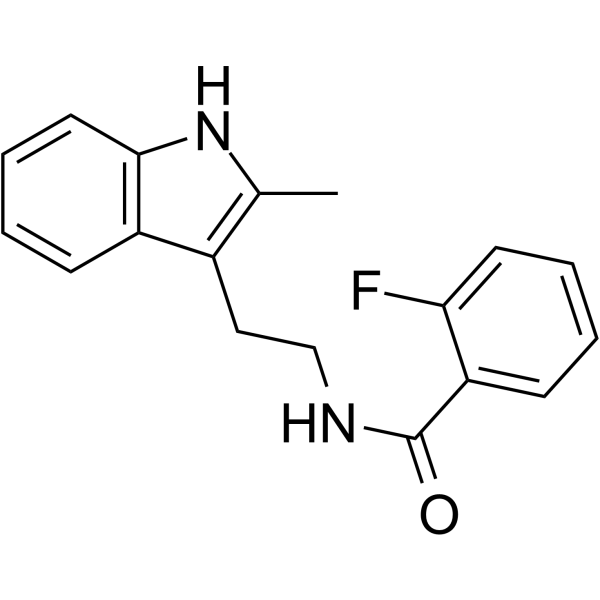
Physicochemical Properties
| Molecular Formula | C18H17FN2O |
| Molecular Weight | 296.338787794113 |
| Exact Mass | 296.132 |
| CAS # | 442633-00-3 |
| PubChem CID | 589075 |
| Appearance | White to off-white solid powder |
| LogP | 4.162 |
| Hydrogen Bond Donor Count | 2 |
| Hydrogen Bond Acceptor Count | 2 |
| Rotatable Bond Count | 4 |
| Heavy Atom Count | 22 |
| Complexity | 389 |
| Defined Atom Stereocenter Count | 0 |
| InChi Key | UXRKUKRXVWJFER-UHFFFAOYSA-N |
| InChi Code | InChI=1S/C18H17FN2O/c1-12-13(14-6-3-5-9-17(14)21-12)10-11-20-18(22)15-7-2-4-8-16(15)19/h2-9,21H,10-11H2,1H3,(H,20,22) |
| Chemical Name | 2-fluoro-N-[2-(2-methyl-1H-indol-3-yl)ethyl]benzamide |
| HS Tariff Code | 2934.99.9001 |
| Storage |
Powder-20°C 3 years 4°C 2 years In solvent -80°C 6 months -20°C 1 month |
| Shipping Condition | Room temperature (This product is stable at ambient temperature for a few days during ordinary shipping and time spent in Customs) |
Biological Activity
| Targets |
The target of CK-666 is the actin-related protein 2/3 (ARP2/3) complex, with an IC50 value of approximately 2 μM for inhibiting ARP2/3-mediated actin polymerization [1] |
| ln Vitro |
Treating trabecular meshwork (TM) cells with CK-666 (100 μM) results in a considerable reduction in the number of filopodia on the surface and a shortening of their length [3]. 1. In the in vitro actin polymerization assay using rabbit skeletal muscle actin, CK-666 dose-dependently inhibited ARP2/3 complex-induced actin nucleation. At a concentration of 2 μM, it significantly reduced the rate and extent of actin polymerization, while higher concentrations (e.g., 10 μM) almost completely blocked this process [1] 2. When tested in HeLa cell extracts, CK-666 (5 μM) inhibited the formation of branched actin networks, which are critical for cell membrane protrusions and intracellular trafficking. Immunofluorescence staining showed a marked decrease in the number of actin branches in the presence of the drug [1] 3. In cell spreading assays, HeLa cells treated with CK-666 (2 μM) exhibited reduced spreading area on fibronectin-coated surfaces compared to untreated cells. The average spreading area was decreased by approximately 40% after 30 minutes of treatment [1] 4. CK-666 (5 μM) also inhibited the formation of lamellipodia in HeLa cells. Time-lapse microscopy revealed that the drug prevented the extension of lamellipodial protrusions, which are dependent on ARP2/3-mediated branched actin [1] |
| Enzyme Assay |
For the ARP2/3 complex activity assay: First, rabbit skeletal muscle actin was purified and labeled with pyrene. Then, the reaction mixture was prepared, containing a fixed concentration of ARP2/3 complex, actin (with pyrene labeling), and a saturating concentration of the ARP2/3 activator (e.g., WASP-VCA domain). Different concentrations of CK-666 (ranging from 0.1 μM to 20 μM) were added to the reaction mixture. The mixture was incubated at 25°C, and the fluorescence intensity of pyrene-actin was monitored over time using a fluorescence spectrophotometer. The rate of actin polymerization was calculated based on the increase in fluorescence intensity, and the IC50 value of CK-666 for inhibiting ARP2/3 activity was determined from the dose-response curve [1] |
| Cell Assay |
1. HeLa cell spreading assay: HeLa cells were first trypsinized and resuspended in serum-free medium. Then, the cells were treated with CK-666 (at concentrations of 0 μM, 2 μM, 5 μM, and 10 μM) for 10 minutes. Next, the treated cells were seeded onto fibronectin-coated coverslips and incubated at 37°C in a CO2 incubator. At different time points (15 minutes, 30 minutes, and 60 minutes), the cells were fixed with 4% paraformaldehyde, permeabilized with 0.1% Triton X-100, and stained with phalloidin (to label actin filaments) and DAPI (to label nuclei). The coverslips were mounted, and the cells were imaged using a fluorescence microscope. The spreading area of each cell was measured using image analysis software, and the average spreading area was calculated for each treatment group [1] 2. Lamellipodia formation assay: HeLa cells were grown on coverslips until they reached 50% confluence. The medium was replaced with serum-free medium containing CK-666 (0 μM, 2 μM, 5 μM) or DMSO (as a control), and the cells were incubated for 30 minutes. Then, the cells were stimulated with epidermal growth factor (EGF) to induce lamellipodia formation and further incubated for 15 minutes. The cells were fixed, permeabilized, and stained with phalloidin and DAPI. The number of cells with lamellipodia was counted under a fluorescence microscope, and the percentage of lamellipodia-positive cells was calculated for each group [1] |
| References |
[1]. Small molecules CK-666 and CK-869 inhibit actin-related protein 2/3 complex by blocking an activating conformational change. Chem Biol. 2013 May 23;20(5):701-12. [2]. Dendritic Cell Maturation Regulates TSPAN7 Function in HIV-1 Transfer to CD4+ T Lymphocytes. Front Cell Infect Microbiol. 2020 Feb 28;10:70. |
| Additional Infomation |
CK-666 is a member of the class of indoles that is 2-methyltryptamine in which a hydrogen attached to the primary amino group has been replaced by a 2-fluorobenzoyl group. It is a cell-permeable inhibitor of actin assembly mediated by actin-related protein Arp2/3 complex which works by binding to Arp2/3 complex, stabilising the inactive state of the complex and preventing its movement into the active conformation. It has a role as an actin polymerisation inhibitor. It is a member of indoles, an organofluorine compound and a member of benzamides. 1. CK-666 exerts its inhibitory effect on the ARP2/3 complex by blocking an activating conformational change of the complex. The ARP2/3 complex requires a conformational change induced by activators (such as WASP family proteins) to become competent for actin nucleation, and CK-666 binds to the complex and prevents this essential conformational shift [1] 2. The ARP2/3 complex plays a key role in various cellular processes, including cell migration, endocytosis, and cytokinesis. By inhibiting this complex, CK-666 serves as a useful tool to study the biological functions of ARP2/3-mediated actin dynamics in vitro [1] |
Solubility Data
| Solubility (In Vitro) | DMSO : ~125 mg/mL (~421.81 mM) |
| Solubility (In Vivo) |
Solubility in Formulation 1: ≥ 12.5 mg/mL (42.18 mM) (saturation unknown) in 10% DMSO + 40% PEG300 + 5% Tween80 + 45% Saline (add these co-solvents sequentially from left to right, and one by one), clear solution. For example, if 1 mL of working solution is to be prepared, you can add 100 μL of 125.0 mg/mL clear DMSO stock solution to 400 μL of PEG300 and mix evenly; then add 50 μL of Tween-80 to the above solution and mix evenly; then add 450 μL of normal saline to adjust the volume to 1 mL. Preparation of saline: Dissolve 0.9 g of sodium chloride in 100 mL ddH₂ O to obtain a clear solution. Solubility in Formulation 2: ≥ 12.5 mg/mL (42.18 mM) (saturation unknown) in 10% DMSO + 90% (20% SBE-β-CD in Saline) (add these co-solvents sequentially from left to right, and one by one), clear solution. For example, if 1 mL of working solution is to be prepared, you can add 100 μL of 125.0 mg/mL clear DMSO stock solution to 900 μL of 20% SBE-β-CD physiological saline solution and mix evenly. Preparation of 20% SBE-β-CD in Saline (4°C,1 week): Dissolve 2 g SBE-β-CD in 10 mL saline to obtain a clear solution. Solubility in Formulation 3: ≥ 12.5 mg/mL (42.18 mM) (saturation unknown) in 10% DMSO + 90% Corn Oil (add these co-solvents sequentially from left to right, and one by one), clear solution. For example, if 1 mL of working solution is to be prepared, you can add 100 μL of 125.0 mg/mL clear DMSO stock solution to 900 μL of corn oil and mix evenly. (Please use freshly prepared in vivo formulations for optimal results.) |
| Preparing Stock Solutions | 1 mg | 5 mg | 10 mg | |
| 1 mM | 3.3745 mL | 16.8725 mL | 33.7450 mL | |
| 5 mM | 0.6749 mL | 3.3745 mL | 6.7490 mL | |
| 10 mM | 0.3375 mL | 1.6873 mL | 3.3745 mL |