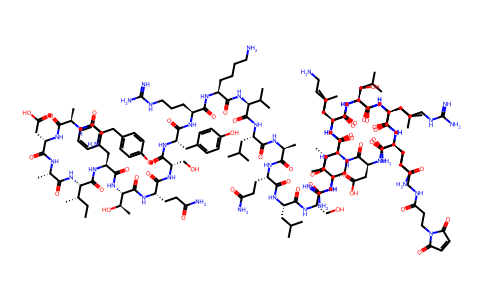
Physicochemical Properties
| Molecular Formula | C165H269N47O46 |
| Molecular Weight | 3647.28 |
| Exact Mass | 3646.019 |
| CAS # | 446262-90-4 |
| PubChem CID | 91971820 |
| Sequence | Tyr-D-Ala-Asp-Ala-Ile-Phe-Thr-Gln-Ser-Tyr-Arg-Lys-Val-Leu-Ala-Gln-Leu-Ser-Ala-Arg- Lys-Leu-Leu-Gln-Asp-Ile-Leu-Ser-Arg-Lys(Maleimidopropionyl)-NH2 |
| Appearance | White powder |
| LogP | -11.7 |
| Hydrogen Bond Donor Count | 54 |
| Hydrogen Bond Acceptor Count | 52 |
| Rotatable Bond Count | 128 |
| Heavy Atom Count | 258 |
| Complexity | 8580 |
| Defined Atom Stereocenter Count | 33 |
| SMILES | CC[C@H](C)[C@@H](C(=O)N[C@@H](CC1=CC=CC=C1)C(=O)N[C@@H]([C@@H](C)O)C(=O)N[C@@H](CCC(=O)N)C(=O)N[C@@H](CO)C(=O)N[C@@H](CC2=CC=C(C=C2)O)C(=O)N[C@@H](CCCNC(=N)N)C(=O)N[C@@H](CCCCN)C(=O)N[C@@H](C(C)C)C(=O)N[C@@H](CC(C)C)C(=O)N[C@@H](C)C(=O)N[C@@H](CCC(=O)N)C(=O)N[C@@H](CC(C)C)C(=O)N[C@@H](CO)C(=O)N[C@@H](C)C(=O)N[C@@H](CCCNC(=N)N)C(=O)N[C@@H](CCCCN)C(=O)N[C@@H](CC(C)C)C(=O)N[C@@H](CC(C)C)C(=O)N[C@@H](CCC(=O)N)C(=O)N[C@@H](CC(=O)O)C(=O)N[C@@H]([C@@H](C)CC)C(=O)N[C@@H](CC(C)C)C(=O)N[C@@H](CO)C(=O)N[C@@H](CCCNC(=N)N)C(=O)N[C@@H](CCCCNC(=O)CCN3C(=O)C=CC3=O)C(=O)N)NC(=O)[C@H](C)NC(=O)[C@H](CC(=O)O)NC(=O)[C@@H](C)NC(=O)[C@H](CC4=CC=C(C=C4)O)N |
| InChi Key | ZUQGTWKGESAQCD-ZGFIGYLBSA-N |
| InChi Code | InChI=1S/C165H269N47O46/c1-22-87(15)130(209-137(233)92(20)185-148(244)116(76-127(225)226)196-136(232)89(17)183-138(234)99(168)73-95-44-48-97(217)49-45-95)160(256)204-115(74-94-36-25-24-26-37-94)154(250)211-132(93(21)216)162(258)195-108(54-57-123(171)221)145(241)205-120(80-215)158(254)200-114(75-96-46-50-98(218)51-47-96)153(249)192-105(43-35-66-182-165(177)178)141(237)191-102(40-28-31-62-167)146(242)208-129(86(13)14)159(255)202-109(68-81(3)4)147(243)184-90(18)135(231)189-106(52-55-121(169)219)143(239)198-112(71-84(9)10)151(247)206-118(78-213)156(252)186-91(19)134(230)188-103(41-33-64-180-163(173)174)140(236)190-101(39-27-30-61-166)142(238)197-111(70-83(7)8)150(246)199-110(69-82(5)6)149(245)194-107(53-56-122(170)220)144(240)201-117(77-128(227)228)155(251)210-131(88(16)23-2)161(257)203-113(72-85(11)12)152(248)207-119(79-214)157(253)193-104(42-34-65-181-164(175)176)139(235)187-100(133(172)229)38-29-32-63-179-124(222)60-67-212-125(223)58-59-126(212)224/h24-26,36-37,44-51,58-59,81-93,99-120,129-132,213-218H,22-23,27-35,38-43,52-57,60-80,166-168H2,1-21H3,(H2,169,219)(H2,170,220)(H2,171,221)(H2,172,229)(H,179,222)(H,183,234)(H,184,243)(H,185,244)(H,186,252)(H,187,235)(H,188,230)(H,189,231)(H,190,236)(H,191,237)(H,192,249)(H,193,253)(H,194,245)(H,195,258)(H,196,232)(H,197,238)(H,198,239)(H,199,246)(H,200,254)(H,201,240)(H,202,255)(H,203,257)(H,204,256)(H,205,241)(H,206,247)(H,207,248)(H,208,242)(H,209,233)(H,210,251)(H,211,250)(H,225,226)(H,227,228)(H4,173,174,180)(H4,175,176,181)(H4,177,178,182)/t87-,88-,89+,90-,91-,92-,93+,99-,100-,101-,102-,103-,104-,105-,106-,107-,108-,109-,110-,111-,112-,113-,114-,115-,116-,117-,118-,119-,120-,129-,130-,131-,132-/m0/s1 |
| Chemical Name | (3S)-4-[[(2S)-1-[[(2S,3S)-1-[[(2S)-1-[[(2S,3R)-1-[[(2S)-5-amino-1-[[(2S)-1-[[(2S)-1-[[(2S)-1-[[(2S)-6-amino-1-[[(2S)-1-[[(2S)-1-[[(2S)-1-[[(2S)-5-amino-1-[[(2S)-1-[[(2S)-1-[[(2S)-1-[[(2S)-1-[[(2S)-6-amino-1-[[(2S)-1-[[(2S)-1-[[(2S)-5-amino-1-[[(2S)-1-[[(2S,3S)-1-[[(2S)-1-[[(2S)-1-[[(2S)-1-[[(2S)-1-amino-6-[3-(2,5-dioxopyrrol-1-yl)propanoylamino]-1-oxohexan-2-yl]amino]-5-carbamimidamido-1-oxopentan-2-yl]amino]-3-hydroxy-1-oxopropan-2-yl]amino]-4-methyl-1-oxopentan-2-yl]amino]-3-methyl-1-oxopentan-2-yl]amino]-3-carboxy-1-oxopropan-2-yl]amino]-1,5-dioxopentan-2-yl]amino]-4-methyl-1-oxopentan-2-yl]amino]-4-methyl-1-oxopentan-2-yl]amino]-1-oxohexan-2-yl]amino]-5-carbamimidamido-1-oxopentan-2-yl]amino]-1-oxopropan-2-yl]amino]-3-hydroxy-1-oxopropan-2-yl]amino]-4-methyl-1-oxopentan-2-yl]amino]-1,5-dioxopentan-2-yl]amino]-1-oxopropan-2-yl]amino]-4-methyl-1-oxopentan-2-yl]amino]-3-methyl-1-oxobutan-2-yl]amino]-1-oxohexan-2-yl]amino]-5-carbamimidamido-1-oxopentan-2-yl]amino]-3-(4-hydroxyphenyl)-1-oxopropan-2-yl]amino]-3-hydroxy-1-oxopropan-2-yl]amino]-1,5-dioxopentan-2-yl]amino]-3-hydroxy-1-oxobutan-2-yl]amino]-1-oxo-3-phenylpropan-2-yl]amino]-3-methyl-1-oxopentan-2-yl]amino]-1-oxopropan-2-yl]amino]-3-[[(2R)-2-[[(2S)-2-amino-3-(4-hydroxyphenyl)propanoyl]amino]propanoyl]amino]-4-oxobutanoic acid |
| Synonyms | CJC-1295 With DAC; CID 91971820 |
| HS Tariff Code | 2934.99.9001 |
| Storage |
Powder-20°C 3 years 4°C 2 years In solvent -80°C 6 months -20°C 1 month |
| Shipping Condition | Room temperature (This product is stable at ambient temperature for a few days during ordinary shipping and time spent in Customs) |
Biological Activity
| ln Vivo | CJC-1295 With DAC is a 30 amino acid peptide-based drug that stimulates the release of growth hormone (GH) from the pituitary gland. It is unique among performance-enhancing peptides due to the presence of a reactive maleimidopropionic acid group that covalently links the peptide to free thiols on the surface of plasma proteins. Once conjugated, CJC-1295 With DAC remains active in the bloodstream for significantly longer than non-conjugated peptide-based drugs that are rapidly excreted. Conjugation of CJC-1295 With DAC to plasma proteins prevents its detection by top-down mass-spectrometry-based peptide screening protocols as it effectively becomes a macromolecular protein with an undefined molecular weight. Using a pair of monoclonal antibodies raised against the CJC-1295 With DAC peptide, we present an immuno-polymerase chain reaction (I-PCR) assay that is capable of detecting the CJC-1295 With DAC-protein conjugate at concentrations down to 0.8 pg/mL. Detection of endogenous equine GHRH necessitated a screening threshold for CJC-1295 With DAC in equine plasma of 50 pg/mL. The effectiveness of the assay for controlling the illicit use of CJC-1295 With DAC was confirmed in equine blood samples after administration in thoroughbred race horses [1]. |
| References | [1]. An immuno polymerase chain reaction screen for the detection of CJC-1295 With DAC and other growth-hormone-releasing hormone analogs in equine plasma. Drug Test Anal. 2019 Jun;11(6):804-812. |
| Additional Infomation | Background: Communal online folk pharmacology fuels the drive for short cuts in attaining muscle enhancement, fat loss, and youthful skin. Objectives: The study used "netnography" to explore female use of CJC-1295 With DAC, a synthetic growth hormone analogue from the perspectives contained in Internet forum activity. Methods: A systematic Internet search was conducted using variation of the term "CJC-1295 With DAC"; and combined with "forum." Ninety-six hits related to bodybuilding websites where CJC-1295 With DAC was mentioned. Following application of exclusion criteria to confine to female use and evidence of forum activity, 9 sites remained. These were searched internally for reference to CJC-1295 With DAC. Twenty-three discussion threads relating to female use of CJC-1295 With DAC formed the end data set, and analyzed using the Empirical Phenomenological Psychological method. Results: Forum users appeared well versed and experienced in the poly use of performance and image drug supplementation. Choice to use CJC-1295 With DAC centered on weight loss, muscle enhancement, youthful skin, improved sleep, and injury healing. Concerns were described relating to female consequences of use given gender variations in growth hormone pulses affecting estimation of dosage, cycling, and long-term consequences. Conclusions: Public health interventions should consider female self-medicating use of synthetic growth hormone within a repertoire of product supplementation, and related adverse health consequences.[Subst Use Misuse . 2016 Jan 2;51(1):73-84] |
Solubility Data
| Solubility (In Vitro) | May dissolve in DMSO (in most cases), if not, try other solvents such as H2O, Ethanol, or DMF with a minute amount of products to avoid loss of samples |
| Solubility (In Vivo) |
Note: Listed below are some common formulations that may be used to formulate products with low water solubility (e.g. < 1 mg/mL), you may test these formulations using a minute amount of products to avoid loss of samples. Injection Formulations (e.g. IP/IV/IM/SC)Injection Formulation 1: DMSO : Tween 80: Saline = 10 : 5 : 85 (i.e. 100 μL DMSO stock solution → 50 μL Tween 80 → 850 μL Saline) *Preparation of saline: Dissolve 0.9 g of sodium chloride in 100 mL ddH ₂ O to obtain a clear solution. Injection Formulation 2: DMSO : PEG300 :Tween 80 : Saline = 10 : 40 : 5 : 45 (i.e. 100 μL DMSO → 400 μLPEG300 → 50 μL Tween 80 → 450 μL Saline) Injection Formulation 3: DMSO : Corn oil = 10 : 90 (i.e. 100 μL DMSO → 900 μL Corn oil) Example: Take the Injection Formulation 3 (DMSO : Corn oil = 10 : 90) as an example, if 1 mL of 2.5 mg/mL working solution is to be prepared, you can take 100 μL 25 mg/mL DMSO stock solution and add to 900 μL corn oil, mix well to obtain a clear or suspension solution (2.5 mg/mL, ready for use in animals). Injection Formulation 4: DMSO : 20% SBE-β-CD in saline = 10 : 90 [i.e. 100 μL DMSO → 900 μL (20% SBE-β-CD in saline)] *Preparation of 20% SBE-β-CD in Saline (4°C,1 week): Dissolve 2 g SBE-β-CD in 10 mL saline to obtain a clear solution. Injection Formulation 5: 2-Hydroxypropyl-β-cyclodextrin : Saline = 50 : 50 (i.e. 500 μL 2-Hydroxypropyl-β-cyclodextrin → 500 μL Saline) Injection Formulation 6: DMSO : PEG300 : castor oil : Saline = 5 : 10 : 20 : 65 (i.e. 50 μL DMSO → 100 μLPEG300 → 200 μL castor oil → 650 μL Saline) Injection Formulation 7: Ethanol : Cremophor : Saline = 10: 10 : 80 (i.e. 100 μL Ethanol → 100 μL Cremophor → 800 μL Saline) Injection Formulation 8: Dissolve in Cremophor/Ethanol (50 : 50), then diluted by Saline Injection Formulation 9: EtOH : Corn oil = 10 : 90 (i.e. 100 μL EtOH → 900 μL Corn oil) Injection Formulation 10: EtOH : PEG300:Tween 80 : Saline = 10 : 40 : 5 : 45 (i.e. 100 μL EtOH → 400 μLPEG300 → 50 μL Tween 80 → 450 μL Saline) Oral FormulationsOral Formulation 1: Suspend in 0.5% CMC Na (carboxymethylcellulose sodium) Oral Formulation 2: Suspend in 0.5% Carboxymethyl cellulose Example: Take the Oral Formulation 1 (Suspend in 0.5% CMC Na) as an example, if 100 mL of 2.5 mg/mL working solution is to be prepared, you can first prepare 0.5% CMC Na solution by measuring 0.5 g CMC Na and dissolve it in 100 mL ddH2O to obtain a clear solution; then add 250 mg of the product to 100 mL 0.5% CMC Na solution, to make the suspension solution (2.5 mg/mL, ready for use in animals). Oral Formulation 3: Dissolved in PEG400 Oral Formulation 4: Suspend in 0.2% Carboxymethyl cellulose Oral Formulation 5: Dissolve in 0.25% Tween 80 and 0.5% Carboxymethyl cellulose Oral Formulation 6: Mixing with food powders Note: Please be aware that the above formulations are for reference only. InvivoChem strongly recommends customers to read literature methods/protocols carefully before determining which formulation you should use for in vivo studies, as different compounds have different solubility properties and have to be formulated differently. (Please use freshly prepared in vivo formulations for optimal results.) |
| Preparing Stock Solutions | 1 mg | 5 mg | 10 mg | |
| 1 mM | 0.2742 mL | 1.3709 mL | 2.7418 mL | |
| 5 mM | 0.0548 mL | 0.2742 mL | 0.5484 mL | |
| 10 mM | 0.0274 mL | 0.1371 mL | 0.2742 mL |