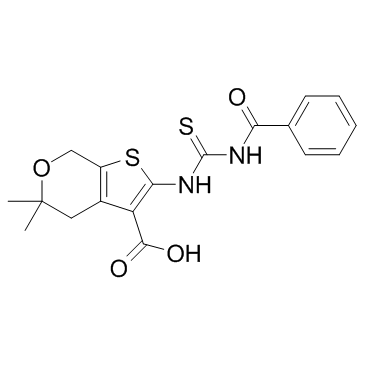
CID-1067700 (CID1067700) is a novel and potent pan GTPase inhibitor that can competitively inhibit Ras-related in brain 7 (Rab7) with a Ki of 13 nM.
Physicochemical Properties
| Molecular Formula | C18H18N2O4S2 |
| Molecular Weight | 390.47652 |
| Exact Mass | 390.07 |
| CAS # | 314042-01-8 |
| PubChem CID | 1067700 |
| Appearance | Light yellow to yellow solid powder |
| Density | 1.4±0.1 g/cm3 |
| Index of Refraction | 1.681 |
| LogP | 4.76 |
| Hydrogen Bond Donor Count | 3 |
| Hydrogen Bond Acceptor Count | 6 |
| Rotatable Bond Count | 3 |
| Heavy Atom Count | 26 |
| Complexity | 578 |
| Defined Atom Stereocenter Count | 0 |
| InChi Key | ATSWBWHRHAQVFM-UHFFFAOYSA-N |
| InChi Code | InChI=1S/C18H18N2O4S2/c1-18(2)8-11-12(9-24-18)26-15(13(11)16(22)23)20-17(25)19-14(21)10-6-4-3-5-7-10/h3-7H,8-9H2,1-2H3,(H,22,23)(H2,19,20,21,25) |
| Chemical Name | 2-(benzoylcarbamothioylamino)-5,5-dimethyl-4,7-dihydrothieno[2,3-c]pyran-3-carboxylic acid |
| HS Tariff Code | 2934.99.9001 |
| Storage |
Powder-20°C 3 years 4°C 2 years In solvent -80°C 6 months -20°C 1 month |
| Shipping Condition | Room temperature (This product is stable at ambient temperature for a few days during ordinary shipping and time spent in Customs) |
Biological Activity
| Targets |
Ki: 13 nM (Rab7)[1] |
| ln Vitro |
With a Ki of 13 nM, CID-1067700 (ML282), a pan-GTPase inhibitor, inhibits Rab7 in a competitive manner. Rab7 nucleotide binding is inhibited by CID-1067700, with Kd values of 40 nM and 100 nM for BODIPY-GDP and BODIPY-GTP, respectively. CID-1067700 substantially inhibits BODIPY-linked nucleotide binding as concentration rises. BODIPY-GTP has an EC50 value of 11.22 nM, while BODIPY-GDP has an EC50 value of 20.96 ± 1.34 nM. The computed values of Ki are 19.70 and 12.89 nM, respectively. M. Under equilibrium binding settings, CID-1067700 (10 μM) has no effect on the release rate of wild-type Rab7-bound BODIPY-linked nucleotides [1]. In B cells, CID-1067700 (0–40 μM) suppresses AID induction, NF-κB activation, and Rab7 activity. Additionally, CID-1067700 targets Rab7 to bind it with high affinity (EC50=10–20 nM) and prevent class switch DNA recombination (CSR) in B cells [2]. - Rab7 GTPase activity inhibition: CID-1067700 acts as a competitive nucleotide binding inhibitor of Rab7, inhibiting GTP hydrolysis activity with a Ki value of 1.1 μM; it does not significantly inhibit the GTPase activity of other Rab proteins (Rab1, Rab5, Rab6, Rab8, Rab11) at concentrations up to 100 μM[1] - B cell class switching recombination (CSR) inhibition: CID-1067700 (1, 5, 10 μM) inhibits IgA and IgG1 class switching in LPS + IL-4-stimulated mouse splenic B cells in a concentration-dependent manner, with reduced expression of CSR-related genes (Aicda, Prdm1) detected by RT-PCR[2] - Plasma cell survival inhibition: CID-1067700 (5, 10 μM) induces apoptosis of mouse primary plasma cells and plasmablasts in vitro, as evidenced by increased Annexin V/PI double-positive cells and reduced expression of anti-apoptotic protein Mcl-1[2] - Rab7 subcellular localization disruption: CID-1067700 (10 μM) treatment disrupts Rab7-mediated late endosome-lysosome fusion in HeLa cells, leading to accumulation of late endosomes and impaired lysosomal degradation[1] |
| ln Vivo |
By inhibiting Rab7, CID-1067700 (ML282; 16 mg/kg, i.p.) stops the progression of lupus-prone mice's disease and lowers IgG-IC deposition in MRL/Faslpr/lpr mice. Additionally focusing on B cells, CID-1067700 directly impairs the body's CSR mechanism [2]. - Murine lupus model (MRL/lpr mice): Intraperitoneal administration of CID-1067700 (10 mg/kg, 3 times/week for 4 weeks) significantly reduces serum levels of anti-dsDNA autoantibodies and rheumatoid factor (RF)[2] - Murine lupus model (MRL/lpr mice): CID-1067700 treatment alleviates lupus nephritis, as shown by reduced glomerular immune complex deposition, decreased renal histological damage score, and improved renal function (reduced proteinuria)[2] - Murine lupus model (MRL/lpr mice): CID-1067700 decreases the number of splenic plasma cells and germinal center B cells, and downregulates the expression of Blimp-1 and IRF4 (key transcription factors for plasma cell differentiation) in splenic tissues[2] |
| Enzyme Assay |
- Rab7 GTP hydrolysis assay: Recombinant Rab7 protein is preincubated with CID-1067700 at various concentrations (0.1-100 μM) for 30 minutes at 30°C. GTP is added to initiate the hydrolysis reaction, and the reaction mixture is incubated for another 60 minutes. The amount of free phosphate generated from GTP hydrolysis is measured using a malachite green phosphate detection kit. Ki value is calculated by nonlinear regression analysis of the inhibition curve[1] - Rab7 nucleotide binding assay (fluorescence polarization): Fluorescently labeled GTP analog (mant-GTP) is mixed with recombinant Rab7 protein and various concentrations of CID-1067700. The mixture is incubated at room temperature for 60 minutes, and fluorescence polarization values are measured using a microplate reader. The binding affinity of CID-1067700 to Rab7 is determined by competitive displacement of mant-GTP[1] |
| Cell Assay |
To treat human and mouse B cells in vitro with the Rab7 inhibitor, CID-1067700 is diluted in DMSO and added to cell cultures to the final concentration of 40 μM. CID-1067700 or DMSO is added either at the time when B cell stimulation started, or 66 h after B cells are stimulated with LPS plus IL-4, TGF-β, anti-δ/dex and RA, for analysis of plasma cell survival[2]. - B cell class switching assay: Splenic B cells are isolated from C57BL/6 mice and cultured in medium containing LPS and IL-4. CID-1067700 (1, 5, 10 μM) is added to the culture system, and cells are incubated for 72 hours. The percentage of IgA⁺ and IgG1⁺ B cells is detected by flow cytometry. Total RNA is extracted from cells, and the mRNA levels of Aicda and Prdm1 are analyzed by quantitative RT-PCR[2] - Plasma cell apoptosis assay: Primary plasma cells are isolated from mouse spleens and cultured with CID-1067700 (5, 10 μM) for 24 hours. Cells are stained with Annexin V-FITC and PI, and apoptotic rates are quantified by flow cytometry. For protein detection, cells are lysed, and Mcl-1 expression is determined by Western blot[2] - Late endosome-lysosome fusion assay: HeLa cells are transfected with EGFP-Rab7 plasmid to label late endosomes. After 24 hours of transfection, cells are treated with CID-1067700 (10 μM) for 16 hours, then stained with lysosomal marker (Lamp1 antibody) and observed under a confocal microscope. The colocalization coefficient of EGFP-Rab7 and Lamp1 is calculated to evaluate fusion efficiency[1] |
| Animal Protocol | - Murine lupus model (MRL/lpr mice): Female MRL/lpr mice (8-10 weeks old) are randomly divided into control group (vehicle) and CID-1067700 treatment group. CID-1067700 is dissolved in a suitable vehicle and administered via intraperitoneal injection at a dose of 10 mg/kg, 3 times per week for 4 consecutive weeks. Body weight is measured weekly. After the treatment period, mice are sacrificed, and serum, spleen, and kidney tissues are collected for further analysis (autoantibody detection, flow cytometry, histological staining)[2] |
| Toxicity/Toxicokinetics |
- In vivo toxicity: CID-1067700 (10 mg/kg, i.p., 3 times/week for 4 weeks) does not cause obvious systemic toxicity in MRL/lpr mice, as indicated by stable body weight, no significant pathological damage in major organs (heart, liver, spleen, lung, kidney), and normal hematological parameters[2] |
| References |
[1]. A competitive nucleotide binding inhibitor: in vitro characterization of Rab7 GTPase inhibition. ACS Chem Biol. 2012 Jun 15;7(6):1095-108. [2]. Small Molecule Inhibition of Rab7 Impairs B Cell Class Switching and Plasma Cell Survival To Dampen the Autoantibody Response in Murine Lupus. J Immunol. 2016 Nov 15;197(10):3792-3805. |
| Additional Infomation |
2-[[benzamido(sulfanylidene)methyl]amino]-5,5-dimethyl-4,7-dihydrothieno[2,3-c]pyran-3-carboxylic acid is a thienopyran. - CID-1067700 is a small-molecule inhibitor that specifically binds to the nucleotide binding pocket of Rab7 GTPase, blocking GTP binding and hydrolysis to inhibit Rab7 function[1] - The therapeutic effect of CID-1067700 in murine lupus is associated with impaired B cell class switching, reduced plasma cell survival, and decreased autoantibody production[2] - Rab7 GTPase plays a key role in late endosome maturation, lysosomal fusion, and intracellular trafficking, which are essential for B cell differentiation and plasma cell survival[1][2] |
Solubility Data
| Solubility (In Vitro) | DMSO : ~12.5 mg/mL (~32.01 mM) |
| Solubility (In Vivo) |
Solubility in Formulation 1: ≥ 2.5 mg/mL (6.40 mM) (saturation unknown) in 10% DMSO + 90% (20% SBE-β-CD in Saline) (add these co-solvents sequentially from left to right, and one by one), clear solution. For example, if 1 mL of working solution is to be prepared, you can add 100 μL of 25.0 mg/mL clear DMSO stock solution to 900 μL of 20% SBE-β-CD physiological saline solution and mix evenly. Preparation of 20% SBE-β-CD in Saline (4°C,1 week): Dissolve 2 g SBE-β-CD in 10 mL saline to obtain a clear solution. (Please use freshly prepared in vivo formulations for optimal results.) |
| Preparing Stock Solutions | 1 mg | 5 mg | 10 mg | |
| 1 mM | 2.5610 mL | 12.8048 mL | 25.6095 mL | |
| 5 mM | 0.5122 mL | 2.5610 mL | 5.1219 mL | |
| 10 mM | 0.2561 mL | 1.2805 mL | 2.5610 mL |