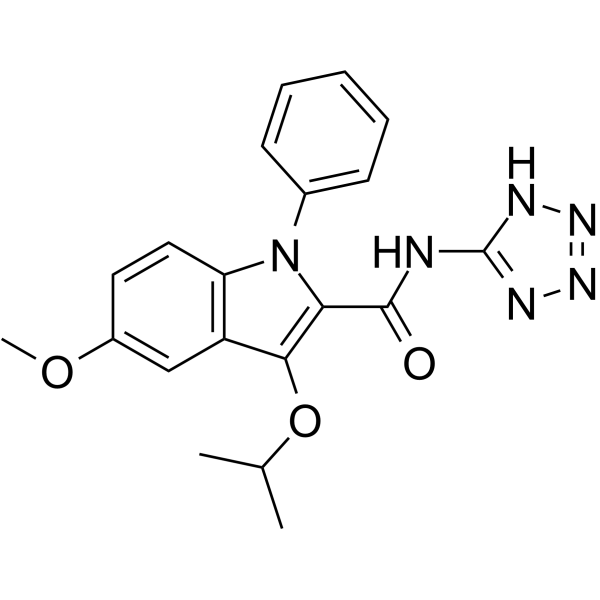
Physicochemical Properties
| Molecular Formula | C20H20N6O3 |
| Molecular Weight | 392.4112 |
| Exact Mass | 392.159 |
| CAS # | 104961-19-5 |
| PubChem CID | 159563 |
| Appearance | Typically exists as solid at room temperature |
| LogP | 3.5 |
| Hydrogen Bond Donor Count | 2 |
| Hydrogen Bond Acceptor Count | 6 |
| Rotatable Bond Count | 6 |
| Heavy Atom Count | 29 |
| Complexity | 558 |
| Defined Atom Stereocenter Count | 0 |
| InChi Key | JPTSIWRGXIZEOO-UHFFFAOYSA-N |
| InChi Code | InChI=1S/C20H20N6O3/c1-12(2)29-18-15-11-14(28-3)9-10-16(15)26(13-7-5-4-6-8-13)17(18)19(27)21-20-22-24-25-23-20/h4-12H,1-3H3,(H2,21,22,23,24,25,27) |
| Chemical Name | 5-methoxy-1-phenyl-3-propan-2-yloxy-N-(2H-tetrazol-5-yl)indole-2-carboxamide |
| HS Tariff Code | 2934.99.9001 |
| Storage |
Powder-20°C 3 years 4°C 2 years In solvent -80°C 6 months -20°C 1 month |
| Shipping Condition | Room temperature (This product is stable at ambient temperature for a few days during ordinary shipping and time spent in Customs) |
Biological Activity
| ln Vitro | In a dose-dependent manner, CI-949 suppresses the production of histamine, leukotrienes, and thromboxane from human basophils challenged with anti-IgE. 11.4 μM is the IC50 value for histamine release inhibition. Histamine release is almost entirely inhibited at 100 μM, and only slightly inhibited at less than 3 μM. At lower quantities (IC50 0.5 and 0.1 μM, respectively), the release of TXB2 and LTC4/LTD4 was suppressed. CI-949 fully suppressed the synthesis/release of thromboxane and leukotrienes at 1 μM and 10 μM, respectively. The release of all three mediators in response to this stimulation is strongly inhibited by CI-949. The IC50 values for histamine, leukotrienes, and thromboxane inhibition when subjected to FMLP challenges were 6.3, 2, and 0.1 μM, in that order [1]. In antigen-challenged lung segments of actively sensitized guinea pigs, CI-949 efficiently suppresses the release of histamine as well as the synthesis or release of the immunoreactive thiopeptides leukotrienes C4-D4 and thromboxane B2. The IC50 values for histamine, leukotriene, and thromboxane are 26.7±2.8 μM, 2.7±2.4 μM, and 3.0±1.8 μM, respectively[2]. |
| ln Vivo | Actively sensitized guinea pigs received intraperitoneal injections. Between 20 and 120 minutes before the antigen aerosol challenge, CI-949 was given at doses of 30, 50, or 100 mg/kg. CI-949 administered intraperitoneally at a dose of 50 mg/kg protected conscious guinea pigs exposed to aerosol allergens for a minimum of one hour, and orally at a dose of 100 mg/kg for a minimum of two hours. Animals did not collapse for at least an hour after 50 and 100 mg/kg, and for up to two hours after 100 mg/kg, total protection was given. Moreover, oral administration of 100 mg/kg two hours (but not four hours) prior to challenge inhibited collapse. A single dose at two hours is less effective than two doses of 100 mg/kg given four and two hours prior to challenge [2]. |
| References |
[1]. Inhibition of histamine, leukotriene C4/D4, and thromboxane B2 release from human leukocytes and human chopped lung mast cells by the allergic mediator release inhibitor, CI-949. J Allergy Clin Immunol. 1990 Dec;86(6 Pt 1):902-8. [2]. CI-949: a new, potential antiallergy compound inhibits antigen-induced allergic reactions in guinea-pigs in vitro and in vivo. Pulm Pharmacol. 1990;3(4):203-8. |
Solubility Data
| Solubility (In Vitro) | May dissolve in DMSO (in most cases), if not, try other solvents such as H2O, Ethanol, or DMF with a minute amount of products to avoid loss of samples |
| Solubility (In Vivo) |
Note: Listed below are some common formulations that may be used to formulate products with low water solubility (e.g. < 1 mg/mL), you may test these formulations using a minute amount of products to avoid loss of samples. Injection Formulations (e.g. IP/IV/IM/SC) Injection Formulation 1: DMSO : Tween 80: Saline = 10 : 5 : 85 (i.e. 100 μL DMSO stock solution → 50 μL Tween 80 → 850 μL Saline) *Preparation of saline: Dissolve 0.9 g of sodium chloride in 100 mL ddH ₂ O to obtain a clear solution. Injection Formulation 2: DMSO : PEG300 :Tween 80 : Saline = 10 : 40 : 5 : 45 (i.e. 100 μL DMSO → 400 μLPEG300 → 50 μL Tween 80 → 450 μL Saline) Injection Formulation 3: DMSO : Corn oil = 10 : 90 (i.e. 100 μL DMSO → 900 μL Corn oil) Example: Take the Injection Formulation 3 (DMSO : Corn oil = 10 : 90) as an example, if 1 mL of 2.5 mg/mL working solution is to be prepared, you can take 100 μL 25 mg/mL DMSO stock solution and add to 900 μL corn oil, mix well to obtain a clear or suspension solution (2.5 mg/mL, ready for use in animals). Injection Formulation 4: DMSO : 20% SBE-β-CD in saline = 10 : 90 [i.e. 100 μL DMSO → 900 μL (20% SBE-β-CD in saline)] *Preparation of 20% SBE-β-CD in Saline (4°C,1 week): Dissolve 2 g SBE-β-CD in 10 mL saline to obtain a clear solution. Injection Formulation 5: 2-Hydroxypropyl-β-cyclodextrin : Saline = 50 : 50 (i.e. 500 μL 2-Hydroxypropyl-β-cyclodextrin → 500 μL Saline) Injection Formulation 6: DMSO : PEG300 : castor oil : Saline = 5 : 10 : 20 : 65 (i.e. 50 μL DMSO → 100 μLPEG300 → 200 μL castor oil → 650 μL Saline) Injection Formulation 7: Ethanol : Cremophor : Saline = 10: 10 : 80 (i.e. 100 μL Ethanol → 100 μL Cremophor → 800 μL Saline) Injection Formulation 8: Dissolve in Cremophor/Ethanol (50 : 50), then diluted by Saline Injection Formulation 9: EtOH : Corn oil = 10 : 90 (i.e. 100 μL EtOH → 900 μL Corn oil) Injection Formulation 10: EtOH : PEG300:Tween 80 : Saline = 10 : 40 : 5 : 45 (i.e. 100 μL EtOH → 400 μLPEG300 → 50 μL Tween 80 → 450 μL Saline) Oral Formulations Oral Formulation 1: Suspend in 0.5% CMC Na (carboxymethylcellulose sodium) Oral Formulation 2: Suspend in 0.5% Carboxymethyl cellulose Example: Take the Oral Formulation 1 (Suspend in 0.5% CMC Na) as an example, if 100 mL of 2.5 mg/mL working solution is to be prepared, you can first prepare 0.5% CMC Na solution by measuring 0.5 g CMC Na and dissolve it in 100 mL ddH2O to obtain a clear solution; then add 250 mg of the product to 100 mL 0.5% CMC Na solution, to make the suspension solution (2.5 mg/mL, ready for use in animals). Oral Formulation 3: Dissolved in PEG400 Oral Formulation 4: Suspend in 0.2% Carboxymethyl cellulose Oral Formulation 5: Dissolve in 0.25% Tween 80 and 0.5% Carboxymethyl cellulose Oral Formulation 6: Mixing with food powders Note: Please be aware that the above formulations are for reference only. InvivoChem strongly recommends customers to read literature methods/protocols carefully before determining which formulation you should use for in vivo studies, as different compounds have different solubility properties and have to be formulated differently. (Please use freshly prepared in vivo formulations for optimal results.) |
| Preparing Stock Solutions | 1 mg | 5 mg | 10 mg | |
| 1 mM | 2.5484 mL | 12.7418 mL | 25.4836 mL | |
| 5 mM | 0.5097 mL | 2.5484 mL | 5.0967 mL | |
| 10 mM | 0.2548 mL | 1.2742 mL | 2.5484 mL |