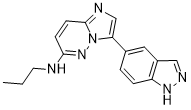
Physicochemical Properties
| Molecular Formula | C16H16N6 |
| Molecular Weight | 292.346 |
| Exact Mass | 292.143 |
| CAS # | 1333377-65-3 |
| Related CAS # | CHR-6494 TFA;1458630-17-5 |
| PubChem CID | 70679308 |
| Appearance | Light yellow to khaki solid powder |
| Density | 1.4±0.1 g/cm3 |
| Index of Refraction | 1.747 |
| LogP | 2.48 |
| Hydrogen Bond Donor Count | 2 |
| Hydrogen Bond Acceptor Count | 4 |
| Rotatable Bond Count | 4 |
| Heavy Atom Count | 22 |
| Complexity | 378 |
| Defined Atom Stereocenter Count | 0 |
| InChi Key | CZZCAOGIEGXMBZ-UHFFFAOYSA-N |
| InChi Code | InChI=1S/C16H16N6/c1-2-7-17-15-5-6-16-18-10-14(22(16)21-15)11-3-4-13-12(8-11)9-19-20-13/h3-6,8-10H,2,7H2,1H3,(H,17,21)(H,19,20) |
| Chemical Name | 3-(1H-indazol-5-yl)-N-propylimidazo[1,2-b]pyridazin-6-amine |
| Synonyms | CHR-6494 CHR6494 CHR 6494 |
| HS Tariff Code | 2934.99.9001 |
| Storage |
Powder-20°C 3 years 4°C 2 years In solvent -80°C 6 months -20°C 1 month |
| Shipping Condition | Room temperature (This product is stable at ambient temperature for a few days during ordinary shipping and time spent in Customs) |
Biological Activity
| ln Vitro | The growth of dyes such as HCT-116, HeLa, MDA-MB-231, and Wi-38 cells is dose-dependently inhibited by CHR-6494 (0-10-5 nM; 72 hours); the IC50 of 500 nM and 473 nM CHR, respectively, are produced by CHR-6494 (500 nM). Additionally, the spindle assembly checkpoint protein BUB1 and the mitotic division marker cyclin B1, 752 nM and 1059 nM, are upregulated by CHR-6494 (500 nM). With an IC50 ranging from 396 nM to 1229 nM, CHR-6494 exhibits inhibitory effect against melanoma cell lines, including BRAFV600E mutants, NRAS mutants, and wild-type cells [2]. 300 nM and 600 nM of CHR-6494. ; 72 hours) causes a cell exchange that increases the activity of caspase 3/7 by three and six times in COLO-792 cells, and eighty-five and sixteen times in RPMI-7951 cells [2]. When CHR-6494 and MEK dye are combined, they can effectively suppress melanoma cell viability, accelerate melanoma cell shutdown, individually control the course of the cell cycle by stopping melanoma cells at various stages, and stop melanoma cell migration [2]. The anti-proliferative activity of MLN8237 on MDA-MB-231, SKBR3 breast cancer cells is enhanced by CHR-6494 (50, 200 nM; 1 week) [3]. The combination of MLN8237 and CHR-6494 (200 nM; 72 hours) improves the sterility of SKBR3 and MDA-MB-231 cells [3]. |
| ln Vivo | In nude mice of the human colorectal colon, HCT-116 was shown to inhibit tumor growth in CHR-6494 (50 mg/kg; intraperitoneal injection; 2 cycles of 5 consecutive days, 15 d) without significantly changing body weight [1]. In nude mice carrying MDA-MB-231 xenograft tumors, CHR-6494 (20 mg/kg; intraperitoneal injection for 15 consecutive days) has an inhibitory effect on tumor volume and weight when compared with cosmetics [3]. (20 mg/kg; po) for 15 days straight intraperitoneal administration) increases the suppression of tumor weight and volume in vivo by MLN8237 (20 mg/kg; po) [3]. |
| References |
[1]. Antitumor activity of a small-molecule inhibitor of the histone kinase Haspin. Oncogene. 2012 Mar 15;31(11):1408-18. [2]. Anti-Melanoma Activities of Haspin Inhibitor CHR-6494 Deployed as a Single Agent or in a Synergistic Combination with MEK Inhibitor. J Cancer. 2017 Aug 25;8(15):2933-2943. [3]. CRISPR/Cas9 screening identifies a kinetochore-microtubule dependent mechanism for Aurora-A inhibitor resistance in breast cancer. Cancer Commun (Lond). 2021 Feb;41(2):121-139. |
Solubility Data
| Solubility (In Vitro) | DMSO : ~50 mg/mL (~171.03 mM) |
| Solubility (In Vivo) |
Solubility in Formulation 1: ≥ 2.5 mg/mL (8.55 mM) (saturation unknown) in 10% DMSO + 40% PEG300 + 5% Tween80 + 45% Saline (add these co-solvents sequentially from left to right, and one by one), clear solution. For example, if 1 mL of working solution is to be prepared, you can add 100 μL of 25.0 mg/mL clear DMSO stock solution to 400 μL PEG300 and mix evenly; then add 50 μL Tween-80 to the above solution and mix evenly; then add 450 μL normal saline to adjust the volume to 1 mL. Preparation of saline: Dissolve 0.9 g of sodium chloride in 100 mL ddH₂ O to obtain a clear solution. Solubility in Formulation 2: 1 mg/mL (3.42 mM) in 10% DMSO + 90% Corn Oil (add these co-solvents sequentially from left to right, and one by one), suspension solution; with ultrasonication. For example, if 1 mL of working solution is to be prepared, you can add 100 μL of 10.0 mg/mL clear DMSO stock solution to 900 μL of corn oil and mix evenly. (Please use freshly prepared in vivo formulations for optimal results.) |
| Preparing Stock Solutions | 1 mg | 5 mg | 10 mg | |
| 1 mM | 3.4206 mL | 17.1028 mL | 34.2056 mL | |
| 5 mM | 0.6841 mL | 3.4206 mL | 6.8411 mL | |
| 10 mM | 0.3421 mL | 1.7103 mL | 3.4206 mL |