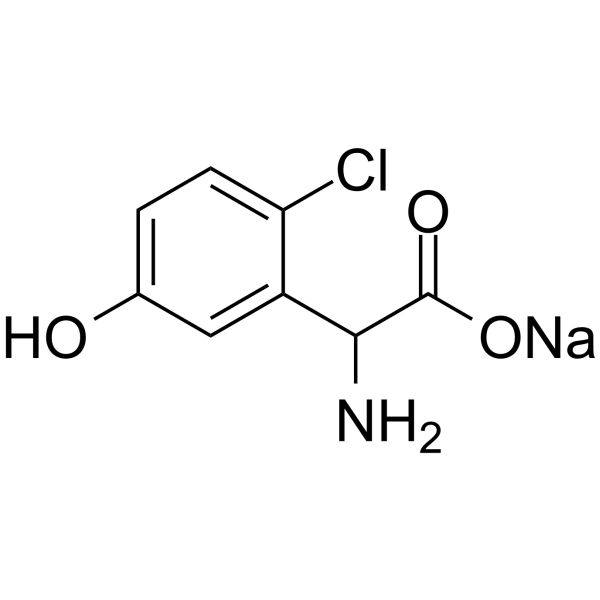
Physicochemical Properties
| Molecular Formula | C8H7CLNNAO3 |
| Molecular Weight | 223.58885216713 |
| Exact Mass | 223.001 |
| CAS # | 1303993-73-8 |
| Related CAS # | CHPG;170846-74-9 |
| PubChem CID | 52974246 |
| Appearance | White to off-white solid powder |
| Hydrogen Bond Donor Count | 2 |
| Hydrogen Bond Acceptor Count | 4 |
| Rotatable Bond Count | 2 |
| Heavy Atom Count | 14 |
| Complexity | 205 |
| Defined Atom Stereocenter Count | 0 |
| InChi Key | KZRZZIISUUINJT-UHFFFAOYSA-M |
| InChi Code | InChI=1S/C8H8ClNO3.Na/c9-6-2-1-4(11)3-5(6)7(10)8(12)13;/h1-3,7,11H,10H2,(H,12,13);/q;+1/p-1 |
| Chemical Name | sodium;2-amino-2-(2-chloro-5-hydroxyphenyl)acetate |
| HS Tariff Code | 2934.99.9001 |
| Storage |
Powder-20°C 3 years 4°C 2 years In solvent -80°C 6 months -20°C 1 month Note: Please store this product in a sealed and protected environment, avoid exposure to moisture. |
| Shipping Condition | Room temperature (This product is stable at ambient temperature for a few days during ordinary shipping and time spent in Customs) |
Biological Activity
| ln Vitro | After SO2 model treatment, CHPG sodium salt (10-500 μM; 24 hours) dramatically enhanced cell survival and reduced LDH release [1]. CHPG sodium salt (0.5 mM; 30 minutes) protects the BV2 cell scaffold SO2 cell model. Treatment with CHPG sodium salt (0.5 mM; 30 minutes) alone increases the expression of TSG-6 at the mRNA and protein levels [1]. |
| Cell Assay |
Cell Viability Assay[1] Cell Types: BV2 microglial cells Tested Concentrations: 10, 50, 100 and 500 µM Incubation Duration: 24 hrs (hours) Experimental Results: Increased cell viability. Apoptosis analysis[1] Cell Types: BV2 microglia Tested Concentrations: 0.5 mM Incubation Duration: 30 minutes Experimental Results: Protection of BV2 cells from SO2-induced apoptosis. Western Blot Analysis[1] Cell Types: BV2 Microglia Tested Concentrations: 0.5 mM Incubation Duration: 30 minutes Experimental Results: TSG-6 mRNA and protein level expression increased. |
| Animal Protocol |
Animal/Disease Models: Adult SD (SD (Sprague-Dawley)) male rats, body weight 280-320 g[2] Doses: 250 nM Route of Administration: injection; CHPG sodium salt (injection; 250 nM; 7 days) Dramatically reduces the volume of brain damage[2 ]. Results for 7 days: The size of the brain lesions was Dramatically diminished. |
| References |
[1]. The selective mGluR5 agonist CHPG attenuates SO2-induced oxidative stress and inflammation through TSG-6/NF-κB pathway in BV2 microglial cells. Neurochem Int. 2015 Jun-Jul;85-86:46-52. [2]. The selective mGluR5 agonist CHPG protects against traumatic brain injury in vitro and in vivo via ERK and Akt pathway. Int J Mol Med. 2012 Apr;29(4):630-6. |
Solubility Data
| Solubility (In Vitro) |
DMSO : ~100 mg/mL (~447.25 mM) H2O : ~6.67 mg/mL (~29.83 mM) |
| Solubility (In Vivo) |
Solubility in Formulation 1: ≥ 2.5 mg/mL (11.18 mM) (saturation unknown) in 10% DMSO + 40% PEG300 + 5% Tween80 + 45% Saline (add these co-solvents sequentially from left to right, and one by one), clear solution. For example, if 1 mL of working solution is to be prepared, you can add 100 μL of 25.0 mg/mL clear DMSO stock solution to 400 μL PEG300 and mix evenly; then add 50 μL Tween-80 to the above solution and mix evenly; then add 450 μL normal saline to adjust the volume to 1 mL. Preparation of saline: Dissolve 0.9 g of sodium chloride in 100 mL ddH₂ O to obtain a clear solution. Solubility in Formulation 2: ≥ 2.5 mg/mL (11.18 mM) (saturation unknown) in 10% DMSO + 90% (20% SBE-β-CD in Saline) (add these co-solvents sequentially from left to right, and one by one), clear solution. For example, if 1 mL of working solution is to be prepared, you can add 100 μL of 25.0 mg/mL clear DMSO stock solution to 900 μL of 20% SBE-β-CD physiological saline solution and mix evenly. Preparation of 20% SBE-β-CD in Saline (4°C,1 week): Dissolve 2 g SBE-β-CD in 10 mL saline to obtain a clear solution. Solubility in Formulation 3: ≥ 2.5 mg/mL (11.18 mM) (saturation unknown) in 10% DMSO + 90% Corn Oil (add these co-solvents sequentially from left to right, and one by one), clear solution. For example, if 1 mL of working solution is to be prepared, you can add 100 μL of 25.0 mg/mL clear DMSO stock solution to 900 μL of corn oil and mix evenly. Solubility in Formulation 4: 5 mg/mL (22.36 mM) in PBS (add these co-solvents sequentially from left to right, and one by one), clear solution; with ultrasonication (<60°C). (Please use freshly prepared in vivo formulations for optimal results.) |
| Preparing Stock Solutions | 1 mg | 5 mg | 10 mg | |
| 1 mM | 4.4725 mL | 22.3624 mL | 44.7247 mL | |
| 5 mM | 0.8945 mL | 4.4725 mL | 8.9449 mL | |
| 10 mM | 0.4472 mL | 2.2362 mL | 4.4725 mL |