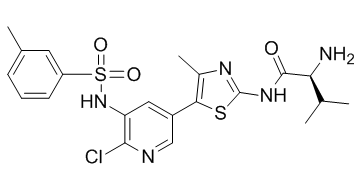
CHMFL-PI3KD-317 is a novel, highly potent, selective and orally bioavailable PI3Kδ inhibitor, with an IC50 of 6 nM, it exhibits over 10-1500 fold selectivity over other class I, II and III PIKK family isoforms, such as PI3Kα (IC50, 62.6 nM), PI3Kβ (IC50, 284 nM), PI3Kγ (IC50, 202.7 nM), PIK3C2A (IC50, >10000 nM), PIK3C2B (IC50, 882.3 nM), VPS34 (IC50, 1801.7 nM), PI4KIIIA (IC50, 574.1 nM) and PI4KIIIB (IC50, 300.2 nM). CHMFL-PI3KD-317 inhibits PI3Kδ-mediated Akt T308 phosphorylation in Raji cells, with an EC50 of 4.3 nM. CHMFL-PI3KD-317 has antiproliferative effects on cancer cells.
Physicochemical Properties
| Molecular Formula | C21H24CLN5O3S2 |
| Molecular Weight | 494.029960632324 |
| Exact Mass | 493.1 |
| CAS # | 2244992-76-3 |
| PubChem CID | 137333450 |
| Appearance | White to off-white solid powder |
| LogP | 3.8 |
| Hydrogen Bond Donor Count | 3 |
| Hydrogen Bond Acceptor Count | 8 |
| Rotatable Bond Count | 7 |
| Heavy Atom Count | 32 |
| Complexity | 750 |
| Defined Atom Stereocenter Count | 1 |
| SMILES | ClC1=C(C=C(C=N1)C1=C(C)N=C(NC([C@H](C(C)C)N)=O)S1)NS(C1C=CC=C(C)C=1)(=O)=O |
| InChi Key | PIBKKQFQADCDAW-KRWDZBQOSA-N |
| InChi Code | InChI=1S/C21H24ClN5O3S2/c1-11(2)17(23)20(28)26-21-25-13(4)18(31-21)14-9-16(19(22)24-10-14)27-32(29,30)15-7-5-6-12(3)8-15/h5-11,17,27H,23H2,1-4H3,(H,25,26,28)/t17-/m0/s1 |
| Chemical Name | (2S)-2-amino-N-[5-[6-chloro-5-[(3-methylphenyl)sulfonylamino]pyridin-3-yl]-4-methyl-1,3-thiazol-2-yl]-3-methylbutanamide |
| Synonyms | CHMFL-PI3KD-317; CHMFL PI3KD-317; CHMFL-PI3KD 317 |
| HS Tariff Code | 2934.99.9001 |
| Storage |
Powder-20°C 3 years 4°C 2 years In solvent -80°C 6 months -20°C 1 month |
| Shipping Condition | Room temperature (This product is stable at ambient temperature for a few days during ordinary shipping and time spent in Customs) |
Biological Activity
| ln Vitro | CHMFL-PI3KD-317 possesses anti-proliferative effects with GI50 of 3.5 ± 0.8, 4.0 ± 0.9, 4.8 ± 0.2, 3.3 ± 0.2, 3.0 ± compared to PF382, NALM-6, MV4-11, MOLM-14 and MOLM-13. 0.4 μM cells, in that order [1]. |
| ln Vivo | Mice's MOLM14 tumor growth is inhibited by CHMFL-PI3KD-317 (Compound 15i; 25, 50, and 100 mg/kg/day, orally, for 14 days) [1]. In Sprague-Dawley rats, CHMFL-PI3KD-317 has a respectable half-life (T1/2 = 3.28 h) and good oral bioavailability [1]. |
| Animal Protocol |
Animal/Disease Models: Female nu/nu (nude) mice bearing MOLM-14 tumor xenografts [1] Doses: 25, 50 and 100 mg/kg/day Route of Administration: Orally for 14 days Experimental Results: Inhibition of MOLM14 tumor growth, no deaths or significant weight loss in mice. |
| References |
[1]. Discovery of (S)-2-amino-N-(5-(6-chloro-5-(3-methylphenylsulfonamido)pyridin-3-yl)-4-methylthiazol-2-yl)-3-methylbutanamide (CHMFL-PI3KD-317) as a potent and selective phosphoinositide 3-kinase delta (PI3Kδ) inhibitor. Eur J Med Chem. 2018. |
Solubility Data
| Solubility (In Vitro) | DMSO : ~250 mg/mL (~506.04 mM) |
| Solubility (In Vivo) |
Solubility in Formulation 1: ≥ 2.08 mg/mL (4.21 mM) (saturation unknown) in 10% DMSO + 40% PEG300 + 5% Tween80 + 45% Saline (add these co-solvents sequentially from left to right, and one by one), clear solution. For example, if 1 mL of working solution is to be prepared, you can add 100 μL of 20.8 mg/mL clear DMSO stock solution to 400 μL PEG300 and mix evenly; then add 50 μL Tween-80 to the above solution and mix evenly; then add 450 μL normal saline to adjust the volume to 1 mL. Preparation of saline: Dissolve 0.9 g of sodium chloride in 100 mL ddH₂ O to obtain a clear solution. Solubility in Formulation 2: ≥ 2.08 mg/mL (4.21 mM) (saturation unknown) in 10% DMSO + 90% Corn Oil (add these co-solvents sequentially from left to right, and one by one), clear solution. For example, if 1 mL of working solution is to be prepared, you can add 100 μL of 20.8 mg/mL clear DMSO stock solution to 900 μL of corn oil and mix evenly. (Please use freshly prepared in vivo formulations for optimal results.) |
| Preparing Stock Solutions | 1 mg | 5 mg | 10 mg | |
| 1 mM | 2.0242 mL | 10.1208 mL | 20.2417 mL | |
| 5 mM | 0.4048 mL | 2.0242 mL | 4.0483 mL | |
| 10 mM | 0.2024 mL | 1.0121 mL | 2.0242 mL |