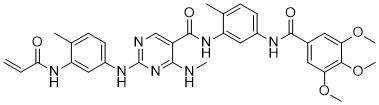
CHMFL-BMX-078 is a highly potent and selective type II irreversible/covalent kinase inhibitor of BMX (bone marrow kinase on chromosome X) kinase with an IC50 of 11 nM. In the DFG-out inactive conformation of BMX, CHMFL-BMX-078 forms a covalent bond with the cysteine 496 residue, exhibiting an IC50 of 11 nM. It achieves at least 40-fold selectivity over BTK kinase (IC50=437 nM) and exhibits a high selectivity profile against the 468 kinases/mutants in the KINOMEscan evaluation. Belonging to the TEC family of nonreceptor tyrosine kinases, BMX plays a crucial role in numerous physiological and pathological processes. Since the exact mechanism of the BMX-mediated signaling pathways is still unknown, CHMFL-BMX-078 would be a helpful pharmacological tool to clarify the specifics of the pathway.
Physicochemical Properties
| Molecular Formula | C33H35N7O6 | |
| Molecular Weight | 625.6743 | |
| Exact Mass | 625.26 | |
| Elemental Analysis | C, 63.35; H, 5.64; N, 15.67; O, 15.34 | |
| CAS # | 1808288-51-8 | |
| Related CAS # |
|
|
| PubChem CID | 122633900 | |
| Appearance | Off-white to yellow solid powder | |
| LogP | 5 | |
| Hydrogen Bond Donor Count | 5 | |
| Hydrogen Bond Acceptor Count | 10 | |
| Rotatable Bond Count | 12 | |
| Heavy Atom Count | 46 | |
| Complexity | 1020 | |
| Defined Atom Stereocenter Count | 0 | |
| InChi Key | XURALSVDCFXBAX-UHFFFAOYSA-N | |
| InChi Code | InChI=1S/C33H35N7O6/c1-8-28(41)38-24-16-22(12-10-18(24)2)37-33-35-17-23(30(34-4)40-33)32(43)39-25-15-21(11-9-19(25)3)36-31(42)20-13-26(44-5)29(46-7)27(14-20)45-6/h8-17H,1H2,2-7H3,(H,36,42)(H,38,41)(H,39,43)(H2,34,35,37,40) | |
| Chemical Name | 4-(methylamino)-2-[4-methyl-3-(prop-2-enoylamino)anilino]-N-[2-methyl-5-[(3,4,5-trimethoxybenzoyl)amino]phenyl]pyrimidine-5-carboxamide | |
| Synonyms |
|
|
| HS Tariff Code | 2934.99.9001 | |
| Storage |
Powder-20°C 3 years 4°C 2 years In solvent -80°C 6 months -20°C 1 month |
|
| Shipping Condition | Room temperature (This product is stable at ambient temperature for a few days during ordinary shipping and time spent in Customs) |
Biological Activity
| Targets |
BMX (IC50 = 11 nM)
The therapeutic target is Bone Marrow Kinase in the X Chromosome (BMX), a member of the TEC family of nonreceptor tyrosine kinases. CHMFL-BMX-078 exerts an inhibitory effect on BMX by forming a covalent bond with the cysteine 496 residue in the DFG-out inactive conformation of BMX, with an IC₅₀ value of 11 nM. In the KINOMEscan evaluation against 468 kinases/mutants, the drug exhibited a selectivity score (S score(1)) of 0.01, and its selectivity for BMX was at least 40-fold higher than that for BTK kinase[1] |
| ln Vitro |
Bone marrow kinase in the X chromosome (BMX, also called ETK) is a nonreceptor tyrosine kinase involved in tumorigenicity, cell motility, adhesion, angiogenesis, proliferation, and differentiation. In the DFG-out inactive conformation of BMX, CHMFL-BMX-078 forms a covalent bond with the cysteine 496 residue, exhibiting an IC50 of 11 nM. It achieves at least 40-fold selectivity over BTK kinase (IC50=437 nM) and exhibits a high selectivity profile against the 468 kinases/mutants in the KINOMEscan evaluation. CHMFL-BMX-078 exhibits a binding Kd of 81 nM for BMX kinase in its inactive state and 10200 nM for BMX kinase in its active state. Selectivity over parental BaF3 cells and antiproliferative effects against BaF3-TEL-BMX cells (GI50=0.016 μM) are demonstrated by CHMFL-BMX-078. About 80 times more effective than the C496S mutant (EC50=459 nM) at inhibiting BMX total tyrosine phosphorylation, CHMFL-BMX-078 is against BMX wt (EC50=5.8 nM). In order to clarify the precise mechanism of BMX-mediated signaling pathways, CHMFL-BMX-078 would be a helpful pharmacological tool[1]. 1. Kinase inhibitory activity: CHMFL-BMX-078 shows potent inhibitory activity against BMX kinase with an IC₅₀ of 11 nM. The inhibitory mechanism involves forming a covalent bond with the cysteine 496 residue of BMX, and it acts on the DFG-out inactive conformation of BMX[1] 2. Kinase selectivity: In the KINOMEscan evaluation covering 468 kinases/mutants, CHMFL-BMX-078 had a selectivity score (S score(1)) of 0.01, indicating high selectivity for BMX. Additionally, the drug's selectivity for BMX was at least 40-fold higher than that for BTK kinase, further demonstrating its target specificity[1] |
| ln Vivo | CHMFL-BMX-078 has a brief half-life (T1/2=0.80 h) in iv injection. In intravenous injection, CHMFL-BMX-078 likewise exhibits a respectable Cmax (13565.23 ng/mL) and AUC0-t (1386.41 ng/mL h). When used as a research tool, this compound could be administered via IV or i.p. injection because it is not absorbed when taken orally[1]. |
| Enzyme Assay | The substrate polypeptide with 100 μM ATP, 1 μL of serially diluted CHMFL-BMX-078, and BMX or BTK are all present in the kinase reaction system. ATP is added right away to each tube to start the reaction, which is then maintained for an hour at a temperature below 37 °C. 5 μL of solvent reactions are conducted in a 384-well plate after the tube has cooled for five minutes at room temperature. Subsequently, 5 microliters of ADP-Glo reagent is introduced into every well to halt the reaction and use up the residual ATP in 40 minutes. Lastly, a luminescence signal is generated by adding 10 μL of kinase detection reagent into the well and incubating it for 30 minutes. Using an automated plate reader, the luminosity signal is measured[1]. |
| Cell Assay | A nonreceptor tyrosine kinase involved in angiogenesis, proliferation, differentiation, adhesion, and cell motility, bone marrow kinase in the X chromosome (BMX, also known as ETK) is found in these processes. In the DFG-out inactive conformation of BMX, CHMFL-BMX-078 forms a covalent bond with the cysteine 496 residue, exhibiting an IC50 of 11 nM. It achieves at least 40-fold selectivity over BTK kinase (IC50=437 nM) and exhibits a high selectivity profile against the 468 kinases/mutants in the KINOMEscan evaluation. CHMFL-BMX-078 exhibits a binding Kd of 81 nM for BMX kinase in its inactive state and 10200 nM for BMX kinase in its active state. Selectivity over parental BaF3 cells and antiproliferative effects against BaF3-TEL-BMX cells (GI50=0.016 μM) are demonstrated by CHMFL-BMX-078. About 80 times more effective than the C496S mutant (EC50=459 nM) at inhibiting BMX total tyrosine phosphorylation, CHMFL-BMX-078 is against BMX wt (EC50=5.8 nM). In order to clarify the precise mechanism of BMX-mediated signaling pathways, CHMFL-BMX-078 would be a helpful pharmacological tool. |
| Animal Protocol | Rats: Six male Sprague-Dawley rats, age eight weeks, are given an oral and intravenous drug regimen followed by an overnight fast. The following are the time points for collecting animal blood. The following times are chosen for groups 1, 3, and 5 (intravenous): 1 hour, 2 hours, 4 hours, 6 hours, and 8 hours prior to and following administration. Oral: 5 min, 15 min, 30 min, 1 h, 2 h, 4 h, 6 h, 8 h, and 24 h prior to and following dosage for groups 2, 4, and 6. Plasma is gathered in order to be examined[1]. |
| References |
[1]. Discovery of 2-((3-Acrylamido-4-methylphenyl)amino)-N-(2-methyl-5-(3,4,5-trimethoxybenzamido)phenyl)-4-(methylamino)pyrimidine-5-carboxamide (CHMFL-BMX-078) as a Highly Potent and Selective Type II Irreversible Bone Marrow Kinase in the X. |
| Additional Infomation |
1. Drug category and design background: CHMFL-BMX-078 is a type II irreversible BMX kinase inhibitor, and its development combines two strategies: irreversible inhibitor design and type II inhibitor design[1] 2. Research significance: Since the signaling pathway mediated by BMX has not been fully elucidated, CHMFL-BMX-078 can serve as an effective pharmacological tool to deeply analyze the detailed mechanism of the BMX-mediated signaling pathway[1] 3. Chemical structure correlation: The chemical name of CHMFL-BMX-078 is 2-((3-Acrylamido-4-methylphenyl)amino)-N-(2-methyl-5-(3,4,5-trimethoxybenzamido)phenyl)-4-(methylamino)pyrimidine-5-carboxamide, which belongs to pyrimidine compounds and contains a benzamide group in its structure[1] |
Solubility Data
| Solubility (In Vitro) |
|
|||
| Solubility (In Vivo) |
Solubility in Formulation 1: ≥ 2.5 mg/mL (4.00 mM) (saturation unknown) in 10% DMSO + 40% PEG300 + 5% Tween80 + 45% Saline (add these co-solvents sequentially from left to right, and one by one), clear solution. For example, if 1 mL of working solution is to be prepared, you can add 100 μL of 25.0 mg/mL clear DMSO stock solution to 400 μL PEG300 and mix evenly; then add 50 μL Tween-80 to the above solution and mix evenly; then add 450 μL normal saline to adjust the volume to 1 mL. Preparation of saline: Dissolve 0.9 g of sodium chloride in 100 mL ddH₂ O to obtain a clear solution. Solubility in Formulation 2: ≥ 2.5 mg/mL (4.00 mM) (saturation unknown) in 10% DMSO + 90% Corn Oil (add these co-solvents sequentially from left to right, and one by one), clear solution. For example, if 1 mL of working solution is to be prepared, you can add 100 μL of 25.0 mg/mL clear DMSO stock solution to 900 μL of corn oil and mix evenly. (Please use freshly prepared in vivo formulations for optimal results.) |
| Preparing Stock Solutions | 1 mg | 5 mg | 10 mg | |
| 1 mM | 1.5983 mL | 7.9914 mL | 15.9829 mL | |
| 5 mM | 0.3197 mL | 1.5983 mL | 3.1966 mL | |
| 10 mM | 0.1598 mL | 0.7991 mL | 1.5983 mL |