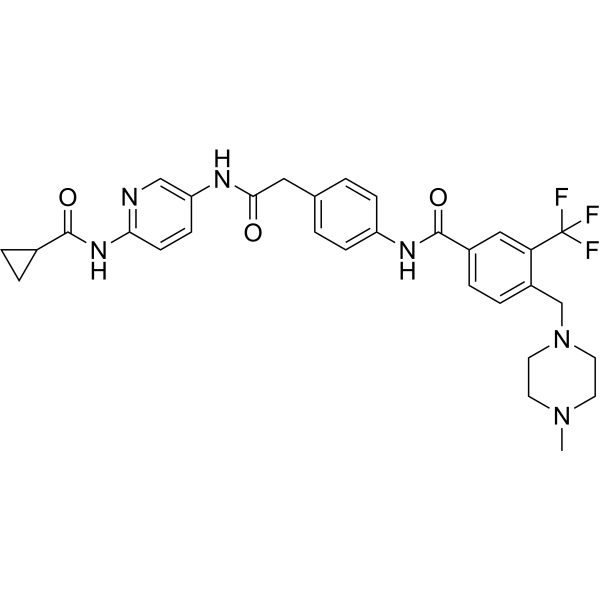
Physicochemical Properties
| Molecular Formula | C31H33F3N6O3 |
| Molecular Weight | 594.627337217331 |
| Exact Mass | 594.256 |
| CAS # | 2304344-56-5 |
| PubChem CID | 138377598 |
| Appearance | Typically exists as solid at room temperature |
| LogP | 3 |
| Hydrogen Bond Donor Count | 3 |
| Hydrogen Bond Acceptor Count | 9 |
| Rotatable Bond Count | 9 |
| Heavy Atom Count | 43 |
| Complexity | 963 |
| Defined Atom Stereocenter Count | 0 |
| InChi Key | RBWVZGKOJYNSAN-UHFFFAOYSA-N |
| InChi Code | InChI=1S/C31H33F3N6O3/c1-39-12-14-40(15-13-39)19-23-7-6-22(17-26(23)31(32,33)34)30(43)37-24-8-2-20(3-9-24)16-28(41)36-25-10-11-27(35-18-25)38-29(42)21-4-5-21/h2-3,6-11,17-18,21H,4-5,12-16,19H2,1H3,(H,36,41)(H,37,43)(H,35,38,42) |
| Chemical Name | N-[4-[2-[[6-(cyclopropanecarbonylamino)pyridin-3-yl]amino]-2-oxoethyl]phenyl]-4-[(4-methylpiperazin-1-yl)methyl]-3-(trifluoromethyl)benzamide |
| HS Tariff Code | 2934.99.9001 |
| Storage |
Powder-20°C 3 years 4°C 2 years In solvent -80°C 6 months -20°C 1 month |
| Shipping Condition | Room temperature (This product is stable at ambient temperature for a few days during ordinary shipping and time spent in Customs) |
Biological Activity
| ln Vitro | In BCRABL-driven cancer cell lines, CHMFL-ABL-039 (0-10 μM; 72 hr) is 6–10 times more sensitive than imatinib and is BCR–ABL independent. The cell lines also exhibit strong selectivity windows. There is no overall cytotoxicity shown by CHMFL-ABL-039 [1]. ABL Y245 phosphorylation and the ensuing downstream signaling mediators are dose-dependently inhibited by CHMFL-ABL-039 (0.01-3 μM; 4 hours) [1]. detection of cell proliferation [1] |
| ln Vivo | CHMFL-ABL-039 (25-100 mg/kg; i.p.; daily for 28 days in a K562-mediated five-week-old female nu/nu mouse model, and five weeks in a BaF3-BCR-ABL-V299L-mediated nu/nu mouse model) did not demonstrate any obvious general toxicity and did not influence mouse body weight. CHMFL-ABL-039 dose-dependently reduced tumor progression in both models at any dose [1]. |
| Cell Assay |
Cell proliferation detection [1] Cell Types: K562, KU812, MEG-01 (BCRABL driven cancer cell lines); HL-60, MOLM-14, MV4-11, U937 (BCR-ABL independent cell lines); CD34+ (normal cells) Tested Concentrations: 0-10 μM Incubation Duration: 72 hrs (hours) Experimental Results: 6-10-fold increased sensitivity to BCRABL-driven cancer cell lines including K562, KU812, and MEG01 compared to imatinib. HL-60, MOLM-14, MV4-11, and U937 demonstrated good selectivity windows compared to BCR-ABL driven cell lines. CHMFL-ABL-039 demonstrated a similar range of antiproliferative effects on CD34+ cells, suggesting the absence of general cytotoxicity. Western Blot Analysis[1] Cell Types: BaF3-BCR-ABL-V299L cells, KU812 cells, MEG-01 cells, K562 cells Tested Concentrations: 0.01 μM, 0.03 μM, 0.1 μM, 0.1 μM, 0.3 μM, 1 μM, 3 μM Incubation Duration: 4 hrs (hours) Experimental Results: Dose-dependent inhibition of ABL Y245 phosphorylation and subsequent downstream signaling mediators such as pSTAT5 Y694, pERK T202/204 in K562, KU812, MEG-01 and BaF3-BCR-ABL-V299L. |
| Animal Protocol |
Animal/Disease Models: BaF3-BCR-ABL-V299L (imatinib insensitive) and K562 cell inoculated xenograft mouse model (fiveweeks old female nu/nu (nude) mice) [1] Doses: 25 mg/kg, 50 mg /kg, 100 mg/kg Route of Administration: ipinjection; one time/day for 28 days (K562-mediated model), one time/day for 11 days (BaF3-BCR-ABL-V299L-mediated model) Experimental Results: No manifestations Any general toxicity was apparent and mouse body weight was not affected. Both models dose-dependently inhibited tumor progression at doses of 25, 50, and 100 mg/kg. In the K562-mediated model, daily administration of CHMFL-ABL-039 at 25 mg/kg achieved 77% tumor growth inhibition (TGI) and even almost complete tumor elimination (TGI: approximately 100%) at the 100 mg/kg dose. In an imatinib-insensitive BaF3-BCR-ABL-V299L mutant cell-mediated xenograft model, a dose of 25 mg/kg of CHMFL-ABL-039 demonstrated similar efficacy to 100 mg/kg. |
| References |
[1]. Discovery and characterization of a novel highly potent and selective type II native and drug-resistant V299L mutant BCR-ABL inhibitor (CHMFL-ABL-039) for Chronic Myeloid Leukemia(CML). Cancer Biol Ther. 2019;20(6):877-885. |
Solubility Data
| Solubility (In Vitro) | May dissolve in DMSO (in most cases), if not, try other solvents such as H2O, Ethanol, or DMF with a minute amount of products to avoid loss of samples |
| Solubility (In Vivo) |
Note: Listed below are some common formulations that may be used to formulate products with low water solubility (e.g. < 1 mg/mL), you may test these formulations using a minute amount of products to avoid loss of samples. Injection Formulations (e.g. IP/IV/IM/SC) Injection Formulation 1: DMSO : Tween 80: Saline = 10 : 5 : 85 (i.e. 100 μL DMSO stock solution → 50 μL Tween 80 → 850 μL Saline) *Preparation of saline: Dissolve 0.9 g of sodium chloride in 100 mL ddH ₂ O to obtain a clear solution. Injection Formulation 2: DMSO : PEG300 :Tween 80 : Saline = 10 : 40 : 5 : 45 (i.e. 100 μL DMSO → 400 μLPEG300 → 50 μL Tween 80 → 450 μL Saline) Injection Formulation 3: DMSO : Corn oil = 10 : 90 (i.e. 100 μL DMSO → 900 μL Corn oil) Example: Take the Injection Formulation 3 (DMSO : Corn oil = 10 : 90) as an example, if 1 mL of 2.5 mg/mL working solution is to be prepared, you can take 100 μL 25 mg/mL DMSO stock solution and add to 900 μL corn oil, mix well to obtain a clear or suspension solution (2.5 mg/mL, ready for use in animals). Injection Formulation 4: DMSO : 20% SBE-β-CD in saline = 10 : 90 [i.e. 100 μL DMSO → 900 μL (20% SBE-β-CD in saline)] *Preparation of 20% SBE-β-CD in Saline (4°C,1 week): Dissolve 2 g SBE-β-CD in 10 mL saline to obtain a clear solution. Injection Formulation 5: 2-Hydroxypropyl-β-cyclodextrin : Saline = 50 : 50 (i.e. 500 μL 2-Hydroxypropyl-β-cyclodextrin → 500 μL Saline) Injection Formulation 6: DMSO : PEG300 : castor oil : Saline = 5 : 10 : 20 : 65 (i.e. 50 μL DMSO → 100 μLPEG300 → 200 μL castor oil → 650 μL Saline) Injection Formulation 7: Ethanol : Cremophor : Saline = 10: 10 : 80 (i.e. 100 μL Ethanol → 100 μL Cremophor → 800 μL Saline) Injection Formulation 8: Dissolve in Cremophor/Ethanol (50 : 50), then diluted by Saline Injection Formulation 9: EtOH : Corn oil = 10 : 90 (i.e. 100 μL EtOH → 900 μL Corn oil) Injection Formulation 10: EtOH : PEG300:Tween 80 : Saline = 10 : 40 : 5 : 45 (i.e. 100 μL EtOH → 400 μLPEG300 → 50 μL Tween 80 → 450 μL Saline) Oral Formulations Oral Formulation 1: Suspend in 0.5% CMC Na (carboxymethylcellulose sodium) Oral Formulation 2: Suspend in 0.5% Carboxymethyl cellulose Example: Take the Oral Formulation 1 (Suspend in 0.5% CMC Na) as an example, if 100 mL of 2.5 mg/mL working solution is to be prepared, you can first prepare 0.5% CMC Na solution by measuring 0.5 g CMC Na and dissolve it in 100 mL ddH2O to obtain a clear solution; then add 250 mg of the product to 100 mL 0.5% CMC Na solution, to make the suspension solution (2.5 mg/mL, ready for use in animals). Oral Formulation 3: Dissolved in PEG400 Oral Formulation 4: Suspend in 0.2% Carboxymethyl cellulose Oral Formulation 5: Dissolve in 0.25% Tween 80 and 0.5% Carboxymethyl cellulose Oral Formulation 6: Mixing with food powders Note: Please be aware that the above formulations are for reference only. InvivoChem strongly recommends customers to read literature methods/protocols carefully before determining which formulation you should use for in vivo studies, as different compounds have different solubility properties and have to be formulated differently. (Please use freshly prepared in vivo formulations for optimal results.) |
| Preparing Stock Solutions | 1 mg | 5 mg | 10 mg | |
| 1 mM | 1.6817 mL | 8.4086 mL | 16.8172 mL | |
| 5 mM | 0.3363 mL | 1.6817 mL | 3.3634 mL | |
| 10 mM | 0.1682 mL | 0.8409 mL | 1.6817 mL |