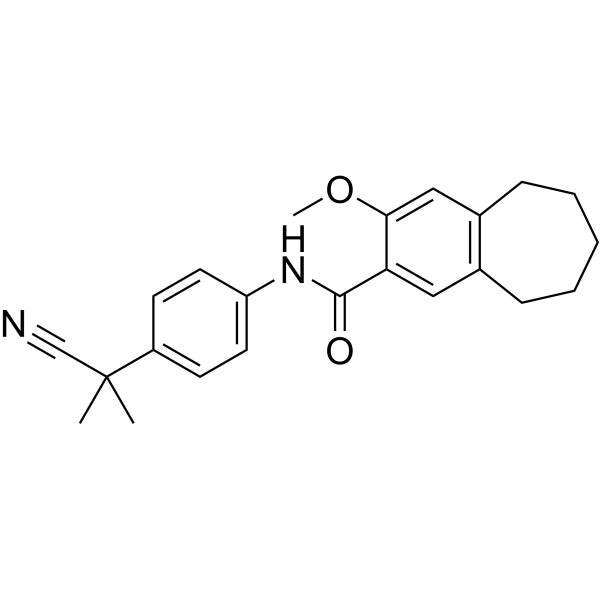
Physicochemical Properties
| Molecular Formula | C23H26N2O2 |
| Molecular Weight | 362.4647 |
| Exact Mass | 362.199 |
| CAS # | 2361289-44-1 |
| PubChem CID | 142616713 |
| Appearance | White to off-white solid powder |
| LogP | 5.2 |
| Hydrogen Bond Donor Count | 1 |
| Hydrogen Bond Acceptor Count | 3 |
| Rotatable Bond Count | 4 |
| Heavy Atom Count | 27 |
| Complexity | 556 |
| Defined Atom Stereocenter Count | 0 |
| SMILES | O(C([H])([H])[H])C1=C(C(N([H])C2C([H])=C([H])C(=C([H])C=2[H])C(C#N)(C([H])([H])[H])C([H])([H])[H])=O)C([H])=C2C(=C1[H])C([H])([H])C([H])([H])C([H])([H])C([H])([H])C2([H])[H] |
| InChi Key | WAOHPFHXTKBTTG-UHFFFAOYSA-N |
| InChi Code | InChI=1S/C23H26N2O2/c1-23(2,15-24)18-9-11-19(12-10-18)25-22(26)20-13-16-7-5-4-6-8-17(16)14-21(20)27-3/h9-14H,4-8H2,1-3H3,(H,25,26) |
| Chemical Name | N-[4-(2-cyanopropan-2-yl)phenyl]-3-methoxy-6,7,8,9-tetrahydro-5H-benzo[7]annulene-2-carboxamide |
| HS Tariff Code | 2934.99.9001 |
| Storage |
Powder-20°C 3 years 4°C 2 years In solvent -80°C 6 months -20°C 1 month |
| Shipping Condition | Room temperature (This product is stable at ambient temperature for a few days during ordinary shipping and time spent in Customs) |
Biological Activity
| Targets | EC90: 270 nM (Chikungunya virus)[1] Dihydroorotate Dehydrogenase[1] |
| ln Vitro | CHIKV-IN-2 (compound 8q) is a strong inhibitor of pan-alphaviruses, with EC90s ranging from 0.85 to 2.5 μM for both attenuated vaccine strains and clinical isolates of CHIKV[1]. CHIKV-IN-2 exhibits efficacy against flaviviruses, including West Nile Virus (WNV; EC90=0.20 μM) and Dengue Virus Strain-2 (DENV-2; EC90=0.60 μM), and alphavirus VEEV (EC90=0.40 μM)[1]. |
| ln Vivo | CHIKV-IN-2 (compound 8q) (80 mg/kg; intraperitoneally twice daily for three days) dramatically reduces the spread of infectious CHIKV to other mouse tissues[1]. CHIKV-IN-2 (40 mg/kg; po, ip, sc) in mice shows a terminal elimination half-life (t1/2=9.9, 18.5, 18.6 h), a moderate bioavailability (F=41%, 43%, 4%), and a Cmax (642, 858, 90 ng/mL)[1]. In mice, CHIKV-IN-2 (1 mg/kg; iv) displays an AUC of 497 h·ng/mL and a terminal elimination half-life of t1/2= 2.02 h[1]. |
| Animal Protocol |
Animal/Disease Models: Female and male C57BL/6 mice[1] Doses: 80 mg/kg Route of Administration: Ip twice a day for 3 days Experimental Results: Failed to inhibit virus loads at the site of infection. diminished virus dissemination to other tissues. Animal/Disease Models: Male C57BL/6 mice were challenged with CHIKV in the right footpad[1] Doses: 1 mg/kg for iv and 40 mg/kg for po, ip, sc (pharmacokinetic/PK Analysis) Route of Administration: Iv, po, ip, sc Experimental Results: Iv: t1/2= 2.02 h; AUC=497 h·ng/mL. Po: F=41%; t1/2=9.9 h; Cmax= 642 ng/mL. Ip: F=43%; t1/2=18.5 h; Cmax=858 ng/mL. Sc: F=4%; t1/2=18.6 h; Cmax=90 ng/mL. |
| References | [1]. Ahmed SK, et, al. Targeting Chikungunya Virus Replication by Benzoannulene Inhibitors. J Med Chem. 2021 Apr 22;64(8):4762-4786. |
Solubility Data
| Solubility (In Vitro) | DMSO : 100 mg/mL (275.89 mM) |
| Solubility (In Vivo) |
Solubility in Formulation 1: ≥ 2.5 mg/mL (6.90 mM) (saturation unknown) in 10% DMSO + 40% PEG300 + 5% Tween80 + 45% Saline (add these co-solvents sequentially from left to right, and one by one), clear solution. For example, if 1 mL of working solution is to be prepared, you can add 100 μL of 25.0 mg/mL clear DMSO stock solution to 400 μL PEG300 and mix evenly; then add 50 μL Tween-80 to the above solution and mix evenly; then add 450 μL normal saline to adjust the volume to 1 mL. Preparation of saline: Dissolve 0.9 g of sodium chloride in 100 mL ddH₂ O to obtain a clear solution. Solubility in Formulation 2: ≥ 2.5 mg/mL (6.90 mM) (saturation unknown) in 10% DMSO + 90% (20% SBE-β-CD in Saline) (add these co-solvents sequentially from left to right, and one by one), clear solution. For example, if 1 mL of working solution is to be prepared, you can add 100 μL of 25.0 mg/mL clear DMSO stock solution to 900 μL of 20% SBE-β-CD physiological saline solution and mix evenly. Preparation of 20% SBE-β-CD in Saline (4°C,1 week): Dissolve 2 g SBE-β-CD in 10 mL saline to obtain a clear solution. Solubility in Formulation 3: ≥ 2.5 mg/mL (6.90 mM) (saturation unknown) in 10% DMSO + 90% Corn Oil (add these co-solvents sequentially from left to right, and one by one), clear solution. For example, if 1 mL of working solution is to be prepared, you can add 100 μL of 25.0 mg/mL clear DMSO stock solution to 900 μL of corn oil and mix evenly. (Please use freshly prepared in vivo formulations for optimal results.) |
| Preparing Stock Solutions | 1 mg | 5 mg | 10 mg | |
| 1 mM | 2.7589 mL | 13.7946 mL | 27.5893 mL | |
| 5 mM | 0.5518 mL | 2.7589 mL | 5.5179 mL | |
| 10 mM | 0.2759 mL | 1.3795 mL | 2.7589 mL |