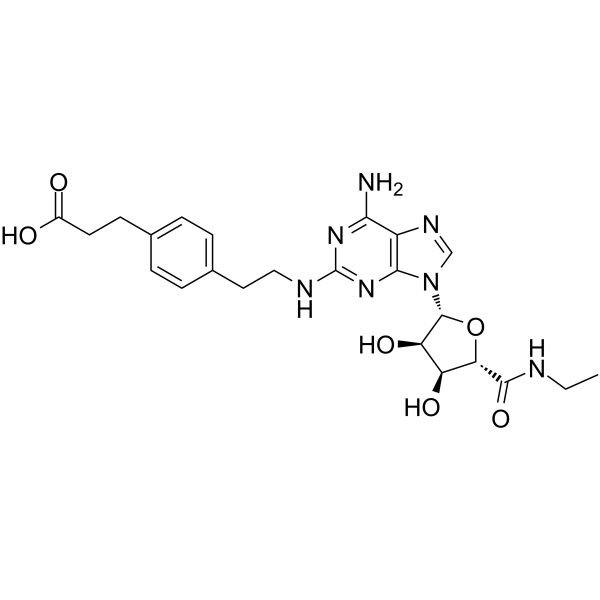
Physicochemical Properties
| Molecular Formula | C23H29N7O6 |
| Molecular Weight | 499.5197 |
| Exact Mass | 499.217931 |
| CAS # | 120225-54-9 |
| Related CAS # | CGS 21680 Hydrochloride;124431-80-7 |
| PubChem CID | 3086599 |
| Appearance | Typically exists as solid at room temperature |
| LogP | 0.88 |
| Hydrogen Bond Donor Count | 6 |
| Hydrogen Bond Acceptor Count | 11 |
| Rotatable Bond Count | 10 |
| Heavy Atom Count | 36 |
| Complexity | 755 |
| Defined Atom Stereocenter Count | 4 |
| SMILES | O1[C@]([H])(C(N([H])C([H])([H])C([H])([H])[H])=O)[C@]([H])([C@]([H])([C@]1([H])N1C([H])=NC2=C(N([H])[H])N=C(N([H])C([H])([H])C([H])([H])C3C([H])=C([H])C(=C([H])C=3[H])C([H])([H])C([H])([H])C(=O)O[H])N=C12)O[H])O[H] |
| InChi Key | PAOANWZGLPPROA-RQXXJAGISA-N |
| InChi Code | InChI=1S/C23H29N7O6/c1-2-25-21(35)18-16(33)17(34)22(36-18)30-11-27-15-19(24)28-23(29-20(15)30)26-10-9-13-5-3-12(4-6-13)7-8-14(31)32/h3-6,11,16-18,22,33-34H,2,7-10H2,1H3,(H,25,35)(H,31,32)(H3,24,26,28,29)/t16-,17+,18-,22+/m0/s1 |
| Chemical Name | 3-[4-[2-[[6-amino-9-[(2R,3R,4S,5S)-5-(ethylcarbamoyl)-3,4-dihydroxyoxolan-2-yl]purin-2-yl]amino]ethyl]phenyl]propanoic acid |
| Synonyms | CGS-21680; 2-(4-(2-Carboxyethyl)phenethylamino)-5'-N-ethylcarboxamidoadenosine; 124182-57-6; CGS21680; 3-[4-[2-[[6-amino-9-[(2R,3R,4S,5S)-5-(ethylcarbamoyl)-3,4-dihydroxyoxolan-2-yl]purin-2-yl]amino]ethyl]phenyl]propanoic acid; CHEMBL331372; |
| HS Tariff Code | 2934.99.9001 |
| Storage |
Powder-20°C 3 years 4°C 2 years In solvent -80°C 6 months -20°C 1 month |
| Shipping Condition | Room temperature (This product is stable at ambient temperature for a few days during ordinary shipping and time spent in Customs) |
Biological Activity
| Targets | Adenosine A2A receptor ( Ki = 27 nM ) |
| ln Vitro | CGS21680 markedly increased the expression of CD39 and CD73. Adenosine triphosphate (ATP) hydrolysis and adenosine synthesis are accelerated by CGS21680 [1]. While CGS21680 (10 nM) by itself demonstrated very little survival activity, the addition of the phosphodiesterase inhibitor IBMX greatly increased this activity. Neurotrophin receptor transactivation and the adenylyl cyclase-cAMP-PKA pathway work together to provide CGS21680's survival effect on cultured motor neurons [4]. |
| ln Vivo | The intervention CGS21680 (1 mg/kg/ip) encourages the growth of EAN. In Lewis rats, CGS21680 aggravates experimental autoimmune neuritis brought on by bovine peripheral myelin. A drop in CD4+ Foxp3+ T cells and an increase in CD4+ CXCR5+ T cells, B cells, dendritic cells, and antigen-specific autoantibodies are observed in conjunction with the worsening of the disease; the latter may be brought on by CGS21680-induced IL-2 suppression [2]. Rats treated with CGS21680 (0.1 mg/kg, i.p.) saw a brief rise in heart rate but no change in blood pressure; at 0.01 mg/kg, neither the heart rate nor blood pressure changed. Both dosages of CGS21680 prevented cerebral impairments from the first day to seven days following acute MCAo. During this period, it enhanced the cellularity of the ischemic cortex and striatum, decreased microgliosis and astrogliosis, and improved myelin structure in the striatum. CGS21680 decreased the amount of granulocytes infiltrating into ischemic tissue two days following transient MCAo [3]. |
| Enzyme Assay | Cloning of the human adenosine receptors, stable transfection of cells, cell culture, membrane preparation, radioligand binding, and adenylyl cyclase activity have been fully described elsewhere. Briefly, all human subtypes were stably transfected into Chinese hamster ovary (CHO) cells in order to be able to study their pharmacological profile in an identical cellular background utilizing radioligand binding studies (A1, A2A, A3) or adenylyl cyclase activity assays (A2B). Receptor binding affinity was determined using [3 H]CCPA as radioligand at A1 receptors, whereas [3 H]NECA was used at A2A and A3 subtypes. The procedure was performed as described previously. Due to the lack of a suitable radioligand the relative potency of agonists at A2B adenosine receptors was determined in adenylyl cyclase experiments. The procedure was carried out as described previously with minor modifications[2]. |
| Cell Assay | The survival activity of adenosine A(2A) agonist CGS21680 on motoneurons in culture through the transactivation of neurotrophin receptor TrkB has been reported previously; however, since adenosine A(2A) receptor belongs to a Gs-protein-coupled receptor, we investigated the involvement of the cAMP pathway in the survival activity of CGS21680 using purified motoneurons in culture. CGS21680 alone showed only small survival activity, but the activity was significantly enhanced by the addition of a phosphodiesterase inhibitor, IBMX. This survival activity was partially inhibited by a protein kinase A inhibitor H89 or a neurotrophin receptor tyrosine kinase inhibitor K252a, and was completely inhibited by their combination. These results indicate that the survival activity of CGS21680 on motoneurons is exerted by the mixed effect of the adenylate cyclase-cAMP-PKA pathway and transactivation of Trk neurotrophin receptor. Under conditions in which the maximum survival of motoneurons was supported by sufficient concentrations of brain-derived neurotrophic factor (BDNF), a TrkB ligand, the addition of 100μM AMPA for 3 days led to significant cell death. Treatment with CGS21680 and IBMX protected motoneurons from the toxicity of AMPA, further supporting the presence of a TrkB-independent pathway of CGS21680 activity and suggesting a novel therapeutic approach to motoneuron diseases such as amyotrophic lateral sclerosis[5]. |
| References |
[1]. Adenosine and the adenosine A2A receptor agonist, CGS21680, upregulate CD39 and CD73 expression through E2F-1 and CREB in regulatory T cells isolated from septic mice. Int J Mol Med. 2016 Sep;38(3):969-75. [2]. Adenosine receptor agonists: synthesis and binding affinity of 2-(aryl)alkylthioadenosine derivatives. [3]. Activation of the adenosine A2A receptor exacerbates experimental autoimmune neuritis in Lewis rats in association with enhanced humoral immunity. J Neuroimmunol. 2016 Apr 15;293:129-36. [4]. Low doses of the selective adenosine A2A receptor agonist CGS21680 are protective in a rat model of transient cerebral ischemia. Brain Res. 2014 Mar 10;1551:59-72. [5]. Trk and cAMP-dependent survival activity of adenosine A(2A) agonist CGS21680 on rat motoneurons in culture. Neurosci Lett. 2012 Jul 26;522(1):21-4. |
| Additional Infomation | CGS-21680 is a derivative of adenosine in which the 5'-hydroxymethyl group is replaced by N-ethylcarboxamido and the hydrogen at position 2 on the adenine is replaced by a 4-(2-carboxyethyl)phenethylamino group. It has a role as an adenosine A2A receptor agonist and an anti-inflammatory agent. It is a member of adenosines, a monocarboxylic acid and a dicarboxylic acid monoamide. It is functionally related to an adenosine. |
Solubility Data
| Solubility (In Vitro) | May dissolve in DMSO (in most cases), if not, try other solvents such as H2O, Ethanol, or DMF with a minute amount of products to avoid loss of samples |
| Solubility (In Vivo) |
Note: Listed below are some common formulations that may be used to formulate products with low water solubility (e.g. < 1 mg/mL), you may test these formulations using a minute amount of products to avoid loss of samples. Injection Formulations (e.g. IP/IV/IM/SC) Injection Formulation 1: DMSO : Tween 80: Saline = 10 : 5 : 85 (i.e. 100 μL DMSO stock solution → 50 μL Tween 80 → 850 μL Saline) *Preparation of saline: Dissolve 0.9 g of sodium chloride in 100 mL ddH ₂ O to obtain a clear solution. Injection Formulation 2: DMSO : PEG300 :Tween 80 : Saline = 10 : 40 : 5 : 45 (i.e. 100 μL DMSO → 400 μLPEG300 → 50 μL Tween 80 → 450 μL Saline) Injection Formulation 3: DMSO : Corn oil = 10 : 90 (i.e. 100 μL DMSO → 900 μL Corn oil) Example: Take the Injection Formulation 3 (DMSO : Corn oil = 10 : 90) as an example, if 1 mL of 2.5 mg/mL working solution is to be prepared, you can take 100 μL 25 mg/mL DMSO stock solution and add to 900 μL corn oil, mix well to obtain a clear or suspension solution (2.5 mg/mL, ready for use in animals). Injection Formulation 4: DMSO : 20% SBE-β-CD in saline = 10 : 90 [i.e. 100 μL DMSO → 900 μL (20% SBE-β-CD in saline)] *Preparation of 20% SBE-β-CD in Saline (4°C,1 week): Dissolve 2 g SBE-β-CD in 10 mL saline to obtain a clear solution. Injection Formulation 5: 2-Hydroxypropyl-β-cyclodextrin : Saline = 50 : 50 (i.e. 500 μL 2-Hydroxypropyl-β-cyclodextrin → 500 μL Saline) Injection Formulation 6: DMSO : PEG300 : castor oil : Saline = 5 : 10 : 20 : 65 (i.e. 50 μL DMSO → 100 μLPEG300 → 200 μL castor oil → 650 μL Saline) Injection Formulation 7: Ethanol : Cremophor : Saline = 10: 10 : 80 (i.e. 100 μL Ethanol → 100 μL Cremophor → 800 μL Saline) Injection Formulation 8: Dissolve in Cremophor/Ethanol (50 : 50), then diluted by Saline Injection Formulation 9: EtOH : Corn oil = 10 : 90 (i.e. 100 μL EtOH → 900 μL Corn oil) Injection Formulation 10: EtOH : PEG300:Tween 80 : Saline = 10 : 40 : 5 : 45 (i.e. 100 μL EtOH → 400 μLPEG300 → 50 μL Tween 80 → 450 μL Saline) Oral Formulations Oral Formulation 1: Suspend in 0.5% CMC Na (carboxymethylcellulose sodium) Oral Formulation 2: Suspend in 0.5% Carboxymethyl cellulose Example: Take the Oral Formulation 1 (Suspend in 0.5% CMC Na) as an example, if 100 mL of 2.5 mg/mL working solution is to be prepared, you can first prepare 0.5% CMC Na solution by measuring 0.5 g CMC Na and dissolve it in 100 mL ddH2O to obtain a clear solution; then add 250 mg of the product to 100 mL 0.5% CMC Na solution, to make the suspension solution (2.5 mg/mL, ready for use in animals). Oral Formulation 3: Dissolved in PEG400 Oral Formulation 4: Suspend in 0.2% Carboxymethyl cellulose Oral Formulation 5: Dissolve in 0.25% Tween 80 and 0.5% Carboxymethyl cellulose Oral Formulation 6: Mixing with food powders Note: Please be aware that the above formulations are for reference only. InvivoChem strongly recommends customers to read literature methods/protocols carefully before determining which formulation you should use for in vivo studies, as different compounds have different solubility properties and have to be formulated differently. (Please use freshly prepared in vivo formulations for optimal results.) |
| Preparing Stock Solutions | 1 mg | 5 mg | 10 mg | |
| 1 mM | 2.0019 mL | 10.0096 mL | 20.0192 mL | |
| 5 mM | 0.4004 mL | 2.0019 mL | 4.0038 mL | |
| 10 mM | 0.2002 mL | 1.0010 mL | 2.0019 mL |