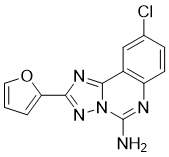
CGS 15943 is a novel, potent and selective adenosine receptor antagonist with Ki values of 3.5, 4.2, 16 and 51 nM for human A1, A2A, A2B and A3 receptors respectively.
Physicochemical Properties
| Molecular Formula | C13H8CLN5O |
| Molecular Weight | 285.68852 |
| Exact Mass | 285.042 |
| CAS # | 104615-18-1 |
| PubChem CID | 2690 |
| Appearance | White to off-white solid powder |
| Density | 1.72 g/cm3 |
| Boiling Point | 566.6ºC at 760 mmHg |
| Melting Point | 278-279 °C |
| Flash Point | 296.5ºC |
| Vapour Pressure | 7.4E-13mmHg at 25°C |
| Index of Refraction | 1.84 |
| LogP | 3.354 |
| Hydrogen Bond Donor Count | 1 |
| Hydrogen Bond Acceptor Count | 5 |
| Rotatable Bond Count | 1 |
| Heavy Atom Count | 20 |
| Complexity | 373 |
| Defined Atom Stereocenter Count | 0 |
| InChi Key | MSJODEOZODDVGW-UHFFFAOYSA-N |
| InChi Code | InChI=1S/C13H8ClN5O/c14-7-3-4-9-8(6-7)12-17-11(10-2-1-5-20-10)18-19(12)13(15)16-9/h1-6H,(H2,15,16) |
| Chemical Name | 9-chloro-2-furan-2-yl-[1,2,4]triazolo[1,5-c]quinazolin-5-amine |
| Synonyms | CGS 15943 CGS15943 CGS-15943. |
| HS Tariff Code | 2934.99.9001 |
| Storage |
Powder-20°C 3 years 4°C 2 years In solvent -80°C 6 months -20°C 1 month |
| Shipping Condition | Room temperature (This product is stable at ambient temperature for a few days during ordinary shipping and time spent in Customs) |
Biological Activity
| ln Vitro | CGS 15943 slightly inhibits p110δ with an IC50 of 8.47 μM and suppresses the intermittent activity of class IB PI3K isoform p110γ with an IC50 of 1.1 μM [3]. HLF and SK-Hep are inhibited by CGS 15943 (0–20 μM; 72 hours). CGS 15943 (0 -20 μM; 24 hours) inhibits the development of HepG2 and PLC-PRF-5 cells [3] as well as the phosphorylation of Akt residues Ser473 and Thr308 in HLF and Sk-Hep-1 cells [3]. |
| Cell Assay |
Cell viability assay [3] Cell Types: HLF, SK-Hep-1, HepG2 and PLC-PRF-5 Cell Tested Concentrations: 0 μM; ]. 1μM; 5μM; 10μM; 20 μM Incubation Duration: 24 hrs (hours) Experimental Results: Inhibited the growth of four different HCC cell lines. Western Blot Analysis[3] Cell Types: HLF and Sk-Hep-1 cells Tested Concentrations: 0 μM; 1μM; 5μM; 10μM; 20 μM Incubation Duration: 24 hrs (hours) Experimental Results: Inhibition of PI3K/ in HLF and Sk-Hep-1 cells Akt pathway |
| References |
[1]. CGS 15943, an adenosine A2 receptor antagonist, reduces cerebral ischemic injury in the Mongolian gerbil. Life Sci. 1994;55(3):PL61-5. [2]. Adenosine receptors and their ligands. Naunyn Schmiedebergs Arch Pharmacol. 2000 Nov;362(4-5):382-91. [3]. Caffeine and the analog CGS 15943 inhibit cancer cell growth by targeting the phosphoinositide 3-kinase/Akt pathway. Cancer Biol Ther. 2014 May;15(5):524-32. |
| Additional Infomation | CGS 15943 is a member of the class of triazoloquinazolines that is [1,2,4]triazolo[1,5-c]quinazoline substited at positions 2, 5 and 9 by furan-2-yl, amino and chloro groups respectively. A potent antagonist at adenosine A1 and adenosine A2A receptors. It has a role as an adenosine A1 receptor antagonist, an adenosine A2A receptor antagonist, a central nervous system stimulant and an antineoplastic agent. It is a triazoloquinazoline, an organochlorine compound, a member of furans, a biaryl, an aromatic amine and a primary amino compound. |
Solubility Data
| Solubility (In Vitro) | DMSO : ~12.22 mg/mL (~42.77 mM) |
| Solubility (In Vivo) |
Solubility in Formulation 1: 1.22 mg/mL (4.27 mM) in 10% DMSO + 40% PEG300 + 5% Tween80 + 45% Saline (add these co-solvents sequentially from left to right, and one by one), suspension solution; with sonication. For example, if 1 mL of working solution is to be prepared, you can add 100 μL of 12.2 mg/mL clear DMSO stock solution to 400 μL PEG300 and mix evenly; then add 50 μL Tween-80 to the above solution and mix evenly; then add 450 μL normal saline to adjust the volume to 1 mL. Preparation of saline: Dissolve 0.9 g of sodium chloride in 100 mL ddH₂ O to obtain a clear solution. Solubility in Formulation 2: 1.22 mg/mL (4.27 mM) in 10% DMSO + 90% (20% SBE-β-CD in Saline) (add these co-solvents sequentially from left to right, and one by one), suspension solution; with ultrasonication. For example, if 1 mL of working solution is to be prepared, you can add 100 μL of 12.2 mg/mL clear DMSO stock solution to 900 μL of 20% SBE-β-CD physiological saline solution and mix evenly. Preparation of 20% SBE-β-CD in Saline (4°C,1 week): Dissolve 2 g SBE-β-CD in 10 mL saline to obtain a clear solution. Solubility in Formulation 3: ≥ 1.22 mg/mL (4.27 mM) (saturation unknown) in 10% DMSO + 90% Corn Oil (add these co-solvents sequentially from left to right, and one by one), clear solution. For example, if 1 mL of working solution is to be prepared, you can add 100 μL of 12.2 mg/mL clear DMSO stock solution to 900 μL corn oil and mix evenly. (Please use freshly prepared in vivo formulations for optimal results.) |
| Preparing Stock Solutions | 1 mg | 5 mg | 10 mg | |
| 1 mM | 3.5003 mL | 17.5015 mL | 35.0030 mL | |
| 5 mM | 0.7001 mL | 3.5003 mL | 7.0006 mL | |
| 10 mM | 0.3500 mL | 1.7501 mL | 3.5003 mL |