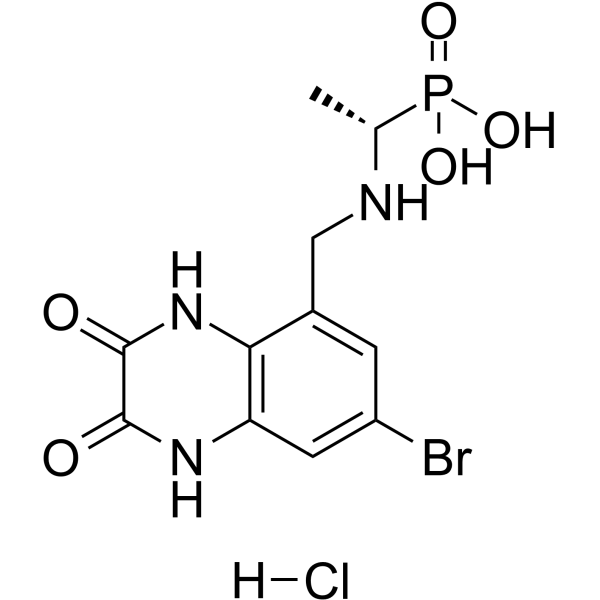
Physicochemical Properties
| Molecular Formula | C11H14BRCLN3O5P |
| Molecular Weight | 414.576721668243 |
| Exact Mass | 412.954 |
| CAS # | 1135278-54-4 |
| PubChem CID | 24978530 |
| Appearance | White to off-white solid powder |
| Hydrogen Bond Donor Count | 6 |
| Hydrogen Bond Acceptor Count | 6 |
| Rotatable Bond Count | 4 |
| Heavy Atom Count | 22 |
| Complexity | 485 |
| Defined Atom Stereocenter Count | 1 |
| SMILES | BrC1C=C2C(=C(C=1)CN[C@H](C)P(=O)(O)O)NC(C(N2)=O)=O.Cl |
| InChi Key | MZQQZBPMRPDKTB-JEDNCBNOSA-N |
| InChi Code | InChI=1S/C11H13BrN3O5P.ClH/c1-5(21(18,19)20)13-4-6-2-7(12)3-8-9(6)15-11(17)10(16)14-8;/h2-3,5,13H,4H2,1H3,(H,14,16)(H,15,17)(H2,18,19,20);1H/t5-;/m0./s1 |
| Chemical Name | [(1S)-1-[(7-bromo-2,3-dioxo-1,4-dihydroquinoxalin-5-yl)methylamino]ethyl]phosphonic acid;hydrochloride |
| Synonyms | CGP 78608 HCl; CGP 78608 HCl |
| HS Tariff Code | 2934.99.9001 |
| Storage |
Powder-20°C 3 years 4°C 2 years In solvent -80°C 6 months -20°C 1 month |
| Shipping Condition | Room temperature (This product is stable at ambient temperature for a few days during ordinary shipping and time spent in Customs) |
Biological Activity
| ln Vitro | GluN1/GluN3A receptors' glycine sensitivity is decreased by CGP-78608 hydrochloride via intersubunit allosteric interactions between GluN1 and GluN3A agonist binding domain (ABD) sites [2]. One of the causes of ammonia neurotoxicity, ammonia-dependent cGMP production, is reduced or eliminated by CGP 78608 hydrochloride [3]. |
| ln Vivo | CGP-78608 hydrochloride intraperitoneally injected mice demonstrated effective anticonvulsant effects in the electric shock-induced convulsions test [1]. |
| References |
[1]. Competitive Gly/NMDA receptor antagonists. Curr Top Med Chem. 2006;6(8):809-21. [2]. Unmasking GluN1/GluN3A excitatory glycine NMDA receptors. Nat Commun. 2018 Nov 13;9(1):4769. [3]. A novel glycine site-specific N-methyl-D-aspartate receptor antagonist prevents activation of the NMDA/NO/CGMP pathway by ammonia. Brain Res. 2004 Jul 23;1015(1-2):186-8. |
| Additional Infomation | CGP 78608 hydrochloride is a hydrochloride that is the monohydrochloride salt of CGP 78608. Potent and selective NMDA antagonist that acts through the glycine site (IC50 = 5 nM). Displays >500-fold selectivity over kainate and AMPA receptors (IC50 values are 2.7 and 3 muM respectively). Anticonvulsant in vivo following systemic administration. It has a role as a prodrug, a NMDA receptor antagonist and an anticonvulsant. It is a conjugate base of a CGP 78608(1+). |
Solubility Data
| Solubility (In Vitro) | May dissolve in DMSO (in most cases), if not, try other solvents such as H2O, Ethanol, or DMF with a minute amount of products to avoid loss of samples |
| Solubility (In Vivo) |
Note: Listed below are some common formulations that may be used to formulate products with low water solubility (e.g. < 1 mg/mL), you may test these formulations using a minute amount of products to avoid loss of samples. Injection Formulations (e.g. IP/IV/IM/SC) Injection Formulation 1: DMSO : Tween 80: Saline = 10 : 5 : 85 (i.e. 100 μL DMSO stock solution → 50 μL Tween 80 → 850 μL Saline) *Preparation of saline: Dissolve 0.9 g of sodium chloride in 100 mL ddH ₂ O to obtain a clear solution. Injection Formulation 2: DMSO : PEG300 :Tween 80 : Saline = 10 : 40 : 5 : 45 (i.e. 100 μL DMSO → 400 μLPEG300 → 50 μL Tween 80 → 450 μL Saline) Injection Formulation 3: DMSO : Corn oil = 10 : 90 (i.e. 100 μL DMSO → 900 μL Corn oil) Example: Take the Injection Formulation 3 (DMSO : Corn oil = 10 : 90) as an example, if 1 mL of 2.5 mg/mL working solution is to be prepared, you can take 100 μL 25 mg/mL DMSO stock solution and add to 900 μL corn oil, mix well to obtain a clear or suspension solution (2.5 mg/mL, ready for use in animals). Injection Formulation 4: DMSO : 20% SBE-β-CD in saline = 10 : 90 [i.e. 100 μL DMSO → 900 μL (20% SBE-β-CD in saline)] *Preparation of 20% SBE-β-CD in Saline (4°C,1 week): Dissolve 2 g SBE-β-CD in 10 mL saline to obtain a clear solution. Injection Formulation 5: 2-Hydroxypropyl-β-cyclodextrin : Saline = 50 : 50 (i.e. 500 μL 2-Hydroxypropyl-β-cyclodextrin → 500 μL Saline) Injection Formulation 6: DMSO : PEG300 : castor oil : Saline = 5 : 10 : 20 : 65 (i.e. 50 μL DMSO → 100 μLPEG300 → 200 μL castor oil → 650 μL Saline) Injection Formulation 7: Ethanol : Cremophor : Saline = 10: 10 : 80 (i.e. 100 μL Ethanol → 100 μL Cremophor → 800 μL Saline) Injection Formulation 8: Dissolve in Cremophor/Ethanol (50 : 50), then diluted by Saline Injection Formulation 9: EtOH : Corn oil = 10 : 90 (i.e. 100 μL EtOH → 900 μL Corn oil) Injection Formulation 10: EtOH : PEG300:Tween 80 : Saline = 10 : 40 : 5 : 45 (i.e. 100 μL EtOH → 400 μLPEG300 → 50 μL Tween 80 → 450 μL Saline) Oral Formulations Oral Formulation 1: Suspend in 0.5% CMC Na (carboxymethylcellulose sodium) Oral Formulation 2: Suspend in 0.5% Carboxymethyl cellulose Example: Take the Oral Formulation 1 (Suspend in 0.5% CMC Na) as an example, if 100 mL of 2.5 mg/mL working solution is to be prepared, you can first prepare 0.5% CMC Na solution by measuring 0.5 g CMC Na and dissolve it in 100 mL ddH2O to obtain a clear solution; then add 250 mg of the product to 100 mL 0.5% CMC Na solution, to make the suspension solution (2.5 mg/mL, ready for use in animals). Oral Formulation 3: Dissolved in PEG400 Oral Formulation 4: Suspend in 0.2% Carboxymethyl cellulose Oral Formulation 5: Dissolve in 0.25% Tween 80 and 0.5% Carboxymethyl cellulose Oral Formulation 6: Mixing with food powders Note: Please be aware that the above formulations are for reference only. InvivoChem strongly recommends customers to read literature methods/protocols carefully before determining which formulation you should use for in vivo studies, as different compounds have different solubility properties and have to be formulated differently. (Please use freshly prepared in vivo formulations for optimal results.) |
| Preparing Stock Solutions | 1 mg | 5 mg | 10 mg | |
| 1 mM | 2.4121 mL | 12.0604 mL | 24.1208 mL | |
| 5 mM | 0.4824 mL | 2.4121 mL | 4.8242 mL | |
| 10 mM | 0.2412 mL | 1.2060 mL | 2.4121 mL |