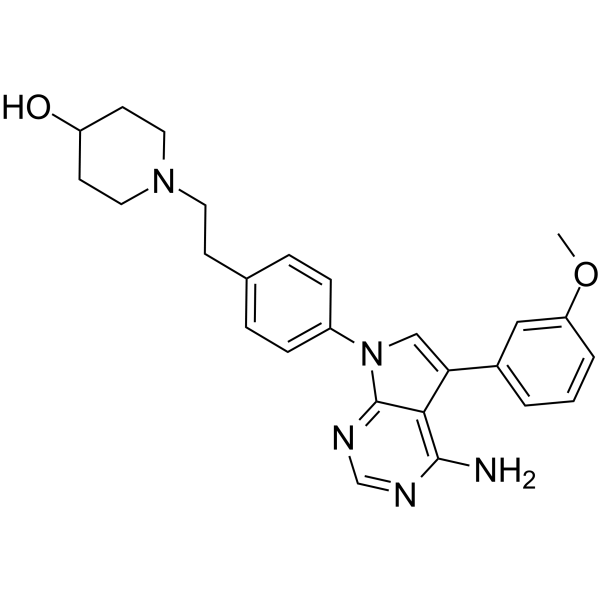
Physicochemical Properties
| Molecular Formula | C26H29N5O2 |
| Molecular Weight | 443.54 |
| Exact Mass | 443.232 |
| Elemental Analysis | C, 70.41; H, 6.59; N, 15.79; O, 7.21 |
| CAS # | 234772-64-6 |
| Related CAS # | CGP77675 hydrate |
| PubChem CID | 5311381 |
| Appearance | White to light yellow solid powder |
| LogP | 4.196 |
| Hydrogen Bond Donor Count | 2 |
| Hydrogen Bond Acceptor Count | 6 |
| Rotatable Bond Count | 6 |
| Heavy Atom Count | 33 |
| Complexity | 608 |
| Defined Atom Stereocenter Count | 0 |
| SMILES | COC1=CC=CC(=C1)C2=CN(C3=CC=C(C=C3)CCN4CCC(CC4)O)C5=NC=NC(=C25)N |
| InChi Key | WUPXZZWTHIZICK-UHFFFAOYSA-N |
| InChi Code | InChI=1S/C26H29N5O2/c1-33-22-4-2-3-19(15-22)23-16-31(26-24(23)25(27)28-17-29-26)20-7-5-18(6-8-20)9-12-30-13-10-21(32)11-14-30/h2-8,15-17,21,32H,9-14H2,1H3,(H2,27,28,29) |
| Chemical Name | 1-(4-(4-amino-5-(3-methoxyphenyl)-7H-pyrrolo[2,3-d]pyrimidin-7-yl)phenethyl)piperidin-4-ol |
| Synonyms | CGP77675; CGP 77675; CGP-77675 |
| HS Tariff Code | 2934.99.9001 |
| Storage |
Powder-20°C 3 years 4°C 2 years In solvent -80°C 6 months -20°C 1 month Note: Please store this product in a sealed and protected environment (e.g. under nitrogen), avoid exposure to moisture. |
| Shipping Condition | Room temperature (This product is stable at ambient temperature for a few days during ordinary shipping and time spent in Customs) |
Biological Activity
| Targets | Src (IC50s = 5-40 nM) |
| ln Vitro | Phosphorylation of poly-Glu-Tyr (IC50 = 5.5 nM) and optimal Src substrate (OSS) peptide (IC50 = 16.7 nM) are both dose-dependently inhibited by CGP77675. These IC50 values resemble the results of using 20 nM chicken Src [1]. With an IC50 of 0.8 μM, CGP77675 prevents bone resorption caused by parathyroid hormone in rat fetal long bone cultures [1]. CGP77675 (0.04-10 μM; 2 hours) has minimal effect on Src in IC8.1 cells (IC50 values 0.2, 0.5, and 5.7 μM), but it effectively inhibits the tyrosine phosphorylation of the Src substrates Fak and paxillin [1]. |
| ln Vivo | Mice treated subcutaneously twice daily with CGP77675 (1, 5 and 25 mg/kg) are able to prevent IL-1β-induced hypercalcemia [1]. In young Ovx rats, CGP77675 (10 and 50 mg/kg; oral; twice daily for 6 weeks) recovers bone microarchitectural features and partially prevents bone loss [1]. |
| Enzyme Assay |
Protein kinase assays [1] 33P-based tyrosine kinase assays with human Src enzyme were performed with a kinase buffer containing 20 mmol/L Tris, pH 7.4, 10 mmol/L MgCl2, 0.1 mmol/L sodium vanadate, and 1 mmol/L dithiothreitol (DTT), substrates poly Glu-Tyr (4:1), or optimal Src substrate (OSS) peptide at 1 and 0.5 mg/mL; 50 μmol/L adenosine triphosphate (ATP), and 0.5–2 μCi of 33P-γATP per assay. Incubations were performed for 15 min at room temperature. The reactions were stopped with 33 mmol/L ethylenediaminetetraacetic acid (EDTA) and spotted onto phosphocellulose paper squares . The paper squares were washed three times with 0.5% phosphoric acid, once with absolute ethanol, and air-dried, and the paper-bound radioactivity was quantified in a liquid scintillation counter. Chicken Src was expressed and purified as described before; the assay was similar to that with human Src except that 6 μmol/L ATP was used for routine screening, and the phosphorylated poly Glu-Tyr was retained on an Immobilon-P membrane. Human Lck was expressed as His-tagged protein in a baculovirus system, purified, and assayed in a kinase buffer containing 25 mmol/L Hepes, pH 7.4, 10 mmol/L MnCl2, 0.1 mmol/L sodium vanadate, 0.2 mmol/L DTT, 6 μmol/L ATP, and 0.5 mg/mL poly-Glu-Tyr substrate. Assays with EGF receptor, v-Abl, and Cdc2 were done as previously described. The kinase activity of human vascular endothelial growth factor (VEGF) receptors KDR and Flt-1 was tested by measuring the phosphorylation of a synthetic substrate, poly-Glu-Tyr (3 μg/mL), by purified fusion proteins of glutathione S-transferase with the kinase domains of the receptors. The kinase buffer contained 20 mmol/L Tris, pH 7.6, 3 mmol/L MnCl2, 3 mmol/L MgCl2, 1 mmol/L DTT, 10 μmol/L sodium vanadate, and 8 μmol/L ATP. Kinase autophosphorylation reactions [1] Human Src kinase (UBI; 1.5 U/reaction) was incubated for 10 min at 37°C in the kinase buffer containing 20 mmol/L Tris, pH 7.4, 10 mmol/L MgCl2, 0.1 mmol/L Na-vanadate, 1 mmol/L DTT, and 10 μCi [32P]ATP (3000 Ci/mmol) per reaction. The autophosphorylation was analyzed after protein separation by sodium dodecyl sulfate–polyacrylamide gel electrophoresis (SDS-PAGE) and autoradiography, and quantified after the exposure to the PhosphorImager screen (Molecular Dynamics, Sunnyvale, CA). Focal adhesion kinase was immunoprecipitated with the monoclonal antibody 2A7 (UBI), and immune complexes were washed as described above. An additional wash was performed in kinase buffer (30 mmol/L Tris, pH 7.5, 2 mmol/L MgCl2, and 5 mmol/L MnCl2). The protein kinase assays were performed in 30 μL kinase buffer and 10 μCi [32P]ATP (3000 Ci/mmol) per reaction at 37°C for 10 min. Immune complexes were washed three times with 1 mL of ice-cold TNE (Tris-NaCl-EDTA) buffer (see Immunoprecipitation) to remove free [32P]ATP. The antigens were released from the beads by boiling in 50 μL SDS loading buffer and were subjected to 12% SDS-PAGE. The autophosphorylation was analyzed by autoradiography and quantified after the exposure to the PhosphorImager screen. |
| Cell Assay |
Cell Viability Assay[1] Cell Types: MC3T3-E1 Cell Tested Concentrations: 0.2, 1 and 5 μM Incubation Duration: 3 days Experimental Results: Treatment for up to 3 days did not affect cell viability. Western Blot Analysis[1] Cell Types: Src overexpression IC8.1 Cell Tested Concentrations: 0.04, 0.2, 1, 5 and 10 μM Incubation Duration: 2 hrs (hours) Experimental Results: Dose-dependent inhibition of phosphorylation of Fak and paxillin, but not Src. |
| Animal Protocol |
Animal/Disease Models: Male mice (Tif:MAGf; Novartis Animal Farm), body weight 25-30 g [1] Doses: 1, 5 and 25 mg/kg Route of Administration: subcutaneous injection; twice (two times) daily Experimental Results: Prevention of IL-1β Induced hypercalcemia in mice without affecting serum amyloid levels. Animal/Disease Models: 8weeks old (175-209 g) female rats, SD (SD (Sprague-Dawley)) derivative strain Tif:RAlf[1] Doses: 10 and 50 mg/kg Route of Administration: Oral; twice (two times) daily for 6 weeks Experimental Results:Partial prevention of bone loss. |
| References |
[1]. A novel inhibitor of the tyrosine kinase Src suppresses phosphorylation of its major cellularsubstrates and reduces bone resorption in vitro and in rodent models in vivo. Bone. 1999 May;24(5):437-49. |
Solubility Data
| Solubility (In Vitro) | DMSO : ~26.0 mg/mL (~58.62 mM) |
| Solubility (In Vivo) |
Solubility in Formulation 1: ≥ 2.08 mg/mL (4.69 mM) (saturation unknown) in 10% DMSO + 90% (20% SBE-β-CD in Saline) (add these co-solvents sequentially from left to right, and one by one), clear solution. For example, if 1 mL of working solution is to be prepared, you can add 100 μL of 20.8 mg/mL clear DMSO stock solution to 900 μL of 20% SBE-β-CD physiological saline solution and mix evenly. Preparation of 20% SBE-β-CD in Saline (4°C,1 week): Dissolve 2 g SBE-β-CD in 10 mL saline to obtain a clear solution. (Please use freshly prepared in vivo formulations for optimal results.) |
| Preparing Stock Solutions | 1 mg | 5 mg | 10 mg | |
| 1 mM | 2.2546 mL | 11.2729 mL | 22.5459 mL | |
| 5 mM | 0.4509 mL | 2.2546 mL | 4.5092 mL | |
| 10 mM | 0.2255 mL | 1.1273 mL | 2.2546 mL |