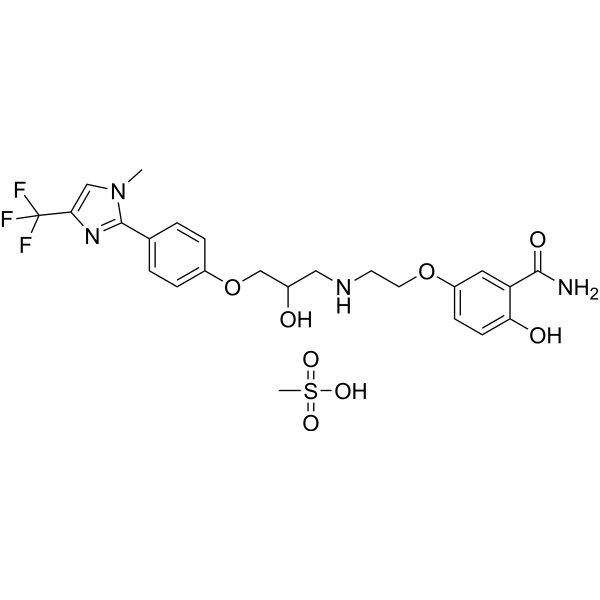
Physicochemical Properties
| Molecular Formula | C24H29F3N4O8S |
| Molecular Weight | 590.569275617599 |
| Exact Mass | 590.166 |
| Elemental Analysis | C, 48.81; H, 4.95; F, 9.65; N, 9.49; O, 21.67; S, 5.43 |
| CAS # | 105737-62-0 |
| Related CAS # | CGP 20712 dihydrochloride;1216905-73-5 |
| PubChem CID | 10008573 |
| Appearance | White to yellow solid powder |
| Boiling Point | 764.8ºC at 760mmHg |
| Flash Point | 416.3ºC |
| Vapour Pressure | 9.69E-23mmHg at 25°C |
| LogP | 3.994 |
| Hydrogen Bond Donor Count | 5 |
| Hydrogen Bond Acceptor Count | 13 |
| Rotatable Bond Count | 11 |
| Heavy Atom Count | 40 |
| Complexity | 758 |
| Defined Atom Stereocenter Count | 0 |
| SMILES | S(C)(=O)(=O)O.FC(C1=CN(C)C(C2C=CC(=CC=2)OCC(CNCCOC2C=CC(=C(C(N)=O)C=2)O)O)=N1)(F)F |
| InChi Key | VFPOVCXWKBYDNF-UHFFFAOYSA-N |
| InChi Code | InChI=1S/C23H25F3N4O5.CH4O3S/c1-30-12-20(23(24,25)26)29-22(30)14-2-4-16(5-3-14)35-13-15(31)11-28-8-9-34-17-6-7-19(32)18(10-17)21(27)33;1-5(2,3)4/h2-7,10,12,15,28,31-32H,8-9,11,13H2,1H3,(H2,27,33);1H3,(H,2,3,4) |
| Chemical Name | 2-hydroxy-5-[2-[[2-hydroxy-3-[4-[1-methyl-4-(trifluoromethyl)imidazol-2-yl]phenoxy]propyl]amino]ethoxy]benzamide;methanesulfonic acid |
| Synonyms | CGP 20712 A; CGP 20712A methanesulfonate; 105737-62-0; CGP 20712-A; CGP 20712-A; CGP-20712A methanesulfonate salt; UNII-CNU8DA2K9J; CNU8DA2K9J; 1-[2-((3-CARBAMOYL-4-HYDROXY)PHENOXY)ETHYLAMINO]-3-[4-(1-METHYL-4-TRIFLUOROMETHYL-2-IMIDAZOLYL)PHENOXY]-2-PROPANOL DIHYDROCHLORIDE; CGP-20712 A |
| HS Tariff Code | 2934.99.9001 |
| Storage |
Powder-20°C 3 years 4°C 2 years In solvent -80°C 6 months -20°C 1 month Note: Please store this product in a sealed and protected environment, avoid exposure to moisture. |
| Shipping Condition | Room temperature (This product is stable at ambient temperature for a few days during ordinary shipping and time spent in Customs) |
Biological Activity
| Targets | β1-adrenoceptor (IC50 = 0.7 nM) |
| ln Vitro |
CGP 20712 A (CGP 20712 mesylate), which specifically antagonizes beta1 adrenergic receptors, at concentrations of 10 nM, 100 nM, or 1000 nM did not cause any adenosine to be produced by beta2 adrenergic receptors in myocytes. Acid cyclase activation [2]. CGP 20712 A (1-[2-((3-carbamoyl-4-hydroxy)phenoxy)ethylamino]-3- [4-(1-methyl-4-trifluoromethyl-2-imidazolyl) phenoxy]-2-propanol methanesulfonate), a specific beta 1-adrenoceptor antagonist, was tested for resolution of beta 1- and beta 2-adrenoceptors in an in vitro [3H]dihydroalprenolol ([3H]DHA) binding assay. Competition experiments, using rat neocortical and cerebellar membranes, yielded two dissimilar concentration-effect curves. A distinct biphasic curve was evident for neocortex, with a plateau at 100 nM CGP 20712 A (60% [3H]DHA displacement). This plateau indicated a differentiation between beta 1- and beta 2-adrenoceptors; the ratio of IC50-beta 2 to IC50-beta 1 was approximately 10,000. In contrast, only a monophasic curve was obtained for cerebellum. CGP 20712 A is a useful tool for estimating percentages of beta 1- and beta 2-adrenoceptors in a given tissue. [1] 1. The relative proportions of beta 1- and beta 2-adrenoceptors were determined by radioligand binding studies in three different rat myocardial preparations: membranes prepared from rat ventricle (ventricular membranes), membranes prepared from rat isolated ventricular myocytes (myocyte membranes), and myocytes isolated from rat ventricle (myocytes). 2. Competition experiments using CGP 20712A or ICI 118,551 with [125I]-iodocyanopindolol ([125I]-ICYP) revealed high- and low-affinity binding sites in ventricular membranes. The concentration at which each beta-antagonist occupied 100% of its high-affinity binding sites was 300 nM for CGP 20712A (beta 1-adrenoceptor) and 50 nM for ICI 118,551 (beta 2-adrenoceptor). 3. The density of high-affinity (beta 1-adrenoceptor) and low-affinity (beta 2-adrenoceptor) binding sites for CGP 20712A was measured by a saturation experiment using [125I]-ICYP in the presence and absence of 300 nM CGP 20712A. In ventricular membranes, the proportions of high-affinity and low-affinity binding sites for CGP 20712A were 73% and 27%, respectively, whereas in myocyte membranes, the corresponding figures were 90% and 10%, respectively. The density of low-affinity binding sites for CGP 20712A in ventricular membranes, defined as [125I]-ICYP-specific binding in the presence of 300 nM CGP 20712A, was decreased by addition of 50 nM ICI 118,551, whereas that in myocyte membranes was not affected. 4. In myocytes, specific binding of [125I]-ICYP and [3H]-CGP 12177 was not detected by saturation experiments performed in the presence of 300 nM CGP 20712A. 5 In myocytes, the activation of adenylate cyclase caused by beta2-adrenoceptors was not detected in the presence of 10 nM, 100 nM or 1000 nM CGP 20712A, which selectively antagonized beta1-adrenoceptors.Furthermore, the concentration-response curve for isoprenaline-stimulated cyclic AMP accumulation was not shifted by 10 nm or 100 nM ICI 118,551, which selectively antagonized beta2-adrenoceptors, but was shifted to the right by 1000 nM ICI 118,551.6 These results indicate that beta2-adrenoceptors are not present on rat ventricular myocytes and that beta2-adrenoceptor stimulation does not cause any detectable production of cyclic AMP. We conclude that only beta1-adrenoceptors exist on rat ventricular myocytes. [2] |
| ln Vivo |
The administration of 5 mg/kg CGP 20712 A to 8-day-old rats did not modify their plasma ACTH responses to insulin infusion [3].
Pretreatment of 8-day-old rats with 5 mg/kg CGP 20712 A (a selective beta 1-adrenergic receptor antagonist) did not change the plasma ACTH response to insulin injection, while pretreatment with 2.5 mg/kg ICI 118551 (a selective beta 2-adrenergic receptor antagonist) resulted in a significant decrease of the IIH-induced stimulation of ACTH secretion. We next studied the effect of the blockade of circulating AVP and/or beta-adrenergic receptors on the pituitary response to IIH. Pretreatment of 8-day-old rats with antiserum anti-AVP or propranolol was followed by a significant reduction of IIH-induced increase of plasma ACTH concentrations. No additive effect was found after pretreatment with both antiserum anti-AVP and propranolol, suggesting that the stimulatory effect of catecholamines during IIH in 8-day-old rats is mediated through a modulation of hypothalamic AVP secretion. [3] |
| Animal Protocol |
All injection volumes (vehicle (0.9% saline), insulin, propranolol, CGP 20712 A, ICI 118551 or antiserum, were 50 ~1 for 8-day-old rats and 100 ~1 for 20.day-old rats. Rats were injected ip. Animals were decapitated when hypoglycemia-induced ACTH secretion had reached its maximum [i.e. according to our previous study, 30 min after insulin injection for 20-day-old rats and 90 min after insulin injection for 8-day-old rats].[3] Effect of the blockade of /J’-adrenergic receptors. Eight- or 20-day-old rats were injected with propranolol (2.5 mg/kg) or saline (controls); 15 min later, they were injected with 3 IV/kg insulin or saline (controls). [3] Effect of the selective blockade of (3,- or &adrenergic receptors. Eight-dayold rats were injected with 5 mg/kg CGP 20712 A (a selective p,- adrenergic receptor antagonist) or with 2.5 mg/kg ICI 118551 (a selective /3,-adrenergic receptor antagonist) or with saline (controls); 15 min later, they were injected with insulin or saline (controls). In order to achieve comparable decrease of blood glucose levels, saline-pretreated rats received 2.5 IU/kg insulin, CGP 20712 A-pretreated rats received 1.7 IV/kg insulin and ICI 118551-pretreated rats received 1.25 IV/kg insulin. [3] |
| References |
[1]. CGP 20712 A: a useful tool for quantitating beta 1- and beta 2-adrenoceptors. Eur J Pharmacol. 1986 Oct 14;130(1-2):137-9. [2]. Determination of beta-adrenoceptor subtype on rat isolated ventricular myocytes by use of highly selective beta-antagonists. Br J Pharmacol. 1995 Sep;116(1):1635-43. [3]. Ontogeny of insulin-induced hypoglycemia stimulation of adrenocorticotropin secretion in the rat: role of catecholamines. Endocrinology. 1992 Dec;131(6):2763-8. |
| Additional Infomation | Effect of selective blockade of p,- or &adrenergic receptors on plasma ACTH concentrations after insulin injection in a-dayold rats (Fig. 2) In control animals, injection of CGP 20712 A (a selective P,-adrenergic receptor antagonist) or ICI 118551 (a selective &adrenergic receptor antagonist) did not modify blood glucose levels (respectively: 1.25 -C 0.13 and 1.18 f 0.12 ZIS. 1.12 f 0.14 g/liter in saline-pretreated rats, P > 0.05) and plasma ACTH concentrations (respectively: 59 f 19 and 25 f 5 us. 24 + 3 pg/ml in saline-pretreated rats, P > 0.05). In order to achieve comparable decrease of blood glucose levels, salinepretreated rats received 2.50 IU/kg insulin, CGP 20712 A pretreated rats received 1.70 IU/kg insulin, and ICI 118551- pretreated rats received 1.25 IU/kg insulin. Indeed, it is well established that catecholamines have a counterregulatory action after insulin administration (15). Under these experimental conditions, the effect of insulin injection on blood glucose levels was comparable in the three groups (0.34 + 0.05, 0.37 f 0.05, and 0.36 + 0.03 g/liter, respectively). In saline-pretreated animals, insulin injection induced an increase of ACTH secretion (389 + 73 pg/ml, P < 0.05 vs. control). Pretreatment with CGP 20712 A was followed by a small, not significant reduction of IIH-induced increase of plasma ACTH levels (264 f 85 pg/ml, P > 0.05 DS. saline 118551 significantly reduced the IIH-induced stimulation of ACTH secretion (83 + 22 pg/ml, P < 0.05 us. saline-pretreated insulin-injected rats). [3] |
Solubility Data
| Solubility (In Vitro) | DMSO : ~100 mg/mL (~169.33 mM) |
| Solubility (In Vivo) |
Note: Listed below are some common formulations that may be used to formulate products with low water solubility (e.g. < 1 mg/mL), you may test these formulations using a minute amount of products to avoid loss of samples. Injection Formulations (e.g. IP/IV/IM/SC) Injection Formulation 1: DMSO : Tween 80: Saline = 10 : 5 : 85 (i.e. 100 μL DMSO stock solution → 50 μL Tween 80 → 850 μL Saline) *Preparation of saline: Dissolve 0.9 g of sodium chloride in 100 mL ddH ₂ O to obtain a clear solution. Injection Formulation 2: DMSO : PEG300 :Tween 80 : Saline = 10 : 40 : 5 : 45 (i.e. 100 μL DMSO → 400 μLPEG300 → 50 μL Tween 80 → 450 μL Saline) Injection Formulation 3: DMSO : Corn oil = 10 : 90 (i.e. 100 μL DMSO → 900 μL Corn oil) Example: Take the Injection Formulation 3 (DMSO : Corn oil = 10 : 90) as an example, if 1 mL of 2.5 mg/mL working solution is to be prepared, you can take 100 μL 25 mg/mL DMSO stock solution and add to 900 μL corn oil, mix well to obtain a clear or suspension solution (2.5 mg/mL, ready for use in animals). Injection Formulation 4: DMSO : 20% SBE-β-CD in saline = 10 : 90 [i.e. 100 μL DMSO → 900 μL (20% SBE-β-CD in saline)] *Preparation of 20% SBE-β-CD in Saline (4°C,1 week): Dissolve 2 g SBE-β-CD in 10 mL saline to obtain a clear solution. Injection Formulation 5: 2-Hydroxypropyl-β-cyclodextrin : Saline = 50 : 50 (i.e. 500 μL 2-Hydroxypropyl-β-cyclodextrin → 500 μL Saline) Injection Formulation 6: DMSO : PEG300 : castor oil : Saline = 5 : 10 : 20 : 65 (i.e. 50 μL DMSO → 100 μLPEG300 → 200 μL castor oil → 650 μL Saline) Injection Formulation 7: Ethanol : Cremophor : Saline = 10: 10 : 80 (i.e. 100 μL Ethanol → 100 μL Cremophor → 800 μL Saline) Injection Formulation 8: Dissolve in Cremophor/Ethanol (50 : 50), then diluted by Saline Injection Formulation 9: EtOH : Corn oil = 10 : 90 (i.e. 100 μL EtOH → 900 μL Corn oil) Injection Formulation 10: EtOH : PEG300:Tween 80 : Saline = 10 : 40 : 5 : 45 (i.e. 100 μL EtOH → 400 μLPEG300 → 50 μL Tween 80 → 450 μL Saline) Oral Formulations Oral Formulation 1: Suspend in 0.5% CMC Na (carboxymethylcellulose sodium) Oral Formulation 2: Suspend in 0.5% Carboxymethyl cellulose Example: Take the Oral Formulation 1 (Suspend in 0.5% CMC Na) as an example, if 100 mL of 2.5 mg/mL working solution is to be prepared, you can first prepare 0.5% CMC Na solution by measuring 0.5 g CMC Na and dissolve it in 100 mL ddH2O to obtain a clear solution; then add 250 mg of the product to 100 mL 0.5% CMC Na solution, to make the suspension solution (2.5 mg/mL, ready for use in animals). Oral Formulation 3: Dissolved in PEG400 Oral Formulation 4: Suspend in 0.2% Carboxymethyl cellulose Oral Formulation 5: Dissolve in 0.25% Tween 80 and 0.5% Carboxymethyl cellulose Oral Formulation 6: Mixing with food powders Note: Please be aware that the above formulations are for reference only. InvivoChem strongly recommends customers to read literature methods/protocols carefully before determining which formulation you should use for in vivo studies, as different compounds have different solubility properties and have to be formulated differently. (Please use freshly prepared in vivo formulations for optimal results.) |
| Preparing Stock Solutions | 1 mg | 5 mg | 10 mg | |
| 1 mM | 1.6933 mL | 8.4664 mL | 16.9328 mL | |
| 5 mM | 0.3387 mL | 1.6933 mL | 3.3866 mL | |
| 10 mM | 0.1693 mL | 0.8466 mL | 1.6933 mL |