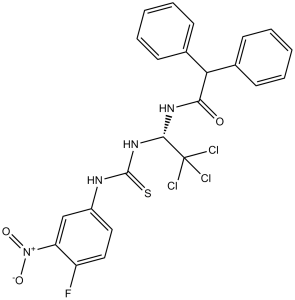
CGK 733 is a novel, potent and selective inhibitor of ATM (ataxia-telangiectasia mutated) and ATR (ATM and Rad3-related) with the potential to treat Hepatocellular carcinoma (HCC). Its IC50 is around 200 nM, and it inhibits ATM/ATR. The cytotoxicity of taxol induced in HBV-positive HepG2.2.15 cells was markedly increased by CGK733. CGK733 may offer a novel treatment approach for patients with HBV-infected HCC and may be able to reverse the taxol resistance in HBV-positive HCC cells.
Physicochemical Properties
| Molecular Formula | C23H18CL3FN4O3S | |
| Molecular Weight | 555.84 | |
| Exact Mass | 554.014 | |
| Elemental Analysis | C, 49.70; H, 3.26; Cl, 19.13; F, 3.42; N, 10.08; O, 8.64; S, 5.77 | |
| CAS # | 905973-89-9 | |
| Related CAS # |
|
|
| PubChem CID | 6605258 | |
| Appearance | White to off-white solid powder | |
| Density | 1.5±0.1 g/cm3 | |
| Index of Refraction | 1.674 | |
| LogP | 6.55 | |
| Hydrogen Bond Donor Count | 3 | |
| Hydrogen Bond Acceptor Count | 5 | |
| Rotatable Bond Count | 6 | |
| Heavy Atom Count | 35 | |
| Complexity | 725 | |
| Defined Atom Stereocenter Count | 0 | |
| SMILES | O=C(C(C1C=CC=CC=1)C1C=CC=CC=1)NC(C(Cl)(Cl)Cl)NC(NC1C=C([N+](=O)[O-])C(F)=CC=1)=S |
|
| InChi Key | HLCDNLNLQNYZTK-UHFFFAOYSA-N | |
| InChi Code | InChI=1S/C23H18Cl3FN4O3S/c24-23(25,26)21(30-22(35)28-16-11-12-17(27)18(13-16)31(33)34)29-20(32)19(14-7-3-1-4-8-14)15-9-5-2-6-10-15/h1-13,19,21H,(H,29,32)(H2,28,30,35) | |
| Chemical Name | 2,2-diphenyl-N-[2,2,2-trichloro-1-[(4-fluoro-3-nitrophenyl)carbamothioylamino]ethyl]acetamide | |
| Synonyms |
|
|
| HS Tariff Code | 2934.99.9001 | |
| Storage |
Powder-20°C 3 years 4°C 2 years In solvent -80°C 6 months -20°C 1 month |
|
| Shipping Condition | Room temperature (This product is stable at ambient temperature for a few days during ordinary shipping and time spent in Customs) |
Biological Activity
| Targets | ATM; ATR | |
| ln Vitro |
|
|
| ln Vivo |
|
|
| Cell Assay | For the assay to be completed with exponential growth, cells are seeded in 96-well plates at a predefined optimal cell density. The growth medium is swapped out for experimental medium containing the right amounts of the drugs or a 0.1% (v/v) vehicle control after a 24-hour preincubation. The assay for measuring sulforhodamine B colorimetric cell proliferation is used after a 48-hour incubation period. The resultant expression is the mean ± SE for six replicates expressed as a percentage of vehicle control, which is represented as 100%. At least three separate experiments are conducted. The Student's t test, with two tails, is used for statistical analyses. Statistics are defined as significant when P < 0.05[2]. | |
| Animal Protocol |
|
|
| References |
[1]. CGK733 enhances multinucleated cell formation and cytotoxicity induced by taxol in Chk1-deficient HBV-positive hepatocellular carcinoma cells. Biochem Biophys Res Commun. 2012 May 25;422(1):103-8. [2]. The ATM and ATR inhibitors CGK733 and caffeine suppress cyclin D1 levels and inhibit cell proliferation. Radiat Oncol. 2009 Nov 10;4:51. [3]. Molecular imaging of the ATM kinase activity. Int J Radiat Oncol Biol Phys. 2013 Aug 1;86(5):969-77. |
|
| Additional Infomation | 2,2-diphenyl-N-[2,2,2-trichloro-1-[[(4-fluoro-3-nitroanilino)-sulfanylidenemethyl]amino]ethyl]acetamide is a diarylmethane. |
Solubility Data
| Solubility (In Vitro) |
|
|||
| Solubility (In Vivo) |
Solubility in Formulation 1: ≥ 2.5 mg/mL (4.50 mM) (saturation unknown) in 10% DMSO + 90% Corn Oil (add these co-solvents sequentially from left to right, and one by one), clear solution. For example, if 1 mL of working solution is to be prepared, you can add 100 μL of 25.0 mg/mL clear DMSO stock solution to 900 μL of corn oil and mix evenly. Solubility in Formulation 2: ≥ 2.08 mg/mL (3.74 mM) (saturation unknown) in 10% DMSO + 40% PEG300 + 5% Tween80 + 45% Saline (add these co-solvents sequentially from left to right, and one by one), clear solution. For example, if 1 mL of working solution is to be prepared, you can add 100 μL of 20.8 mg/mL clear DMSO stock solution to 400 μL PEG300 and mix evenly; then add 50 μL Tween-80 to the above solution and mix evenly; then add 450 μL normal saline to adjust the volume to 1 mL. Preparation of saline: Dissolve 0.9 g of sodium chloride in 100 mL ddH₂ O to obtain a clear solution. (Please use freshly prepared in vivo formulations for optimal results.) |
| Preparing Stock Solutions | 1 mg | 5 mg | 10 mg | |
| 1 mM | 1.7991 mL | 8.9954 mL | 17.9908 mL | |
| 5 mM | 0.3598 mL | 1.7991 mL | 3.5982 mL | |
| 10 mM | 0.1799 mL | 0.8995 mL | 1.7991 mL |