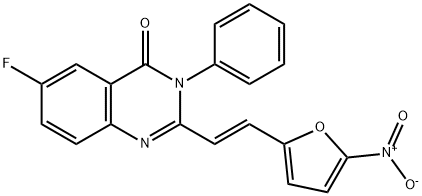
Physicochemical Properties
| Molecular Formula | C20H12FN3O4 |
| Molecular Weight | 377.3254 |
| Exact Mass | 377.081 |
| CAS # | 2374285-52-4 |
| PubChem CID | 155487033 |
| Appearance | Light yellow to yellow solid powder |
| Density | 1.4±0.1 g/cm3 |
| Boiling Point | 559.8±60.0 °C at 760 mmHg |
| Flash Point | 292.4±32.9 °C |
| Vapour Pressure | 0.0±1.5 mmHg at 25°C |
| Index of Refraction | 1.663 |
| LogP | 4.2 |
| Hydrogen Bond Donor Count | 0 |
| Hydrogen Bond Acceptor Count | 6 |
| Rotatable Bond Count | 3 |
| Heavy Atom Count | 28 |
| Complexity | 671 |
| Defined Atom Stereocenter Count | 0 |
| SMILES | FC1C=CC2=C(C=1)C(N(C1C=CC=CC=1)C(/C=C/C1=CC=C([N+](=O)[O-])O1)=N2)=O |
| InChi Key | HBQOIUMWWOMCBS-JXMROGBWSA-N |
| InChi Code | InChI=1S/C20H12FN3O4/c21-13-6-9-17-16(12-13)20(25)23(14-4-2-1-3-5-14)18(22-17)10-7-15-8-11-19(28-15)24(26)27/h1-12H/b10-7+ |
| Chemical Name | 6-fluoro-2-[(E)-2-(5-nitrofuran-2-yl)ethenyl]-3-phenylquinazolin-4-one |
| HS Tariff Code | 2934.99.9001 |
| Storage |
Powder-20°C 3 years 4°C 2 years In solvent -80°C 6 months -20°C 1 month |
| Shipping Condition | Room temperature (This product is stable at ambient temperature for a few days during ordinary shipping and time spent in Customs) |
Biological Activity
| Targets |
CEBPα inducer 1 upregulates the expression of CCAAT/enhancer-binding protein α (C/EBPα), a key transcription factor for myeloid differentiationit acts as an expression inducer rather than a direct binder/inhibitor [1] |
| ln Vitro |
Myeloid differentiation is brought on by C/EBPα inducer 1 (compound 78, 3 μM) [1]. The expression of CD11b, a marker of neutrophil differentiation surface, is upregulated by C/EBPα inducer 1 (compound 78) [1]. The expression of CD11b, a marker of neutrophil differentiation surface, and the upregulation of CEBPA and its downstream targets are induced by C/EBPα inducer 1 (compound 78) [1]. Compound 78, known as C/EBPα inducer 1, has the ability to upregulate G-CSF receptors and increase leukemia cells' sensitivity to G-CSF stimulation [1]. In human acute myeloid leukemia (AML) cell lines (HL-60, NB4): CEBPα inducer 1 (10–50 μM) dose-dependently upregulated C/EBPα protein levels by 2.5–4.8-fold (HL-60) and 2.3–3.6-fold (NB4) (Western blot); C/EBPα mRNA levels were increased by 3.2–5.1-fold (HL-60) and 2.8–4.3-fold (NB4) (qRT-PCR) [1] - The compound induced myeloid differentiation: 50 μM treatment for 5 days increased CD11b-positive cell rate to 78% (HL-60) and 62% (NB4), and CD14-positive cell rate to 65% (HL-60) (flow cytometry); NBT reduction assay showed 72% positive cells (HL-60) at 50 μM, confirming myeloid maturation [1] - It inhibited AML cell proliferation: IC₅₀ values were 32 μM (HL-60) and 38 μM (NB4) (MTT assay); 50 μM reduced clonogenic survival rate by 68% (HL-60) (colony formation assay) [1] - CEBPα inducer 1 (30–50 μM) induced apoptosis in HL-60 cells: 50 μM increased apoptotic rate by 35% (Annexin V-FITC/PI staining), upregulated cleaved caspase-3 by 2.7-fold and Bax by 1.8-fold, downregulated Bcl-2 by 42% (Western blot) [1] - It activated downstream myeloid differentiation pathways: 40 μM upregulated PU.1 (2.3-fold) and CEBPe (2.1-fold) protein levels (HL-60 cells, Western blot) [1] - No significant cytotoxicity was observed in normal human peripheral blood mononuclear cells (PBMCs) at concentrations up to 60 μM; cell viability >90% compared to vehicle control [1] |
| Enzyme Assay |
C/EBPα promoter luciferase assay: HL-60 cells were transfected with a luciferase reporter plasmid driven by the C/EBPα promoter. After 24 hours of transfection, cells were treated with CEBPα inducer 1 (10–50 μM) for another 24 hours. Luciferase activity was measured to assess C/EBPα promoter activation; 50 μM increased promoter activity by 3.8-fold [1] |
| Cell Assay |
AML cell proliferation assay: HL-60/NB4 cells were seeded in 96-well plates (5×10³ cells/well), cultured for 24 hours, and treated with CEBPα inducer 1 (10–60 μM) for 72 hours. MTT reagent was added, and absorbance at 570 nm was measured to calculate cell viability and IC₅₀ values [1] - C/EBPα expression detection: HL-60/NB4 cells were treated with CEBPα inducer 1 (10–50 μM) for 48 hours. Total protein and RNA were extracted; Western blot detected C/EBPα protein, and qRT-PCR quantified C/EBPα mRNA levels [1] - Myeloid differentiation assay: Cells were treated with CEBPα inducer 1 (20–50 μM) for 5 days. Cells were stained with CD11b/CD14 antibodies for flow cytometry; NBT reduction assay was performed by incubating cells with NBT solution, and positive cells (blue formazan deposits) were counted under microscope [1] - Apoptosis assay: HL-60 cells were treated with CEBPα inducer 1 (30–50 μM) for 72 hours, stained with Annexin V-FITC and PI, and analyzed by flow cytometry to quantify apoptotic cells [1] - Colony formation assay: HL-60 cells were seeded in 6-well plates (2×10³ cells/well) with semisolid medium, treated with CEBPα inducer 1 (20–50 μM), and cultured for 14 days. Colonies were stained with crystal violet and counted [1] |
| References | [1]. Radhakrishnan Sridhar, et al. Styryl Quinazolinones as Potential Inducers of Myeloid Differentiation via Upregulation of C/EBPα. Molecules. 2018 Aug 3;23(8):1938. |
| Additional Infomation |
CEBPα inducer 1 is a synthetic small-molecule belonging to the styryl quinazolinone class [1] - Its mechanism of action involves activating the C/EBPα promoter, upregulating C/EBPα transcription and protein expression, thereby initiating the myeloid differentiation program in AML cells [1] - The compound targets the differentiation block in AML (a key pathogenic feature of AML), making it a potential therapeutic candidate for acute myeloid leukemia [1] - It acts synergistically with C/EBPα downstream factors (e.g., PU.1, CEBPe) to promote myeloid maturation, without obvious toxicity to normal hematopoietic cells [1] |
Solubility Data
| Solubility (In Vitro) | DMSO : ~6.25 mg/mL (~16.56 mM) |
| Solubility (In Vivo) |
Note: Listed below are some common formulations that may be used to formulate products with low water solubility (e.g. < 1 mg/mL), you may test these formulations using a minute amount of products to avoid loss of samples. Injection Formulations (e.g. IP/IV/IM/SC) Injection Formulation 1: DMSO : Tween 80: Saline = 10 : 5 : 85 (i.e. 100 μL DMSO stock solution → 50 μL Tween 80 → 850 μL Saline) *Preparation of saline: Dissolve 0.9 g of sodium chloride in 100 mL ddH ₂ O to obtain a clear solution. Injection Formulation 2: DMSO : PEG300 :Tween 80 : Saline = 10 : 40 : 5 : 45 (i.e. 100 μL DMSO → 400 μLPEG300 → 50 μL Tween 80 → 450 μL Saline) Injection Formulation 3: DMSO : Corn oil = 10 : 90 (i.e. 100 μL DMSO → 900 μL Corn oil) Example: Take the Injection Formulation 3 (DMSO : Corn oil = 10 : 90) as an example, if 1 mL of 2.5 mg/mL working solution is to be prepared, you can take 100 μL 25 mg/mL DMSO stock solution and add to 900 μL corn oil, mix well to obtain a clear or suspension solution (2.5 mg/mL, ready for use in animals). Injection Formulation 4: DMSO : 20% SBE-β-CD in saline = 10 : 90 [i.e. 100 μL DMSO → 900 μL (20% SBE-β-CD in saline)] *Preparation of 20% SBE-β-CD in Saline (4°C,1 week): Dissolve 2 g SBE-β-CD in 10 mL saline to obtain a clear solution. Injection Formulation 5: 2-Hydroxypropyl-β-cyclodextrin : Saline = 50 : 50 (i.e. 500 μL 2-Hydroxypropyl-β-cyclodextrin → 500 μL Saline) Injection Formulation 6: DMSO : PEG300 : castor oil : Saline = 5 : 10 : 20 : 65 (i.e. 50 μL DMSO → 100 μLPEG300 → 200 μL castor oil → 650 μL Saline) Injection Formulation 7: Ethanol : Cremophor : Saline = 10: 10 : 80 (i.e. 100 μL Ethanol → 100 μL Cremophor → 800 μL Saline) Injection Formulation 8: Dissolve in Cremophor/Ethanol (50 : 50), then diluted by Saline Injection Formulation 9: EtOH : Corn oil = 10 : 90 (i.e. 100 μL EtOH → 900 μL Corn oil) Injection Formulation 10: EtOH : PEG300:Tween 80 : Saline = 10 : 40 : 5 : 45 (i.e. 100 μL EtOH → 400 μLPEG300 → 50 μL Tween 80 → 450 μL Saline) Oral Formulations Oral Formulation 1: Suspend in 0.5% CMC Na (carboxymethylcellulose sodium) Oral Formulation 2: Suspend in 0.5% Carboxymethyl cellulose Example: Take the Oral Formulation 1 (Suspend in 0.5% CMC Na) as an example, if 100 mL of 2.5 mg/mL working solution is to be prepared, you can first prepare 0.5% CMC Na solution by measuring 0.5 g CMC Na and dissolve it in 100 mL ddH2O to obtain a clear solution; then add 250 mg of the product to 100 mL 0.5% CMC Na solution, to make the suspension solution (2.5 mg/mL, ready for use in animals). Oral Formulation 3: Dissolved in PEG400 Oral Formulation 4: Suspend in 0.2% Carboxymethyl cellulose Oral Formulation 5: Dissolve in 0.25% Tween 80 and 0.5% Carboxymethyl cellulose Oral Formulation 6: Mixing with food powders Note: Please be aware that the above formulations are for reference only. InvivoChem strongly recommends customers to read literature methods/protocols carefully before determining which formulation you should use for in vivo studies, as different compounds have different solubility properties and have to be formulated differently. (Please use freshly prepared in vivo formulations for optimal results.) |
| Preparing Stock Solutions | 1 mg | 5 mg | 10 mg | |
| 1 mM | 2.6502 mL | 13.2510 mL | 26.5020 mL | |
| 5 mM | 0.5300 mL | 2.6502 mL | 5.3004 mL | |
| 10 mM | 0.2650 mL | 1.3251 mL | 2.6502 mL |