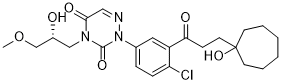
CE-224535 is a novel and selective P2X7 receptor antagonist that can be potentially used for the treatment of rheumatoid arthritis and osteoarthritis. Clinical trials showed that CE-224,535 was not efficacious as compared with placebo, for the treatment of RA in patients with an inadequate response to MTX. CE-224,535 demonstrated an acceptable safety and tolerability profile.
Physicochemical Properties
| Molecular Formula | C22H29N4O6CL |
| Molecular Weight | 480.94186 |
| Exact Mass | 480.177 |
| CAS # | 724424-43-5 |
| PubChem CID | 11547499 |
| Appearance | White to yellow solid powder |
| Density | 1.47g/cm3 |
| Index of Refraction | 1.649 |
| LogP | 1.532 |
| Hydrogen Bond Donor Count | 3 |
| Hydrogen Bond Acceptor Count | 7 |
| Rotatable Bond Count | 8 |
| Heavy Atom Count | 33 |
| Complexity | 742 |
| Defined Atom Stereocenter Count | 1 |
| SMILES | COC[C@@H](CN1C(=O)C=NN(C1=O)C2=CC(=C(C=C2)Cl)C(=O)NCC3(CCCCCC3)O)O |
| InChi Key | IRTORRLRMYAEAR-QGZVFWFLSA-N |
| InChi Code | InChI=1S/C23H30ClN3O6/c1-33-15-17(28)14-26-21(30)13-25-27(22(26)31)16-6-7-19(24)18(12-16)20(29)8-11-23(32)9-4-2-3-5-10-23/h6-7,12-13,17,28,32H,2-5,8-11,14-15H2,1H3/t17-/m1/s1 |
| Chemical Name | 2-(4-Chloro-3-(3-(1-hydroxycycloheptyl)propanoyl)phenyl)-4-((2R)-2-hydroxy-3-methoxy-propyl)-1,2,4-triazine-3,5-dione |
| Synonyms | CE-224,535; CE 224,535; CE224,535; CE-224535; CE 224535; CE224535; |
| HS Tariff Code | 2934.99.9001 |
| Storage |
Powder-20°C 3 years 4°C 2 years In solvent -80°C 6 months -20°C 1 month Note: Please store this product in a sealed and protected environment, avoid exposure to moisture. |
| Shipping Condition | Room temperature (This product is stable at ambient temperature for a few days during ordinary shipping and time spent in Customs) |
Biological Activity
| Targets |
P2X7 receptor (selective antagonist; inhibits IL-1β and IL-18 release; IC90 for IL-1β release inhibition in ex vivo whole-blood assay estimated at 10 ng/mL) [1] |
| ln Vitro |
CE-224535 is a selective antagonist of the human P2X7 receptor and was created as a disease-modifying antirheumatic medication (DMARD). Rheumatoid arthritis (RA) may now be treated with CE-224535, a novel therapy that can inhibit leukocytes' production of IL-1 and IL-18 [1]. CE-224,535 reduces leukocyte secretion of IL-1β and IL-18, providing a novel therapeutic approach for RA. [1] CE-224,535 potently inhibited the release of IL-1β from ATP-stimulated human monocytes with an IC50 of 1.4 nM. [2] CE-224,535 inhibited ATP-induced uptake of YOPRO-1 in P2X7 receptor-overexpressing HEK293 cells with an IC50 of 4 nM. [2] In the presence of human whole blood, CE-224,535 maintained potent activity with an IC50 of 0.8 nM and an IC90 of 4.7 nM for inhibiting IL-1β release. [2] CE-224,535 (10 µM) showed no significant interaction with a panel of 107 receptors, channels, and transporters. [2] CE-224,535 had no inhibitory effect on major human CYP isozymes (CYP1A2, 2C19, 2C9, 2D6, 3A4) with IC50 values >30 µM. [2] CE-224,535 exhibited weak potency against the mouse P2X7 receptor, with minimal inhibition of ATP-induced IL-1β processing in LPS-activated murine peritoneal macrophages at 10 µM. [2] |
| ln Vivo | CE-224535 had a half-life of 2.4 hours in rats due to a lower CLp of 11 mL/min/kg and a greater Vdss of 7.6 L/kg. CE-224535 was given orally to rats at a dose of 5 mg/kg, and after that, the maximum plasma exposure (Cmax) was roughly 90 times more than its IC90 in human blood (Cmax=0.21 μg/mL or 0.44 μM). Although CE-224535's oral bioavailability in rats is low (F=2.6%), it is thought to be rat-specific because it is sufficient when it comes to oral bioavailability in dogs (59%) and monkeys (22%). |
| Cell Assay |
An ex vivo whole-blood assay was used to estimate the 90% inhibitory concentration (IC90) for inhibition of IL-1β release by CE-224,535. [1] The P2X7 receptor antagonist activity of CE-224,535 analogs was evaluated by assessing their ability to inhibit IL-1β release from LPS-activated human monocytes maintained in low serum, stimulated with ATP (final concentration 6 mM). [2] Promising compounds were further evaluated in an analogous assay using human whole blood samples sequentially treated with LPS and ATP. [2] Selected compounds were also tested for their ability to inhibit ATP-induced uptake of YOPRO-1 dye in P2X7 receptor-overexpressing HEK293 cells to provide direct evidence of P2X7 receptor blockade. [2] |
| Animal Protocol |
Pharmacokinetic studies were conducted in rats, dogs, and monkeys. Specific dosing formulations or routes are not detailed, but oral administration was used. [2] A 4-day toxicology study in rats involved daily oral dosing of CE-224,535 at 500 mg/kg. [2] |
| ADME/Pharmacokinetics |
The median trough concentration of CE-224,535 in plasma was approximately 250 ng/mL, which is about 25 times the estimated IC90 for inhibition of IL-1β release. Patients with baseline CRP ≥ 8 mg/L had median trough concentrations about twice as high as those with CRP < 8 mg/L, likely due to downregulation of CYP3A4 during inflammation. [1] |
| Toxicity/Toxicokinetics |
Treatment-emergent adverse events were reported in 62.3% of patients receiving CE-224,535 vs 55.3% in placebo. The most common adverse events were nausea (11.3%) and diarrhea (7.5%). Serious adverse events occurred in 3.8% of CE-224,535 patients vs 2.1% in placebo, none considered treatment-related. Discontinuations due to adverse events were 9.4% vs 6.4%, respectively. [1] |
| References |
[1]. Efficacy and safety of CE-224,535, an antagonist of P2X7 receptor, in treatment of patients with rheumatoid arthritis inadequately controlled by methotrexate. J Rheumatol. 2012 Apr;39(4):720-7. [2]. Optimization of the physicochemical and pharmacokinetic attributes in a 6-azauracil series of P2X7 receptor antagonists leading to the discovery of the clinical candidate CE-224,535. Bioorg Med Chem Lett. 2011 Jun 15;21(12):3708-11. |
| Additional Infomation |
CE-224535 has been used in trials studying the treatment of Osteoarthritis. CE-224,535 was developed as a DMARD for rheumatoid arthritis, with a mechanism involving upstream inhibition of IL-1β and IL-18 via P2X7 receptor antagonism. The Phase IIA study showed no significant efficacy compared to placebo, despite adequate drug exposure. The safety and tolerability profile was acceptable. [1] |
Solubility Data
| Solubility (In Vitro) | DMSO : ~100 mg/mL (~207.93 mM) |
| Solubility (In Vivo) |
Solubility in Formulation 1: ≥ 10 mg/mL (20.79 mM) (saturation unknown) in 10% DMSO + 40% PEG300 + 5% Tween80 + 45% Saline (add these co-solvents sequentially from left to right, and one by one), clear solution. For example, if 1 mL of working solution is to be prepared, you can add 100 μL of 100.0 mg/mL clear DMSO stock solution to 400 μL PEG300 and mix evenly; then add 50 μL Tween-80 to the above solution and mix evenly; then add 450 μL normal saline to adjust the volume to 1 mL. Preparation of saline: Dissolve 0.9 g of sodium chloride in 100 mL ddH₂ O to obtain a clear solution. Solubility in Formulation 2: ≥ 10 mg/mL (20.79 mM) (saturation unknown) in 10% DMSO + 90% (20% SBE-β-CD in Saline) (add these co-solvents sequentially from left to right, and one by one), clear solution. For example, if 1 mL of working solution is to be prepared, you can add 100 μL of 100.0 mg/mL clear DMSO stock solution to 900 μL of 20% SBE-β-CD physiological saline solution and mix evenly. Preparation of 20% SBE-β-CD in Saline (4°C,1 week): Dissolve 2 g SBE-β-CD in 10 mL saline to obtain a clear solution. Solubility in Formulation 3: ≥ 10 mg/mL (20.79 mM) (saturation unknown) in 10% DMSO + 90% Corn Oil (add these co-solvents sequentially from left to right, and one by one), clear solution. For example, if 1 mL of working solution is to be prepared, you can add 100 μL of 100.0 mg/mL clear DMSO stock solution to 900 μL of corn oil and mix evenly. (Please use freshly prepared in vivo formulations for optimal results.) |
| Preparing Stock Solutions | 1 mg | 5 mg | 10 mg | |
| 1 mM | 2.0793 mL | 10.3963 mL | 20.7926 mL | |
| 5 mM | 0.4159 mL | 2.0793 mL | 4.1585 mL | |
| 10 mM | 0.2079 mL | 1.0396 mL | 2.0793 mL |