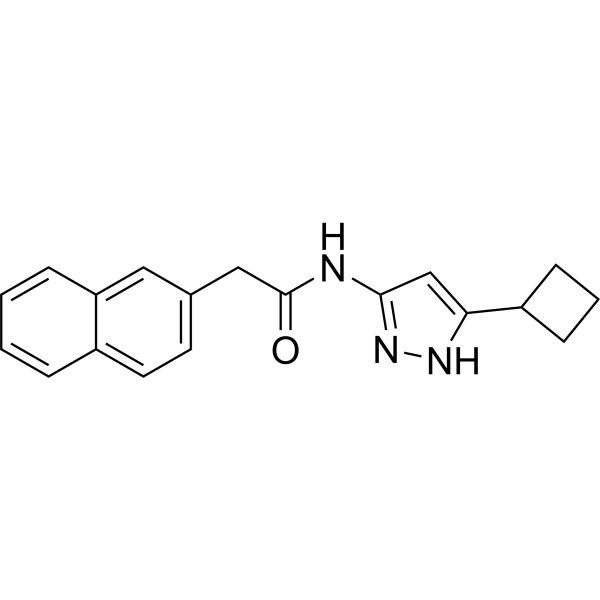
Physicochemical Properties
| Molecular Formula | C19H19N3O |
| Molecular Weight | 305.373664140701 |
| Exact Mass | 305.152 |
| CAS # | 865317-30-2 |
| PubChem CID | 69761759 |
| Appearance | Light yellow to yellow solid powder |
| LogP | 3.7 |
| Hydrogen Bond Donor Count | 2 |
| Hydrogen Bond Acceptor Count | 2 |
| Rotatable Bond Count | 4 |
| Heavy Atom Count | 23 |
| Complexity | 423 |
| Defined Atom Stereocenter Count | 0 |
| SMILES | O=C(CC1C=C2C(C=CC=C2)=CC=1)NC1C=C(C2CCC2)NN=1 |
| InChi Key | AGVIDDQHAQSPIZ-UHFFFAOYSA-N |
| InChi Code | InChI=1S/C19H19N3O/c23-19(20-18-12-17(21-22-18)15-6-3-7-15)11-13-8-9-14-4-1-2-5-16(14)10-13/h1-2,4-5,8-10,12,15H,3,6-7,11H2,(H2,20,21,22,23) |
| Chemical Name | N-(5-cyclobutyl-1H-pyrazol-3-yl)-2-naphthalen-2-ylacetamide |
| Synonyms | CDK5 inhibitor 20223; CDK5 inhibitor 20 223 |
| HS Tariff Code | 2934.99.9001 |
| Storage |
Powder-20°C 3 years 4°C 2 years In solvent -80°C 6 months -20°C 1 month |
| Shipping Condition | Room temperature (This product is stable at ambient temperature for a few days during ordinary shipping and time spent in Customs) |
Biological Activity
| ln Vitro | In a panel of colorectal cancer (CRC) cell lines, the CDK5 inhibitor 20-223 (10 nM-10 μM; 72 h) efficiently reduces cell proliferation [1]. Three CRC cell lines were treated at reduced doses with CDK5 inhibitor 20-223 (0.3125 – 20,000 μM; 6 h) to induce pRB (S807/811) and pFAK (S732) levels [1]. |
| ln Vivo | In human colorectal cancer xenograft tumors in nude mice, the CDK5 inhibitor 20-223 (8 mg/kg; subcutaneous injection; 14 injections) demonstrated tumor anti-tumor efficacy [1]. |
| Cell Assay |
Cell Viability Assay[1] Cell Types: CRC cell line SW620, DLD1, HT29, HCT116, FET, CBS and GEO Cell Tested Concentrations: 10 μM, 1 μM, 100 nM, 10 nM Incubation Duration: 72 hrs (hours) Experimental Results: diminished cell growth. The IC50 of SW620, DLD1, HT29, HCT116, FET, CBS and GEO cells were 168±20, 480±41, 360±72, 763±92, 117±49, 568±49, 79±31 nM. Western Blot Analysis[1] Cell Types: CRC cell lines GEO, HCT116 and HT29 Tested Concentrations: 20, 10, 5, 2.5, 1.25, 0.625, 0.3125 μM Incubation Duration: 6 hrs (hours) Experimental Results: Did not affect total levels of CDK2/5, and Levels of total FAK or total retinoblastoma protein (Rb). A dose-dependent decrease in pRB (S807/811) and pFAK (S732) levels was induced. |
| Animal Protocol |
Animal/Disease Models: athymic nude mice [1] Doses: 8 mg/kg Route of Administration: subcutaneous injection every day in the first week, subcutaneous injection every other day for two weeks, a total of 14 injections. Experimental Results: In vivo tumor growth and tumor weight were diminished. |
| References |
[1]. Characterization of CDK(5) Inhibitor, 20-223 (Aka CP668863) for Colorectal Cancer Therapy. Oncotarget. 2017 Dec 28;9(4):5216-5232. |
Solubility Data
| Solubility (In Vitro) | DMSO : ~100 mg/mL (~327.47 mM) |
| Solubility (In Vivo) |
Solubility in Formulation 1: ≥ 5 mg/mL (16.37 mM) (saturation unknown) in 10% DMSO + 90% Corn Oil (add these co-solvents sequentially from left to right, and one by one), clear solution. For example, if 1 mL of working solution is to be prepared, you can add 100 μL of 50.0 mg/mL clear DMSO stock solution to 900 μL of corn oil and mix evenly. (Please use freshly prepared in vivo formulations for optimal results.) |
| Preparing Stock Solutions | 1 mg | 5 mg | 10 mg | |
| 1 mM | 3.2747 mL | 16.3736 mL | 32.7472 mL | |
| 5 mM | 0.6549 mL | 3.2747 mL | 6.5494 mL | |
| 10 mM | 0.3275 mL | 1.6374 mL | 3.2747 mL |