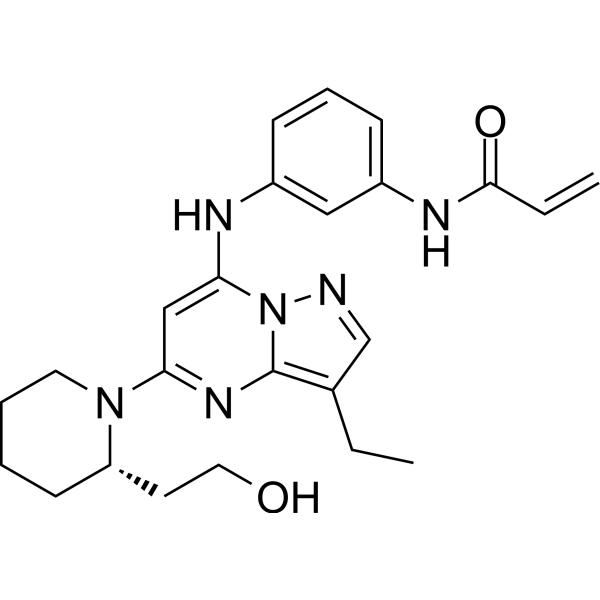
Physicochemical Properties
| Molecular Formula | C24H30N6O2 |
| Molecular Weight | 434.534004688263 |
| Exact Mass | 434.243 |
| CAS # | 2020052-55-3 |
| PubChem CID | 122596923 |
| Appearance | White to off-white solid powder |
| LogP | 3.8 |
| Hydrogen Bond Donor Count | 3 |
| Hydrogen Bond Acceptor Count | 6 |
| Rotatable Bond Count | 8 |
| Heavy Atom Count | 32 |
| Complexity | 634 |
| Defined Atom Stereocenter Count | 1 |
| SMILES | OCC[C@@H]1CCCCN1C1C=C(NC2C=CC=C(C=2)NC(C=C)=O)N2C(=C(C=N2)CC)N=1 |
| InChi Key | CDCHESFKYUNJPV-FQEVSTJZSA-N |
| InChi Code | InChI=1S/C24H30N6O2/c1-3-17-16-25-30-22(26-18-8-7-9-19(14-18)27-23(32)4-2)15-21(28-24(17)30)29-12-6-5-10-20(29)11-13-31/h4,7-9,14-16,20,26,31H,2-3,5-6,10-13H2,1H3,(H,27,32)/t20-/m0/s1 |
| Chemical Name | N-[3-[[3-ethyl-5-[(2S)-2-(2-hydroxyethyl)piperidin-1-yl]pyrazolo[1,5-a]pyrimidin-7-yl]amino]phenyl]prop-2-enamide |
| Synonyms | CDK12 IN E9; CDK12INE9; CDK12-IN-E9 |
| HS Tariff Code | 2934.99.9001 |
| Storage |
Powder-20°C 3 years 4°C 2 years In solvent -80°C 6 months -20°C 1 month |
| Shipping Condition | Room temperature (This product is stable at ambient temperature for a few days during ordinary shipping and time spent in Customs) |
Biological Activity
| ln Vitro | The treatment with CDK12-IN-E9 (E9; 10 nM-10 μM; 72 hours; Kelly, LAN5, SK-N-BE2, PC-9, NCI-H82, and NCI-H3122 cells) demonstrated effective lung anti-proliferative activity against cancer cells and THZ1R NB, with IC50 values ranging from 8 to 40 nM[1]. In THZ1r NB and lung cancer models, CDK12-IN-E9 (E9; 0-3000 nM; 6 hr; Kelly, PC-9, and NCI-H82 cells) therapy causes a dose-dependent reduction of phosphorylated and total RNAPII concurrent with MYC as well as lower expression of MCL1 [1]. CDK12-IN-E9 also resulted in higher PARP cleavage and subGI population in THZ1r lung cancer cells, however in NB cells, greater G2/M arrest was found after 24 h of exposure to CDK12-IN-E9. E9[1]. |
| Cell Assay |
Cell Proliferation Assay[1] Cell Types: Kelly, LAN5, SK-N-BE2, PC-9, NCI-H82, and NCI-H3122 Cell Tested Concentrations: 10 nM-10 μM Incubation Duration: 72 hrs (hours) Experimental Results: In cells shown Potent antiproliferative activity of THZ1R in NB and lung cancer cells with IC50 values ranging from 8 to 40 nM. Western Blot Analysis[1] Cell Types: Kelly, PC-9 and NCI-H82 Cell Tested Concentrations: 0 nM, 30 nM, 100 nM, 300 nM, 1000 nM, 3000 nM Incubation Duration: 6 hrs (hours) Experimental Results: Resulting doses of THZ1r NB and Phosphorylation- and total RNAPII-dependent reduction in lung cancer models. |
| References |
[1]. Overcoming Resistance to the THZ Series of Covalent Transcriptional CDK Inhibitors. Cell Chem Biol. 2018 Feb 15;25(2):135-142.e5. |
Solubility Data
| Solubility (In Vitro) | DMSO : ~125 mg/mL (~287.67 mM) |
| Solubility (In Vivo) |
Solubility in Formulation 1: ≥ 20.83 mg/mL (47.94 mM) (saturation unknown) in 10% DMSO + 90% Corn Oil (add these co-solvents sequentially from left to right, and one by one), clear solution. For example, if 1 mL of working solution is to be prepared, you can add 100 μL of clear DMSO stock solution of 208.3 mg/mL to 900 μL of corn oil and mix evenly. Solubility in Formulation 2: ≥ 2.08 mg/mL (4.79 mM) (saturation unknown) in 10% DMSO + 40% PEG300 + 5% Tween80 + 45% Saline (add these co-solvents sequentially from left to right, and one by one), clear solution. For example, if 1 mL of working solution is to be prepared, you can add 100 μL of 20.8 mg/mL clear DMSO stock solution to 400 μL PEG300 and mix evenly; then add 50 μL Tween-80 to the above solution and mix evenly; then add 450 μL normal saline to adjust the volume to 1 mL. Preparation of saline: Dissolve 0.9 g of sodium chloride in 100 mL ddH₂ O to obtain a clear solution. (Please use freshly prepared in vivo formulations for optimal results.) |
| Preparing Stock Solutions | 1 mg | 5 mg | 10 mg | |
| 1 mM | 2.3013 mL | 11.5067 mL | 23.0134 mL | |
| 5 mM | 0.4603 mL | 2.3013 mL | 4.6027 mL | |
| 10 mM | 0.2301 mL | 1.1507 mL | 2.3013 mL |