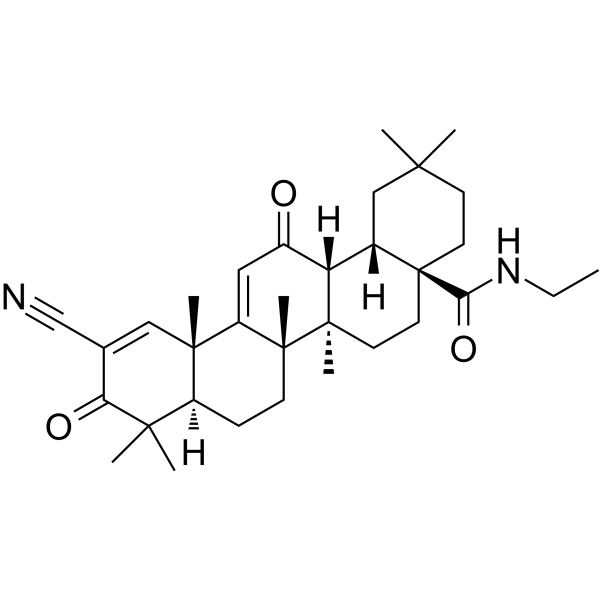
Physicochemical Properties
| Molecular Formula | C33H46N2O3 |
| Molecular Weight | 518.729949474335 |
| Exact Mass | 518.35 |
| CAS # | 932730-51-3 |
| PubChem CID | 44159258 |
| Appearance | White to off-white solid powder |
| LogP | 6.5 |
| Hydrogen Bond Donor Count | 1 |
| Hydrogen Bond Acceptor Count | 4 |
| Rotatable Bond Count | 2 |
| Heavy Atom Count | 38 |
| Complexity | 1230 |
| Defined Atom Stereocenter Count | 7 |
| SMILES | C([C@]12CCC(C)(C)C[C@H]1[C@H]1C(=O)C=C3[C@]4(C=C(C#N)C(=O)C(C)(C)[C@@H]4CC[C@@]3(C)[C@@]1(CC2)C)C)(=O)NCC |
| InChi Key | RZRQJICXYQPEQJ-YKEYHJQHSA-N |
| InChi Code | InChI=1S/C33H46N2O3/c1-9-35-27(38)33-14-12-28(2,3)18-21(33)25-22(36)16-24-30(6)17-20(19-34)26(37)29(4,5)23(30)10-11-31(24,7)32(25,8)13-15-33/h16-17,21,23,25H,9-15,18H2,1-8H3,(H,35,38)/t21-,23-,25-,30-,31+,32+,33-/m0/s1 |
| Chemical Name | (4aS,6aR,6bS,8aR,12aS,14aR,14bS)-11-cyano-N-ethyl-2,2,6a,6b,9,9,12a-heptamethyl-10,14-dioxo-1,3,4,5,6,7,8,8a,14a,14b-decahydropicene-4a-carboxamide |
| HS Tariff Code | 2934.99.9001 |
| Storage |
Powder-20°C 3 years 4°C 2 years In solvent -80°C 6 months -20°C 1 month |
| Shipping Condition | Room temperature (This product is stable at ambient temperature for a few days during ordinary shipping and time spent in Customs) |
Biological Activity
| ln Vitro | In both the G93A SOD1 animal model and the cell culture model of ALS, CDDO-EA potently stimulates Nrf2/ARE[1]. Both PARP cleavage and Annexin staining demonstrate that CDDO-EA is a strong inducer of apoptosis in A549 lung cancer cells. CDDO-EA is a more powerful heme oxygenase-1 (HO-1) inducer than CDDO alone. CDDO-EA is seven times more powerful than CDDO in RAW264.7 macrophage-like cells at suppressing IFN-γ's capacity to activate iNOS[2]. |
| ln Vivo | According to the survival data, G93A mice given CDDO-EA have far longer lives than their G93A littermate controls. The life-span rises by 20.6 days (p<0.001) with CDDO-EA therapy, from 124.05±3.7 days to 144.72±8.1 days (16.6%). The G93A mice treated with CDDO-EA had an age of death of 141.4±5.2 days and a duration of 57.6±7.6 days from the age of onset to the age of death. This indicates that the age of death from onset is delayed by 17.5 days (43%) in these mice[1]. |
| References |
[1]. Neuroprotective effect of Nrf2/ARE activators, CDDO ethylamide and CDDO trifluoroethylamide, in a mouse model of amyotrophic lateral sclerosis. Free Radic Biol Med. 2011 Jul 1;51(1):88-96. [2]. The synthetic triterpenoids CDDO-methyl ester and CDDO-ethyl amide prevent lung cancer induced by vinyl carbamate in A/J mice. Cancer Res. 2007 Mar 15;67(6):2414-9. |
Solubility Data
| Solubility (In Vitro) | DMSO : ~16.67 mg/mL (~32.14 mM) |
| Solubility (In Vivo) |
Solubility in Formulation 1: ≥ 1.67 mg/mL (3.22 mM) (saturation unknown) in 10% DMSO + 90% (20% SBE-β-CD in Saline) (add these co-solvents sequentially from left to right, and one by one), clear solution. For example, if 1 mL of working solution is to be prepared, you can add 100 μL of 16.7 mg/mL clear DMSO stock solution to 900 μL of 20% SBE-β-CD physiological saline solution and mix evenly. Preparation of 20% SBE-β-CD in Saline (4°C,1 week): Dissolve 2 g SBE-β-CD in 10 mL saline to obtain a clear solution. Solubility in Formulation 2: ≥ 1.67 mg/mL (3.22 mM) (saturation unknown) in 10% DMSO + 90% Corn Oil (add these co-solvents sequentially from left to right, and one by one), clear solution. For example, if 1 mL of working solution is to be prepared, you can add 100 μL of 16.7 mg/mL clear DMSO stock solution to 900 μL of corn oil and mix evenly. (Please use freshly prepared in vivo formulations for optimal results.) |
| Preparing Stock Solutions | 1 mg | 5 mg | 10 mg | |
| 1 mM | 1.9278 mL | 9.6389 mL | 19.2779 mL | |
| 5 mM | 0.3856 mL | 1.9278 mL | 3.8556 mL | |
| 10 mM | 0.1928 mL | 0.9639 mL | 1.9278 mL |