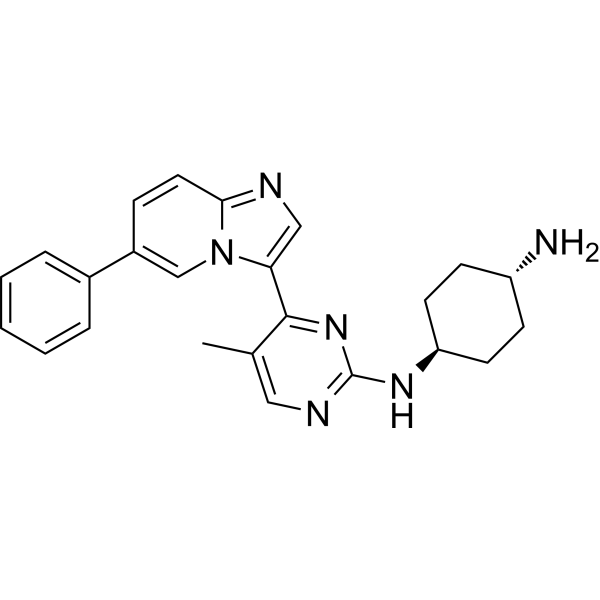
Physicochemical Properties
| Molecular Formula | C24H26N6 |
| Molecular Weight | 398.503444194794 |
| Exact Mass | 398.221 |
| CAS # | 2241659-94-7 |
| PubChem CID | 135301300 |
| Appearance | Off-white to light brown solid powder |
| LogP | 4.4 |
| Hydrogen Bond Donor Count | 2 |
| Hydrogen Bond Acceptor Count | 5 |
| Rotatable Bond Count | 4 |
| Heavy Atom Count | 30 |
| Complexity | 544 |
| Defined Atom Stereocenter Count | 0 |
| InChi Key | OVOYRPVIZNJKHS-UHFFFAOYSA-N |
| InChi Code | InChI=1S/C24H26N6/c1-16-13-27-24(28-20-10-8-19(25)9-11-20)29-23(16)21-14-26-22-12-7-18(15-30(21)22)17-5-3-2-4-6-17/h2-7,12-15,19-20H,8-11,25H2,1H3,(H,27,28,29) |
| Chemical Name | 4-N-[5-methyl-4-(6-phenylimidazo[1,2-a]pyridin-3-yl)pyrimidin-2-yl]cyclohexane-1,4-diamine |
| HS Tariff Code | 2934.99.9001 |
| Storage |
Powder-20°C 3 years 4°C 2 years In solvent -80°C 6 months -20°C 1 month |
| Shipping Condition | Room temperature (This product is stable at ambient temperature for a few days during ordinary shipping and time spent in Customs) |
Biological Activity
| Targets | CDK9 8 nM (Ki) |
| ln Vitro | CDDD11-8 (0-3 μM, 24 hours) inhibits the expression of c-MYC, MCL-1 and XIAP in MV4-11 and MOLM-13 cells [1]. CDDD11-8 dose-dependently inhibits proliferation (IC50 range: 281-734 nM), induces cell cycle arrest, and increases apoptosis in cell lines [2]. |
| ln Vivo | CDDD11-8 (0-125 mg/kg, orally, daily) can induce tumor regression [1]. |
| Animal Protocol |
Animal/Disease Models: MV4-11 tumor-bearing mice[1] Doses: 75 or 125 mg/kg Route of Administration: PO, daily for 5 or 28 days Experimental Results: Induced tumor regression. Potently inhibited the phosphorylation of RNAPII at Ser2 and Ser5, confirming the inhibition of CDK9 in vivo. Reduced phosphorylation of FLT3 at Tyr591 and STAT5 at Tyr 694. |
| References |
[1].An Orally Bioavailable and Highly Efficacious Inhibitor of CDK9/FLT3 for the Treatment of Acute Myeloid Leukemia. Cancers (Basel). 2022 Feb 22;14(5):1113. [2].Selective inhibition of CDK9 in triple negative breast cancer. Oncogene. 2023 Nov 24. |
Solubility Data
| Solubility (In Vitro) | DMSO :~100 mg/mL (~250.94 mM; with sonication) |
| Solubility (In Vivo) |
Solubility in Formulation 1: ≥ 2.5 mg/mL (6.27 mM) (saturation unknown) in 10% DMSO + 40% PEG300 + 5% Tween-80 + 45% Saline (add these co-solvents sequentially from left to right, and one by one),clear solution. For example, if 1 mL of working solution is to be prepared,you can add 100 μL of 25.0 mg/mL clear DMSO stock solution and add it to 400 μL PEG300 and mix well. Then add 50 μL Tween-80 to the above system and mix well. Then continue to add 450 μL of physiological saline to make up to 1 mL. Preparation of saline: Dissolve 0.9 g of sodium chloride in 100 mL ddH₂ O to obtain a clear solution. (Please use freshly prepared in vivo formulations for optimal results.) |
| Preparing Stock Solutions | 1 mg | 5 mg | 10 mg | |
| 1 mM | 2.5094 mL | 12.5471 mL | 25.0941 mL | |
| 5 mM | 0.5019 mL | 2.5094 mL | 5.0188 mL | |
| 10 mM | 0.2509 mL | 1.2547 mL | 2.5094 mL |