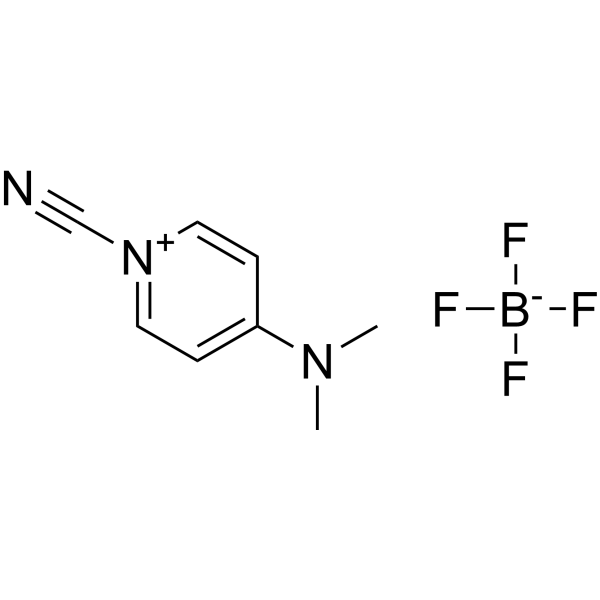
Physicochemical Properties
| Molecular Formula | C8H10BF4N3 |
| Molecular Weight | 234.99 |
| Exact Mass | 235.09 |
| CAS # | 59016-56-7 |
| PubChem CID | 9881151 |
| Appearance | White to off-white solid powder |
| Melting Point | 196-200ºC |
| LogP | 1.669 |
| Hydrogen Bond Donor Count | 0 |
| Hydrogen Bond Acceptor Count | 7 |
| Rotatable Bond Count | 1 |
| Heavy Atom Count | 16 |
| Complexity | 179 |
| Defined Atom Stereocenter Count | 0 |
| SMILES | CN(C1=CC=[N+](C#N)C=C1)C.F[B-](F)(F)F |
| InChi Key | MBLVMDCQDCVKNE-UHFFFAOYSA-N |
| InChi Code | InChI=1S/C8H10N3.BF4/c1-10(2)8-3-5-11(7-9)6-4-8;2-1(3,4)5/h3-6H,1-2H3;/q+1;-1 |
| Chemical Name | 4-(dimethylamino)pyridin-1-ium-1-carbonitrile;tetrafluoroborate |
| Synonyms | 1-cyano-4-dimethylaminopyridinium tetrafluroborate; CDAP |
| HS Tariff Code | 2934.99.9001 |
| Storage |
Powder-20°C 3 years 4°C 2 years In solvent -80°C 6 months -20°C 1 month Note: Please store this product in a sealed and protected environment, avoid exposure to moisture. |
| Shipping Condition | Room temperature (This product is stable at ambient temperature for a few days during ordinary shipping and time spent in Customs) |
Biological Activity
| Targets | Organic cyanylating reagent; Biochemical assay reagents |
| ln Vitro | In this work, researchers used an organic cyanylating reagent, 1-cyano-4-dimethylaminopyridinium tetrafluroborate (CDAP), to activate polysaccharides, in water, and subsequently react them with hexanediamine, in preparation for coupling proteins to the polysaccharide. CDAP activation of polysaccharide is rapid (<2 min) and efficient. CDAP can be used to activate polysaccharides of diverse chemical natures, including dextrans and pneumococcal types 6, 14, 19 and 23. The critical parameters in CDAP activation of polysaccharides were the reagent concentrations and the pH. Activation can be performed over a broad alkaline pH range, with an optimum of pH 9–10. Furthermore, proteins can be coupled to CDAP-activated polysaccharides without the use of a spacer. Direct conjugation of protein to CDAP-activated polysaccharides can be performed under mildly alkaline conditions (pH 7–9). These conditions allow CDAP to be used with alkaline-sensitive polysaccharides and proteins. Mice immunized with BSA-pneumococcal type 14 polysaccharides (Pn14) conjugates, prepared either by direct conjugation or via a spacer, had high anti-Pn14 and anti-BSA serum antibody IgG1 titers, whereas no IgG1 antibody was induced to the unconjugated components. The ease of use and mild activating conditions should prove of value in using CDAP to prepare conjugate vaccines, as well as other immunologically useful reagents. [1] |
| Enzyme Assay |
Activation of polysaccharides [1] Polysaccharide was activated with CDAP according to the following general procedure with variations described in the figure legends. CDAP was made up at 100 mg ml-1 in acetonitrile and stored at - 20°C for up to 1 month. CDAP was slowly pipeted into a vortexed solution of polysaccharide in water (rapid addition of the organic co-solvent precipitates the polysaccharide) and 30 s later, a volume of aqueous 0.2 M triethylamine (TEA) equal to the volume of CDAP used was added. At 2.5 min, a large molar excess of a 0.5 M hexanediamine solution in either O.lM sodium borate at pH 9.3 or 0.75 M HEPES at pH 7.5, was added. The reaction mixture was allowed to stand overnight at 4”C, desalted on either a P-6 DG or a P-6 cartridge, equilibrated with saline and then further dialyzed into saline. The extent of derivatization with hexanediamine was determined using a TNBS assay for primary amines; absorbance was measured at 366 nm, using an extinction coefficient of 11000 M-1 . Polysaccharide concentrations were determined as described by Monsigny et aZ.19, using the corresponding polysaccharide as the standard. Results are expressed as moles of amine detected per 100 kDa of polysaccharide. Conjugation of proteins [1] BSA was coupled to pneumococcal type 14 derivatized with hexanediamine (prepared as described in Table 3) via a thiol-ether linkage as described. The basic protocol for conjugating protein directly to CDAP-activated polysaccharide was as follows: the polysaccharide was activated with CDAP as described above for derivatization with amines. Protein was rapidly added to a gently vortexed solution at 2 min 30 s after the CDAP was introduced. Reactions were quenched with ethanolamine for at least 1 h before gel filtration on a S300HR or S400HR column, equilibrated with saline. Further details and variations on the basic protocol are described in the figure legends. The peak tube from the void volume was assayed for protein by the Bradford method using BioRad protein reagent, with BSA as the standard. Polysaccharide concentrations were determined by the method of Monsigny et a1.19, using the corresponding polysaccharide as the standard. Results for protein conjugations are expressed as mg of protein per mg of polysaccharide. Conjugates used for immunizations were sterilized by passage through a Millex GV filter 0.45 pm. |
| References | [1]. Activation of soluble polysaccharides with 1-cyano-4-dimethylaminopyridinium tetrafluoroborate for use in protein-polysaccharide conjugate vaccines and immunological reagents. Vaccine. 1996 Feb;14(3):190-8. doi: 10.1016/0264-410x(95)00195-7. |
| Additional Infomation | The general conditions described in this article for activating polysaccharides, for derivatizing them with functional groups or for directly conjugating proteins have been found to be applicable to many polysaccharides and proteins (unpublished observations). The ease of using CD.4P allows the reaction to be performed on a small scale and thus easily define a range of suitable conditions for a given polysaccharide and protein combination. We have found, for example, that gelling of the reaction mixture can occur under conditions which promote inter and intrachain crosslinking by the cyanate ester intermediate and by multipoint attachment of the protein, e.g. excess CDAP, elevated pH, high polysaccharide concentration and/or insufficient protein. This technique (offers the advantages of reproducibility, rapid reactivity and the ability to prepare conjugates with varying protein-polysaccharide ratios. This may provide a reproducible approach to studying the role of protein-polysaccharide ratio in influencing the magnitude of the antibody response to the conjugate. Furthermore, since one can achieve comparable protein to polysaccharide ratios under a variety of different experimental conditions, one can study the influence of different degrees of crosslinking of protein to polysaccharide on the immunogenicity of the conjugate. In addition to its value in preparing proteinpolysaccharide constructs, CDAP activation of soluble polysaccharides can be used to synthesize other immunologic and diagnostic reagents. Many nucleophilic moeties can be directly coupled to CDAPactivated polysaccharides. For example, we have prepared biotinylated polysaccharides, using aminobiotin, for use as ELISA reagents, trinitrophenylated polysaccharides for studying the properties of T-independent antigens, and peptide-polysaccharide conjugates for use as immunogens. [1] |
Solubility Data
| Solubility (In Vitro) | May dissolve in DMSO (in most cases), if not, try other solvents such as H2O, Ethanol, or DMF with a minute amount of products to avoid loss of samples |
| Solubility (In Vivo) |
Note: Listed below are some common formulations that may be used to formulate products with low water solubility (e.g. < 1 mg/mL), you may test these formulations using a minute amount of products to avoid loss of samples. Injection Formulations (e.g. IP/IV/IM/SC) Injection Formulation 1: DMSO : Tween 80: Saline = 10 : 5 : 85 (i.e. 100 μL DMSO stock solution → 50 μL Tween 80 → 850 μL Saline) *Preparation of saline: Dissolve 0.9 g of sodium chloride in 100 mL ddH ₂ O to obtain a clear solution. Injection Formulation 2: DMSO : PEG300 :Tween 80 : Saline = 10 : 40 : 5 : 45 (i.e. 100 μL DMSO → 400 μLPEG300 → 50 μL Tween 80 → 450 μL Saline) Injection Formulation 3: DMSO : Corn oil = 10 : 90 (i.e. 100 μL DMSO → 900 μL Corn oil) Example: Take the Injection Formulation 3 (DMSO : Corn oil = 10 : 90) as an example, if 1 mL of 2.5 mg/mL working solution is to be prepared, you can take 100 μL 25 mg/mL DMSO stock solution and add to 900 μL corn oil, mix well to obtain a clear or suspension solution (2.5 mg/mL, ready for use in animals). Injection Formulation 4: DMSO : 20% SBE-β-CD in saline = 10 : 90 [i.e. 100 μL DMSO → 900 μL (20% SBE-β-CD in saline)] *Preparation of 20% SBE-β-CD in Saline (4°C,1 week): Dissolve 2 g SBE-β-CD in 10 mL saline to obtain a clear solution. Injection Formulation 5: 2-Hydroxypropyl-β-cyclodextrin : Saline = 50 : 50 (i.e. 500 μL 2-Hydroxypropyl-β-cyclodextrin → 500 μL Saline) Injection Formulation 6: DMSO : PEG300 : castor oil : Saline = 5 : 10 : 20 : 65 (i.e. 50 μL DMSO → 100 μLPEG300 → 200 μL castor oil → 650 μL Saline) Injection Formulation 7: Ethanol : Cremophor : Saline = 10: 10 : 80 (i.e. 100 μL Ethanol → 100 μL Cremophor → 800 μL Saline) Injection Formulation 8: Dissolve in Cremophor/Ethanol (50 : 50), then diluted by Saline Injection Formulation 9: EtOH : Corn oil = 10 : 90 (i.e. 100 μL EtOH → 900 μL Corn oil) Injection Formulation 10: EtOH : PEG300:Tween 80 : Saline = 10 : 40 : 5 : 45 (i.e. 100 μL EtOH → 400 μLPEG300 → 50 μL Tween 80 → 450 μL Saline) Oral Formulations Oral Formulation 1: Suspend in 0.5% CMC Na (carboxymethylcellulose sodium) Oral Formulation 2: Suspend in 0.5% Carboxymethyl cellulose Example: Take the Oral Formulation 1 (Suspend in 0.5% CMC Na) as an example, if 100 mL of 2.5 mg/mL working solution is to be prepared, you can first prepare 0.5% CMC Na solution by measuring 0.5 g CMC Na and dissolve it in 100 mL ddH2O to obtain a clear solution; then add 250 mg of the product to 100 mL 0.5% CMC Na solution, to make the suspension solution (2.5 mg/mL, ready for use in animals). Oral Formulation 3: Dissolved in PEG400 Oral Formulation 4: Suspend in 0.2% Carboxymethyl cellulose Oral Formulation 5: Dissolve in 0.25% Tween 80 and 0.5% Carboxymethyl cellulose Oral Formulation 6: Mixing with food powders Note: Please be aware that the above formulations are for reference only. InvivoChem strongly recommends customers to read literature methods/protocols carefully before determining which formulation you should use for in vivo studies, as different compounds have different solubility properties and have to be formulated differently. (Please use freshly prepared in vivo formulations for optimal results.) |
| Preparing Stock Solutions | 1 mg | 5 mg | 10 mg | |
| 1 mM | 4.2555 mL | 21.2775 mL | 42.5550 mL | |
| 5 mM | 0.8511 mL | 4.2555 mL | 8.5110 mL | |
| 10 mM | 0.4256 mL | 2.1278 mL | 4.2555 mL |