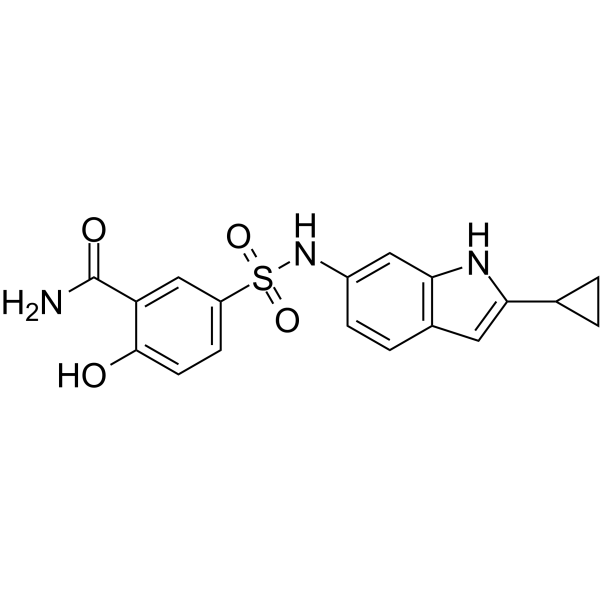
Physicochemical Properties
| Molecular Formula | C18H17N3O4S |
| Molecular Weight | 371.410282850266 |
| Exact Mass | 371.093 |
| CAS # | 2132396-40-6 |
| PubChem CID | 130406413 |
| Appearance | White to off-white solid powder |
| LogP | 2.2 |
| Hydrogen Bond Donor Count | 4 |
| Hydrogen Bond Acceptor Count | 5 |
| Rotatable Bond Count | 5 |
| Heavy Atom Count | 26 |
| Complexity | 645 |
| Defined Atom Stereocenter Count | 0 |
| SMILES | C(N)(=O)C1=CC(S(NC2=CC3=C(C=C2)C=C(C2CC2)N3)(=O)=O)=CC=C1O |
| InChi Key | YUGALILHRFUCAY-UHFFFAOYSA-N |
| InChi Code | InChI=1S/C18H17N3O4S/c19-18(23)14-9-13(5-6-17(14)22)26(24,25)21-12-4-3-11-7-15(10-1-2-10)20-16(11)8-12/h3-10,20-22H,1-2H2,(H2,19,23) |
| Chemical Name | 5-[(2-cyclopropyl-1H-indol-6-yl)sulfamoyl]-2-hydroxybenzamide |
| HS Tariff Code | 2934.99.9001 |
| Storage |
Powder-20°C 3 years 4°C 2 years In solvent -80°C 6 months -20°C 1 month |
| Shipping Condition | Room temperature (This product is stable at ambient temperature for a few days during ordinary shipping and time spent in Customs) |
Biological Activity
| Targets |
- Ecto-5'-nucleotidase (CD73): CD73-IN-1 is a selective inhibitor of CD73, with an IC₅₀ of 0.048 μM for human CD73 and 0.052 μM for mouse CD73 [1] - Other nucleotidases (CD39, alkaline phosphatase): CD73-IN-1 shows no significant inhibition (IC₅₀ > 10 μM) [1] |
| ln Vitro |
1. CD73 enzyme inhibition: CD73-IN-1 dose-dependently inhibits recombinant human and mouse CD73 activity, with IC₅₀ values of 0.048 μM and 0.052 μM, respectively. At 1 μM, it inhibits human CD73 by 96% and mouse CD73 by 94% compared to vehicle control [1] 2. Inhibition of adenosine generation in cells: A549 cells (high CD73 expression) treated with CD73-IN-1 (0.1 μM) and AMP (100 μM) showed a 89% reduction in extracellular adenosine levels vs. vehicle. No significant effect on adenosine levels was observed in CD73-knockdown A549 cells [1] 3. Immune cell activation: CD73-IN-1 (0.05 μM) enhanced IFN-γ secretion by human peripheral blood mononuclear cells (PBMCs) co-cultured with A549 cells (2.8-fold increase vs. vehicle). It also increased CD8⁺ T cell proliferation (1.9-fold) and cytotoxicity against A549 cells (lysis rate: 42% vs. 18% in vehicle) [1] 4. Selectivity: CD73-IN-1 (10 μM) showed no inhibitory activity against CD39, alkaline phosphatase, or other kinases (e.g., EGFR, PI3K), confirming high selectivity for CD73 [1] |
| ln Vivo |
1. Antitumor efficacy in A549 xenograft model: Nude mice bearing A549 tumors were treated with CD73-IN-1 (10, 30 mg/kg oral gavage, once daily) for 21 days. The 30 mg/kg group showed a tumor growth inhibition rate (TGIR) of 86%, and the 10 mg/kg group showed a TGIR of 62% vs. vehicle. Tumor tissue analysis revealed reduced extracellular adenosine levels (75% reduction) and increased CD8⁺ T cell infiltration (2.5-fold) [1] 2. Inhibition of adenosine production in mice: C57BL/6 mice were administered CD73-IN-1 (30 mg/kg oral) 1 hour before intraperitoneal injection of AMP (20 mg/kg). Plasma adenosine levels were reduced by 78% compared to vehicle control [1] |
| Enzyme Assay |
1. CD73 enzyme activity inhibition assay: Recombinant human/mouse CD73 protein was incubated with serial concentrations of CD73-IN-1 (0.001–10 μM) and substrate AMP (50 μM) in reaction buffer at 37°C for 1 hour. The generated adenosine was quantified by high-performance liquid chromatography (HPLC) or a specific adenosine detection kit. IC₅₀ values were calculated from dose-response curves of enzyme activity inhibition [1] 2. Nucleotidase selectivity assay: Recombinant CD39, alkaline phosphatase, and other kinases were incubated with CD73-IN-1 (10 μM) and their respective substrates. Enzyme activity was measured via substrate consumption or product formation, and inhibition percentage was calculated relative to vehicle control [1] |
| Cell Assay |
1. Extracellular adenosine detection assay: A549 cells (wild-type and CD73-knockdown) were seeded in 24-well plates and treated with CD73-IN-1 (0.01–1 μM) for 1 hour, followed by addition of AMP (100 μM). After 4 hours of incubation, culture supernatants were collected, and adenosine levels were quantified by HPLC [1] 2. PBMC- tumor cell co-culture assay: Human PBMCs were isolated and co-cultured with A549 cells at a 10:1 ratio in the presence of CD73-IN-1 (0.01–0.5 μM) for 72 hours. IFN-γ levels in supernatants were measured by ELISA. CD8⁺ T cell proliferation was detected by flow cytometry (CFSE staining), and cytotoxicity was assessed by lactate dehydrogenase (LDH) release assay [1] |
| Animal Protocol |
1. A549 xenograft model: Female nude mice were subcutaneously inoculated with A549 cells (5×10⁶ cells/mouse). When tumors reached 100–150 mm³, mice were randomly divided into vehicle (10% DMSO/40% PEG400/50% saline) and CD73-IN-1 groups (10, 30 mg/kg). The compound was administered via oral gavage once daily for 21 days. Tumor volume and body weight were measured every 2 days. At the end of treatment, tumors were collected for adenosine quantification and CD8⁺ T cell infiltration analysis (flow cytometry) [1] 2. Plasma adenosine inhibition model: C57BL/6 mice were randomly divided into vehicle and CD73-IN-1 (30 mg/kg) groups. The compound was administered via oral gavage, and 1 hour later, all mice received AMP (20 mg/kg, intraperitoneal injection). Thirty minutes after AMP administration, blood was collected, and plasma adenosine levels were quantified by HPLC [1] 3. Acute toxicity study: SD rats were administered CD73-IN-1 via oral gavage at doses of 50, 100, 200 mg/kg. Mice were monitored for 14 days for mortality, behavioral abnormalities, and body weight changes. At the end of the study, blood was collected for biochemical analysis, and major organs were harvested for histopathological examination [1] |
| ADME/Pharmacokinetics |
1. Oral bioavailability: CD73-IN-1 had an oral bioavailability (F) of 52% in SD rats after oral administration of 30 mg/kg [1] 2. Plasma pharmacokinetics: Intravenous administration (10 mg/kg, rats) resulted in t₁/₂ = 4.6 ± 0.5 hours, Cₘₐₓ = 1280 ± 130 ng/mL, AUC₀₋∞ = 5640 ± 580 ng·h/mL. Oral administration (30 mg/kg, rats) resulted in t₁/₂ = 5.1 ± 0.6 hours, Cₘₐₓ = 680 ± 75 ng/mL, AUC₀₋∞ = 5920 ± 610 ng·h/mL [1] 3. Tissue distribution: Rats orally administered CD73-IN-1 (30 mg/kg) showed highest concentrations in liver (11.2 ± 1.3 μg/g), kidney (8.9 ± 0.9 μg/g), and tumor (4.5 ± 0.5 μg/g) at 2 hours post-dosing; brain penetration was low (0.28 ± 0.03 μg/g) [1] 4. Metabolic stability: In vitro liver microsome incubation showed t₁/₂ = 48 ± 5 minutes (human liver microsomes) and 55 ± 6 minutes (rat liver microsomes) [1] |
| Toxicity/Toxicokinetics |
1. Acute toxicity: SD rats administered CD73-IN-1 at doses up to 200 mg/kg showed no mortality or behavioral abnormalities within 14 days. Body weight change was ≤5% vs. control [1] 2. Biochemical and histopathological analysis: Rats treated with CD73-IN-1 (200 mg/kg oral) showed no significant changes in liver function (ALT, AST), kidney function (BUN, creatinine), or hematological parameters (WBC, RBC, platelets). Histopathological examination of liver, kidney, heart, lung, and spleen revealed no obvious tissue damage [1] 3. Plasma protein binding: CD73-IN-1 had a plasma protein binding rate of 91 ± 2% (human plasma) and 89 ± 3% (rat plasma) [1] |
| References |
[1]. 5-sulfamoyl-2-hydroxybenzamide derivatives. WO 2017153952 A1. |
| Additional Infomation |
1. CD73-IN-1 is a 5-sulfamoyl-2-hydroxybenzamide derivative, designed as a selective small-molecule inhibitor of CD73 [1] 2. Its mechanism of action involves competitive binding to the active site of CD73, inhibiting the conversion of AMP to adenosine. Reduced adenosine levels alleviate adenosine-mediated immunosuppression, enhancing antitumor immune responses [1] 3. The compound exhibits potent anti-tumor activity in preclinical models, supporting its potential for the treatment of CD73-overexpressing solid tumors [1] 4. CD73-IN-1 shows high selectivity for CD73, low off-target effects, and favorable pharmacokinetic properties, making it suitable for oral administration [1] |
Solubility Data
| Solubility (In Vitro) | DMSO : ~150 mg/mL (~403.87 mM) |
| Solubility (In Vivo) |
Note: Listed below are some common formulations that may be used to formulate products with low water solubility (e.g. < 1 mg/mL), you may test these formulations using a minute amount of products to avoid loss of samples. Injection Formulations (e.g. IP/IV/IM/SC) Injection Formulation 1: DMSO : Tween 80: Saline = 10 : 5 : 85 (i.e. 100 μL DMSO stock solution → 50 μL Tween 80 → 850 μL Saline) *Preparation of saline: Dissolve 0.9 g of sodium chloride in 100 mL ddH ₂ O to obtain a clear solution. Injection Formulation 2: DMSO : PEG300 :Tween 80 : Saline = 10 : 40 : 5 : 45 (i.e. 100 μL DMSO → 400 μLPEG300 → 50 μL Tween 80 → 450 μL Saline) Injection Formulation 3: DMSO : Corn oil = 10 : 90 (i.e. 100 μL DMSO → 900 μL Corn oil) Example: Take the Injection Formulation 3 (DMSO : Corn oil = 10 : 90) as an example, if 1 mL of 2.5 mg/mL working solution is to be prepared, you can take 100 μL 25 mg/mL DMSO stock solution and add to 900 μL corn oil, mix well to obtain a clear or suspension solution (2.5 mg/mL, ready for use in animals). Injection Formulation 4: DMSO : 20% SBE-β-CD in saline = 10 : 90 [i.e. 100 μL DMSO → 900 μL (20% SBE-β-CD in saline)] *Preparation of 20% SBE-β-CD in Saline (4°C,1 week): Dissolve 2 g SBE-β-CD in 10 mL saline to obtain a clear solution. Injection Formulation 5: 2-Hydroxypropyl-β-cyclodextrin : Saline = 50 : 50 (i.e. 500 μL 2-Hydroxypropyl-β-cyclodextrin → 500 μL Saline) Injection Formulation 6: DMSO : PEG300 : castor oil : Saline = 5 : 10 : 20 : 65 (i.e. 50 μL DMSO → 100 μLPEG300 → 200 μL castor oil → 650 μL Saline) Injection Formulation 7: Ethanol : Cremophor : Saline = 10: 10 : 80 (i.e. 100 μL Ethanol → 100 μL Cremophor → 800 μL Saline) Injection Formulation 8: Dissolve in Cremophor/Ethanol (50 : 50), then diluted by Saline Injection Formulation 9: EtOH : Corn oil = 10 : 90 (i.e. 100 μL EtOH → 900 μL Corn oil) Injection Formulation 10: EtOH : PEG300:Tween 80 : Saline = 10 : 40 : 5 : 45 (i.e. 100 μL EtOH → 400 μLPEG300 → 50 μL Tween 80 → 450 μL Saline) Oral Formulations Oral Formulation 1: Suspend in 0.5% CMC Na (carboxymethylcellulose sodium) Oral Formulation 2: Suspend in 0.5% Carboxymethyl cellulose Example: Take the Oral Formulation 1 (Suspend in 0.5% CMC Na) as an example, if 100 mL of 2.5 mg/mL working solution is to be prepared, you can first prepare 0.5% CMC Na solution by measuring 0.5 g CMC Na and dissolve it in 100 mL ddH2O to obtain a clear solution; then add 250 mg of the product to 100 mL 0.5% CMC Na solution, to make the suspension solution (2.5 mg/mL, ready for use in animals). Oral Formulation 3: Dissolved in PEG400 Oral Formulation 4: Suspend in 0.2% Carboxymethyl cellulose Oral Formulation 5: Dissolve in 0.25% Tween 80 and 0.5% Carboxymethyl cellulose Oral Formulation 6: Mixing with food powders Note: Please be aware that the above formulations are for reference only. InvivoChem strongly recommends customers to read literature methods/protocols carefully before determining which formulation you should use for in vivo studies, as different compounds have different solubility properties and have to be formulated differently. (Please use freshly prepared in vivo formulations for optimal results.) |
| Preparing Stock Solutions | 1 mg | 5 mg | 10 mg | |
| 1 mM | 2.6924 mL | 13.4622 mL | 26.9244 mL | |
| 5 mM | 0.5385 mL | 2.6924 mL | 5.3849 mL | |
| 10 mM | 0.2692 mL | 1.3462 mL | 2.6924 mL |